Do organic and homemade weed killers actually work?
Vinegar, salt, bleach, the 3-ingredient recipe, shop-bought “organic” sprays: here's the honest, sourced verdict on what any of it actually does to a weed, why it works on a tiny seedling and fails on anything established, and the one genuine exception worth knowing about.
By The Weed GuyLast updated
The short version
Vinegar, salt, bleach and most shop-bought “organic” sprays are all contact treatments: they burn whatever leaf they touch and stop there. None of them travel down into a root system, which is why a weed can look dead within a day and be back within a fortnight. They can genuinely finish off a tiny seedling with only a leaf or two, because at that size the whole plant is basically the leaf. On anything established, they’re a stalling tactic, not a fix.
What actually works, and what just burns the top off
The same test as every weed on this site: does it reach the root, or does it only deal with the leaf?
| Method | Kills it? | What actually happens |
|---|---|---|
| Household vinegar (about 5%) | No, not on an established weed | A contact burn only. It can finish off a tiny 1 to 2 leaf seedling, but it never reaches a real root. |
| Horticultural vinegar (20%+) | No, just a faster burn | Same contact-only mechanism, stronger and quicker, and strong enough to genuinely burn skin and eyes if you’re not careful with it. |
| The vinegar, salt and washing-up liquid recipe | No, not on anything established | The soap helps the vinegar stick to the leaf instead of running off. The salt works in the soil, not on the plant. Neither one reaches a root that’s already established. |
| Bleach | No, and the run-off is the real problem | Same root-blind failure as vinegar. Adds a colour risk on pigmented surfaces and a labelled hazard to aquatic life if it reaches a drain. |
| Boiling water | No | Scalds whatever it lands on. Nothing about hot water travels down into a root system. |
| A shop-bought "organic" spray (pelargonic acid) | No, just standardised | Chemically the same contact-only story as vinegar, just a consistent concentration in a bottle instead of a kitchen guess. |
| Neudorff WeedFree Plus | Slows it right down, not a clean kill | The one genuine exception on this list: it pairs a contact acid with a growth regulator that does travel to the root and stop it resprouting, though that’s inhibiting the root, not destroying it outright. |
| A proper systemic weedkiller (glyphosate) | Yes | The reference point everything above is measured against: it travels into the root and kills the plant there, unlike a leaf-only treatment. |
Why vinegar works on a seedling and fails on anything bigger
Vinegar’s active ingredient is acetic acid, and the National Pesticide Information Center is direct about how it works: it breaks open plant cells on contact and the tissue dries out from there. It has to physically touch the leaf to do anything at all, and once it’s worked its way through the leaf tissue, it stops. Nothing about the mechanism lets it travel further into the plant.
That single fact explains the whole pattern people see. A seedling with one or two leaves is small enough that a spray can hit every bit of it, and at that size the leaf more or less is the plant, so browning the leaf is close to finishing the whole thing. An established weed has leaf mass shading other leaf mass, and a root or crown that was never touched by the spray at all, holding enough reserve to send up new growth. One gardening blogger’s own timed test makes the point better than any explanation: sprayed goldenrod and crabgrass browned within a day, “the crown of the plant and the stems are still green”, and it was growing back within a week.
Household vinegar vs horticultural vinegar: is the stronger stuff worth it?
Ordinary vinegar from the kitchen cupboard is around 5% acetic acid. Horticultural vinegar, sold specifically as a stronger weedkiller, is typically 20% or more. Going stronger genuinely speeds up and thickens the burn, so a bigger seedling gets finished off more reliably. What it doesn’t do is change the ceiling: it still can’t travel into a root, so the same ceiling that limits 5% vinegar limits the 20% version too, just with a faster result on whatever it actually reaches.
The stronger stuff is also a real safety step up, not a detail to skip past. University of Maryland Extension puts it plainly: concentrations of around 11% acetic acid and above can burn skin and cause real eye injury. Gloves and eye protection aren’t optional once you’re using anything sold at horticultural strength.
The vinegar, salt and washing-up liquid recipe
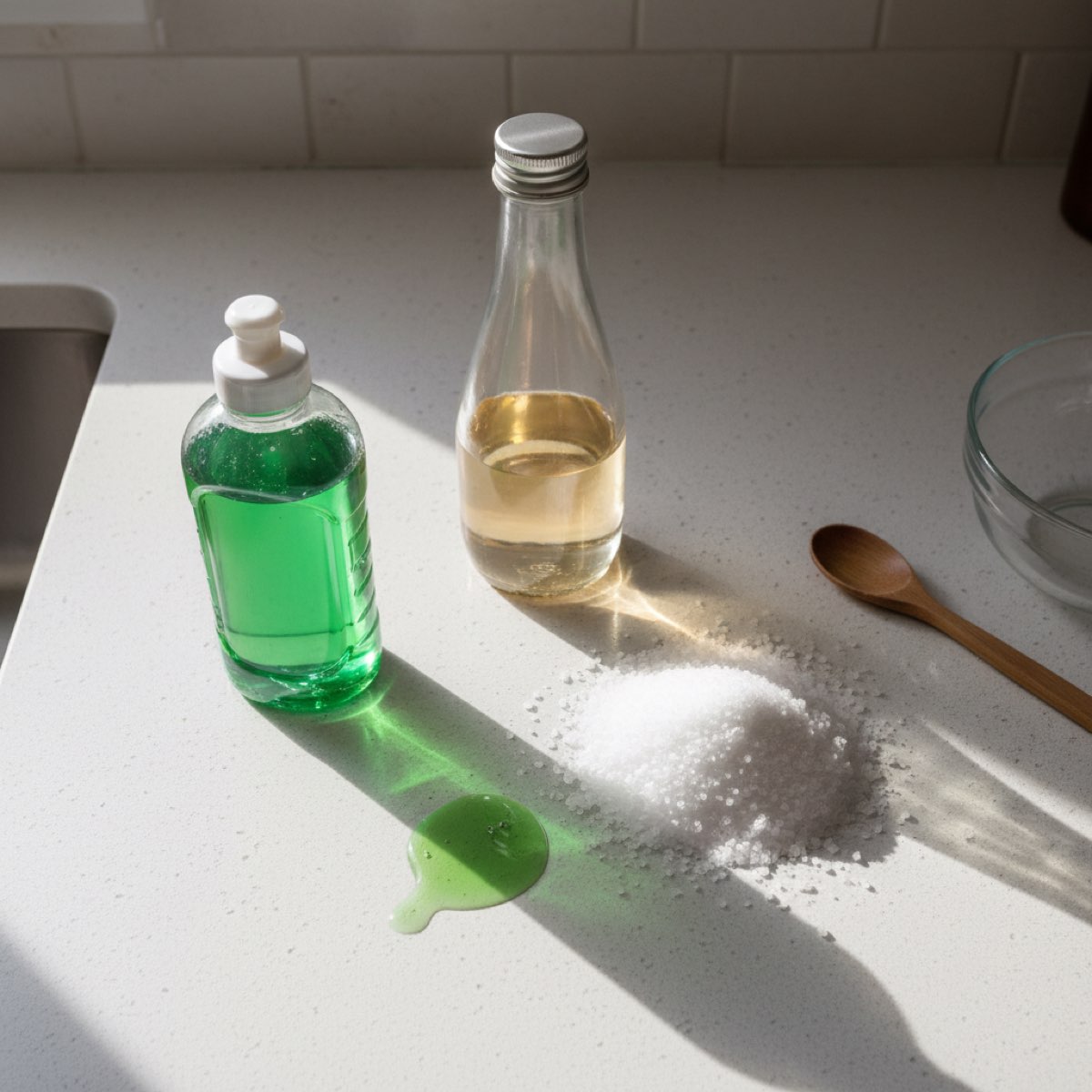
This one does a genuinely more convincing job on small, soft weeds than vinegar alone, and there’s a real reason for each ingredient rather than folklore. The washing-up liquid is a surfactant: it breaks the surface tension of the spray so it spreads and clings to a waxy leaf instead of beading straight off, which gives the vinegar more contact time to do its (still leaf-only) job. The salt works differently again, drawing moisture out of the soil rather than acting on the leaf at all.
Together, they’re still leaf-and-soil-surface treatments, not root treatments. Nothing about mixing the three changes the basic limit: an established root system is untouched by any of it.
The real downside of the salt, on a driveway specifically
Salt doesn’t stay where you put it. It leaches sideways through the joints and gaps in a hard surface into the sub-base and any soil nearby, and once it’s there it sterilises the ground for years, not weeks. That matters far more next to a border, a lawn edge or a planted bed running alongside your drive than it does in the middle of an open patio with nothing either side of it. It’s exactly why the usual advice is to keep salt strictly to paving and paths and nowhere near anything you actually want to keep growing.
What about bleach?
It is a step backwards rather than a stronger option, for the same reason vinegar is: it kills the leaf it touches and does nothing to the root. It also carries risks vinegar does not. That is a question with its own answer on this site rather than a paragraph here, and the full version, including what the label actually warns about, is on the bleach answer.
Are shop-bought “organic” weed killers any different?
Mostly, no. Most UK "glyphosate-free" or "organic" branded sprays are built on pelargonic acid, a naturally occurring fatty acid that works by contact, exactly like vinegar, and never reaches the root. What you’re paying for is a standardised, pre-measured strength in a bottle rather than a kitchen guess, which is genuinely convenient, but it isn’t a different result.
There is one real exception worth knowing about. Neudorff WeedFree Plus pairs that same pelargonic acid with maleic hydrazide, an ingredient that does travel into the plant and act on the root, rather than stopping at the leaf. An independent UK review testing it on creeping buttercup, oxalis and dock found visible wilting within a day, the weeds dying back within a week, and the roots gone within three to four weeks. It’s worth being precise about what that means: maleic hydrazide slows or stops the root regrowing, it doesn’t destroy it outright the way glyphosate does, so it sits a genuine step above plain vinegar without fully replacing a systemic weedkiller.
What actually reaches the root
The honest conclusion of this page is that the kitchen-cupboard routes burn the top off and leave the root alive underneath. This is the product that does the thing they cannot.
What I’d use
Glyphosate concentrate, 360 g/L
Gallup Home & Garden Glyphosate Weedkiller (1 litre)
The one Gallup a homeowner can legally buy and use: a 1 litre glyphosate concentrate at 360 g/L, approved for home and garden use under MAPP 17672.
It is the same active, the same 360 g/L loading and the same isopropylamine salt as the professional Gallup XL, and its single label rate of 24 ml per litre of water is exactly the rate the professional labels reserve for perennial broad-leaved weeds. What the two labels set apart is the authorisation printed on them rather than the strength, and this is the side of that line you are allowed to stand on.
- Active ingredient
- Glyphosate, 360 g/L, as the isopropylamine salt
- Formulation
- Soluble concentrate you dilute yourself
- Approval
- MAPP 17672, labelled for use only as a home and garden weedkiller
- Mixing rate
- 24 ml per 1 litre of water, per the label
- Coverage
- 40 sq m per litre of made-up spray, so roughly 1,667 sq m per bottle
- Rainfast
- Rain within 6 hours may reduce effectiveness, per the label
- Size
- 1 litre of concentrate
Watch out for
- No measuring cap in the bottle. Check a cup arrives, or the dose is guesswork.
- One re-treatment a season, and it takes four weeks. Do not go again early.
- Not for lawns. It is non-selective and takes the grass too.
- Resellers dominate the listing, so check the label that arrives is Barclay.
- "Super strength" is keyword stacking. It is 360 g/L, same as professional Gallup XL.
That’s an affiliate link: buy through it and I earn a small commission at no extra cost to you. It doesn’t change what I recommend or what I say is wrong with it. More on how that works in the affiliate disclosure.
No brand pays for a mention here, and nothing on this page is a paid-for opinion. The card above is an affiliate link, so I earn a commission if you buy through it, at no extra cost to you. It buys no product a kinder write-up, which is why the watch-outs sit on the same card as the reasons to buy.
About this resource
I’m The Weed Guy, one bloke who’s qualified to use professional weedkiller. This resource exists because most advice on vinegar and homemade weed killers either oversells them or dismisses them without explaining why, and the honest answer sits between the two.
Straight disclosure: nothing here is a paid-for opinion, no brand sponsors this site, and the product card above carries an affiliate link, so I earn a commission if you buy through it, at no extra cost to you.
Common questions
Does vinegar kill weeds to the root?
No, and this is worth being direct about. Vinegar is a contact treatment: it damages whatever leaf it actually touches and stops there, it never travels down into the root the way a systemic weedkiller does. A weed can look dead within a day and still grow back from the root within a week. "To the root" and "overnight" are really two different questions, and vinegar only ever answers the second one, on a young weed, not the first.
What is the 3-ingredient homemade weed killer recipe?
Vinegar, salt and a squirt of washing-up liquid. The soap is a surfactant, it breaks the surface tension of the spray so it wets and clings to a waxy leaf instead of beading off, which makes the vinegar’s burn more thorough. The salt works differently again, it acts in the soil rather than on the leaf. Together they do a more convincing job on small, soft growth, but neither ingredient does anything to a root system that’s already established.
Is horticultural vinegar worth buying over the vinegar in my kitchen?
It’s stronger, typically 20% acetic acid or more against roughly 5% for the household stuff, so the burn is faster and more complete on whatever it touches. It doesn’t change the fundamental limit, it still can’t reach a root. It’s also a genuine safety step up: concentrations from around 11% upwards can burn skin and cause real eye injury, so gloves and eye protection aren’t optional if you’re using it.
Is bleach a good weed killer?
No, and it is worse than vinegar for this job rather than stronger. It shares the same root-blind failure, and it carries risks vinegar does not: a colour risk on pigmented surfaces like coloured concrete, and a GB CLP label warning that it is very toxic to aquatic life, which matters on a drive that drains to a gully. Mixing it with anything acidic releases chlorine gas. I have gone through the whole thing on the bleach page.
Does salt damage a driveway?
Not the paving itself, but the ground underneath and around it, yes, and for longer than people expect. Salt leaches sideways through the joints into the sub-base and any soil nearby, sterilising it, and that effect can last for years. It’s exactly why the usual advice is to keep salt strictly to the paving or path itself and nowhere near a border, a lawn edge, or anything you actually want to keep growing.
Are organic weed killers worth buying, or is homemade just as good?
For most of them, homemade vinegar and a shop-bought "organic" spray are the same chemistry in different packaging, usually pelargonic acid, a fatty acid that works by contact and never reaches the root, same as vinegar. You’re paying for a consistent, pre-measured strength rather than a different result. There is one real exception, covered below.
Is there an organic weed killer that actually reaches the root?
One genuine one on the UK market: Neudorff WeedFree Plus pairs pelargonic acid with maleic hydrazide, an ingredient that does travel into the plant and works on the root, slowing or stopping regrowth rather than just burning the leaf. It’s inhibiting the root, not killing it outright the way glyphosate does, so it’s a real step up from plain vinegar without being a full replacement for a systemic weedkiller.
What do professional gardeners and weed sprayers actually use?
A proper systemic weedkiller, in almost every case. It’s the only category here that travels into the root and kills the plant from there rather than just the leaf that got sprayed, which is the whole reason a professional job tends to actually finish a weed rather than just tidy it for a fortnight. See what actually kills weeds for good.