What actually kills weeds for good
Most weedkillers just brown the tops off, so the weeds are back through your block paving a few weeks later. Here is what actually kills driveway, path and patio weeds down to the root, whether the strongest shop weed killer is worth it, why the cheap sprays and home remedies keep letting you down, and how to stop them coming back.
By The Weed GuyLast updated
The short version
Weeds only die for good when the root dies. That takes a systemic weedkiller, one the plant carries down into its own roots, applied properly and at full strength. Everything that only hits the top growth (pulling, burning, jet-washing, home remedies and most contact sprays) leaves the root alive in the joints, so the weed regrows. It is not about hitting them harder. It is about hitting the part that matters, then keeping the joints closed so new seed has nowhere to sit.
What works, and what just fills your weekend
A quick way to read it: if a method doesn't reach the root, whatever you saved in effort you pay back in a few weeks when it grows again.
| Method | Kills root? | Lasts | The catch |
|---|---|---|---|
| Pulling or scraping | No | Weeks | Snaps the top off; the root stays and pushes up again, and you reopen the joints. |
| Hoeing | No | Weeks | Chops the visible growth only. The root is untouched. |
| Jet-washing | No | Weeks | Blasts off the greenery and washes out the jointing sand, so weeds seed back faster. |
| Boiling water | Rarely | Days | Scalds the top. Roots down in the sub-base usually survive it. |
| Salt, vinegar, bleach | Rarely | Varies | Knock the top back, but can wreck the soil, stain the paving and drift onto plants you want. |
| Flame / weed burner | No | Weeks | Scorches the leaves; the root barely notices. |
| Shop-shelf spray | Sometimes | Weeks | Often too weak or contact-only, so it browns the top and misses the deep roots. |
| Professional systemic spray | Yes | Months+ | Carried down into the root, so the whole plant dies. Takes 2 to 4 weeks and needs dry weather. |
Is there a “strongest weed killer that kills everything”?
Short version: “strongest” is the wrong thing to shop for. What kills weeds for good is a systemic weedkiller that reaches the root, not the one with the scariest label. Glyphosate is the one that does it, and how well it works comes down to how it’s put on far more than the number on the bottle.
There is a real gap in what’s in the bottle, mind. The ready-to-use trigger sprays off the shop shelf often carry only about 7 to 9 grams of glyphosate a litre. The concentrates the trade uses run 360 to 490 grams a litre, so the strongest professional concentrate is roughly fifty times stronger than a shop trigger-spray before it’s even diluted. That’s a lot of watering-down between what you buy and what actually goes down a weed.
But strength you can see in a day is usually the tell that it went nowhere. A lot of the “extra strong” and “fast-acting” shop products are contact killers, so they scorch the top off by teatime and look brilliant, while the root sits there untouched. Systemic takes its time on purpose. If it browned off overnight, it didn’t reach the part that matters.
It’s no secret what councils and groundskeepers use, either: professional, or amenity, glyphosate, put on at the right rate. Same active ingredient councils have long used on pavements and kerbs. The difference between that and a shop bottle isn’t some stronger mystery chemical, it’s the concentration, mixing it to the label rate, and being certificated to spray it. Chasing the strongest bottle on the shelf tends to cost you twice: once for the bottle, again when it grows back.
Why they grow on your driveway in the first place
Weeds don’t grow out of the slab or the block. They root in the thin layer of grit, soil and debris that collects in the joints between your blocks and in the sub-base underneath. On most UK drives that means annual meadow grass, chickweed and the tough perennials working their way down the sand-filled joints. It’s the same story on a patio or a gravel bed: the surface looks sealed, but the joints underneath are one long seed bed.
That is the whole problem in one sentence: the living bit you can see is sitting on top, but the part that keeps it alive is wedged down in a joint you can’t dig out. So the honest test for any method is simple. Does it get down into that root, or does it just deal with the green on top? Pull, hoe, flame or jet-wash and you deal with the green. It looks sorted for a fortnight, then it’s back.
Why nothing kills weeds “down to the root overnight”
It’s the most searched-for thing and it doesn’t exist. Anything that works overnight is a contact killer: it burns whatever it touches on the day and goes no further, which is exactly the top growth you don’t need to worry about. To kill the root, the weedkiller has to be taken in through the leaves and carried down through the plant, and that takes time.
So the wait is not the treatment failing. The wait is the treatment. You’ll usually see the weeds start to yellow within a few days, but it takes two to four weeks for the plant to carry it all the way down and die off properly, roots and all. If something browns them off by tomorrow morning, it hasn’t touched the root, and you’ll be doing it again next month.
Home remedies: do they work, and will they wreck your paving?
Boiling water, vinegar, salt and bleach all get passed around online. They share a problem (they only hit the top, so perennials regrow) and, on a hard surface, most of them bring a second problem: they damage the thing you’re trying to keep nice.
- Vinegar is a contact burn. Household vinegar is too weak to do much, and even the strong stuff scorches the leaf without reaching the root. It can also corrode any metal it runs onto.
- Salt does knock things back, but it sterilises the ground. Washed down into the sub-base it stops anything growing there for a long time and can’t be flushed out easily, which is the last thing you want next to borders or a lawn.
- Bleach stains. It can permanently mark block paving, coloured concrete and natural stone like Indian sandstone, and it still doesn’t kill the root. Never mix it with vinegar either, that gives off chlorine gas.
- Boiling water is the safe one for your paving, but it only scalds the top. The root down in the cool sub-base usually shrugs it off.
The straight verdict: for a stray weed in a crack, boiling water is harmless enough if you enjoy repeating it. For a whole drive or a patio full of weeds, salt and bleach risk your surface and the ground around it without ever settling the weeds. A proper systemic spray is the only one on that list that reaches the root without wrecking the paving.
Don’t scrape or jet-wash them off first
This is the one that catches most people out. The instinct is to blast the drive clean first, then treat it. It’s the wrong way round, and it makes the problem worse.
Jet-washing and scraping strip out the kiln-dried sand in the joints, chew up the block faces and open up the sub-base underneath. You’ve just cleared out the exact voids weeds love and brought buried seed up to the light, so the next flush comes through faster and thicker. Worse, you’ve torn off the leaves the weedkiller needs to get in through, so a spray afterwards has nothing to work on. Spray first, let it die off, then clean and re-sand once it’s dead.
Why some come back (and why that isn’t the same as it not working)
Here’s the honest bit no product label will tell you: nothing stops new weeds forever. Seed blows in on the wind and arrives in bird droppings all year round, so a month or two on you might see fresh green in the joints. That is brand-new seed germinating, not the weeds you treated coming back to life.
It matters because the two are different jobs. The weeds that were there and got sprayed should be dead and stay dead, and that’s the test of the treatment. New seed settling in later is just what happens to any outdoor surface, and it’s managed with a bit of aftercare rather than another full treatment.
There’s one real exception worth knowing about. A few deep-rooted weeds, horsetail and mare’s tail chief among them, genuinely do keep pushing back through repeated treatments, because their roots run a couple of metres down. That isn’t the spray failing, it’s just how that plant works, and it needs its own approach over several seasons. I’ve set that out in how to get rid of horsetail and mare’s tail.
Keeping them from coming back
Once the weeds are dead and the joints are clear, the trick is to leave new seed nowhere to root. Refill the joints with kiln-dried or jointing sand so they’re packed tight rather than a soil-filled gap, and a paving sealant on top helps lock it in and slow the grit building back up. Sealing isn’t forever, it wants redoing every year or two, but it genuinely cuts down how much comes through.
That’s the difference between a drive that’s clear for a season and one that’s clear for years: kill the root properly, then close the joint so the next lot of seed has nothing to get into. The surface side of that, re-sanding and sealing block paving and sorting gravel, is in how to stop weeds in block paving and gravel.
What doing it properly actually looks like
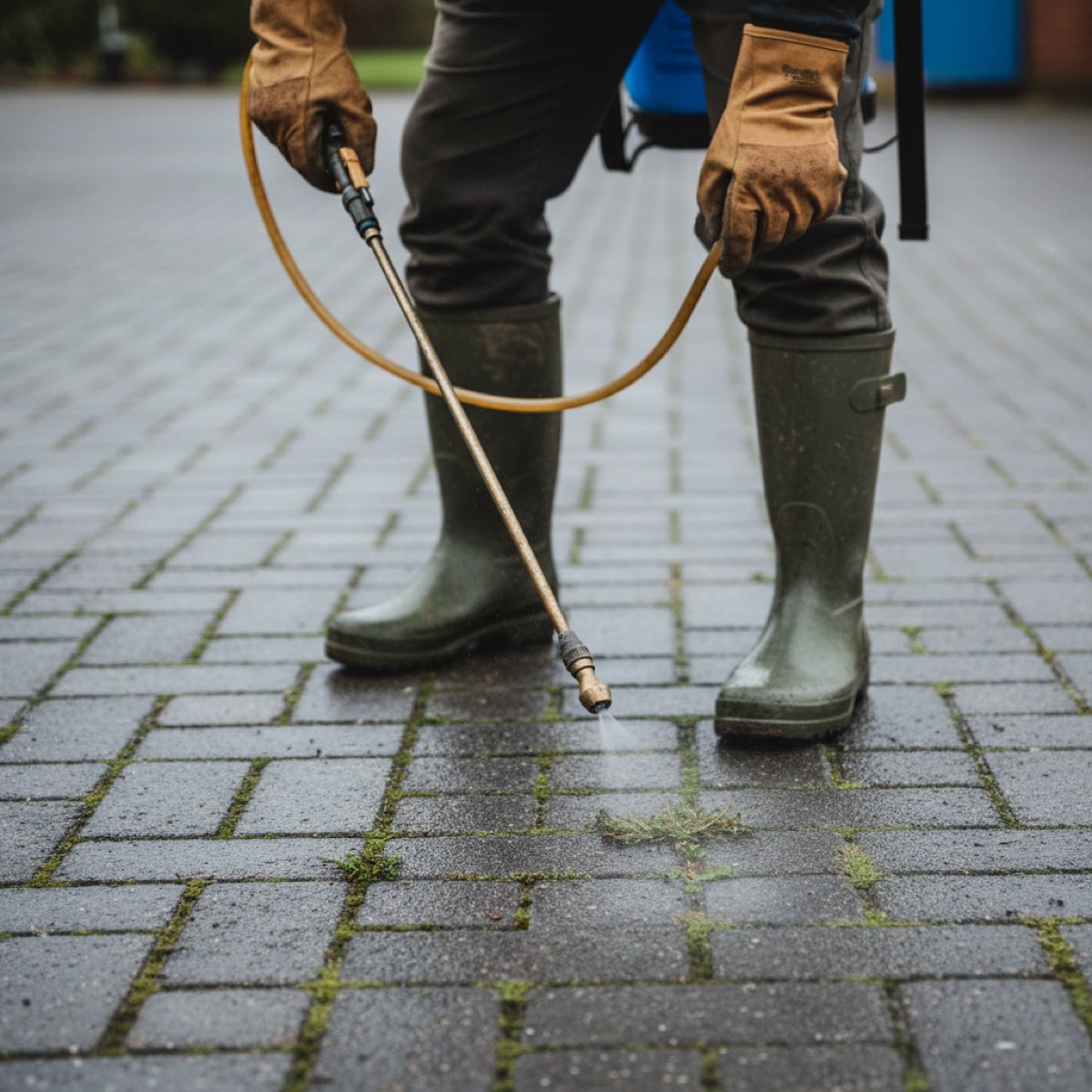
The weedkiller I use is professional-grade glyphosate, the same systemic, non-selective active councils use on pavements, and I’m qualified to spray it. It’s taken in through the leaves and carried, or translocated, down into the roots, so the plant kills itself from the inside rather than just browning off on top. It needs a dry spell after it goes on, at least six hours and preferably twenty four, which is what the labels themselves demand. Once it reaches the soil it stops working (it’s non-residual), so it won’t linger in the ground or creep across to your borders.
If the whole drive is overgrown, the answer isn’t to strip it first, it’s to treat the lot and wait it out. Everything green takes the spray up, then dies back together over the next few weeks, and it gets cleared and re-sanded once it’s dead. It’s not instant, and anyone promising overnight results is guessing, but it’s the version that’s still clear months later, on block paving, gravel and paths alike.
If you are still choosing what to buy, the honest verdict on which product type actually suits which job goes into that in more depth than a shop shelf ever will.
What that mechanism looks like in a bottle
Everything above comes down to one distinction: contact kills what it touches, systemic gets carried to the root. This is the systemic side of that, at the strongest loading the amateur label allows.
What I’d use
Glyphosate concentrate, 360 g/L
Gallup Home & Garden Glyphosate Weedkiller (1 litre)
The one Gallup a homeowner can legally buy and use: a 1 litre glyphosate concentrate at 360 g/L, approved for home and garden use under MAPP 17672.
It is the same active, the same 360 g/L loading and the same isopropylamine salt as the professional Gallup XL, and its single label rate of 24 ml per litre of water is exactly the rate the professional labels reserve for perennial broad-leaved weeds. What the two labels set apart is the authorisation printed on them rather than the strength, and this is the side of that line you are allowed to stand on.
- Active ingredient
- Glyphosate, 360 g/L, as the isopropylamine salt
- Formulation
- Soluble concentrate you dilute yourself
- Approval
- MAPP 17672, labelled for use only as a home and garden weedkiller
- Mixing rate
- 24 ml per 1 litre of water, per the label
- Coverage
- 40 sq m per litre of made-up spray, so roughly 1,667 sq m per bottle
- Rainfast
- Rain within 6 hours may reduce effectiveness, per the label
- Size
- 1 litre of concentrate
Watch out for
- No measuring cap in the bottle. Check a cup arrives, or the dose is guesswork.
- One re-treatment a season, and it takes four weeks. Do not go again early.
- Not for lawns. It is non-selective and takes the grass too.
- Resellers dominate the listing, so check the label that arrives is Barclay.
- "Super strength" is keyword stacking. It is 360 g/L, same as professional Gallup XL.
That’s an affiliate link: buy through it and I earn a small commission at no extra cost to you. It doesn’t change what I recommend or what I say is wrong with it. More on how that works in the affiliate disclosure.
No brand pays for a mention here, and nothing on this page is a paid-for opinion. The card above is an affiliate link, so I earn a commission if you buy through it, at no extra cost to you. It buys no product a kinder write-up, which is why the watch-outs sit on the same card as the reasons to buy.
About this resource
I’m The Weed Guy, one bloke who’s qualified to spray professional weedkiller. This resource reflects how hard-surface weeds actually behave and what it genuinely takes to kill them.
The honest disclosure: nothing on this page is a paid-for opinion, no brand sponsors this site. The product card above is an affiliate link, so I earn a commission if you buy through it, at no extra cost to you. You can absolutely do this yourself with the right systemic product, applied properly in dry weather, and a bit of patience. The point of this resource is that you only do it once.
Common questions
Is there a strongest weed killer that kills everything?
Sort of, but strength is the wrong thing to shop for. Anything that kills the whole plant is systemic and reaches the root, and glyphosate is the one that does it. Shop ready-to-use sprays are heavily watered down, often around 7 to 9 grams of glyphosate a litre against 360 to 490 in the concentrates the trade uses. The real difference isn’t a secret stronger chemical, it’s the right product mixed to the right rate and put on properly.
What weed killer do councils and professional gardeners use?
Professional, or amenity, glyphosate, applied at the correct rate. It’s the same active ingredient councils have long used on pavements and kerbs, just at trade concentration and mixed to the label. You have to be certificated to spray it, which is the real gap between a shop bottle and what a pro puts down, not a different, stronger chemical.
Does the strongest weedkiller from B&Q or Screwfix actually work?
It can knock weeds back, but most shop sprays are either too diluted or contact-only, so they brown the top and miss the root. The fast-acting ones look impressive by teatime because they’re burning the leaf, not killing the plant. For a stray weed in a crack it’s fine. For a whole drive it usually means doing it again in a few weeks.
What kills weeds down to the root overnight?
Nothing does, and that’s worth knowing before you waste money. Anything that works overnight is a contact killer that only scorches the top. A systemic weedkiller reaches the root, but it needs two to four weeks to get there. The delay is the job working, not failing.
Is bleach or vinegar better for killing weeds?
Neither is a good idea on a driveway. Vinegar only top-burns and household strength barely does that. Bleach can permanently stain block paving and stone and still misses the root. Both leave the weeds to regrow, and bleach can wreck the look of your paving for good. Never mix the two, it releases chlorine gas.
Does salt kill weeds permanently, and will it ruin my driveway?
Salt knocks the top back but sterilises the ground. Washed into the sub-base it can stop anything growing for a long time and it’s very hard to flush out, so it risks your borders and lawn nearby. It’s not worth it on a surface you care about.
Should I jet-wash the weeds off first?
No. Jet-washing strips the jointing sand and opens up the sub-base, which is exactly where weeds root, so it tends to make the next flush worse. Spray first, let it die off, then clean and re-sand once the weeds are dead.
How do I sort a completely overgrown driveway?
Treat the whole lot in one go and wait for it to die back, rather than stripping it first. Everything green takes the spray up and dies off together over a few weeks, then it’s cleared and re-sanded. Stripping it first just throws away the leaf area the spray needs to get in through.
Is it safe once it’s dry?
Used correctly and left to dry, this class of weedkiller is low-risk on hard surfaces, and it stops working once it hits the soil rather than lingering. If you’d rather not handle it, that’s a fair reason to have it done by someone qualified to spray it.
How long does glyphosate stay in the soil?
Not long, as these things go. Soil microbes break it down, and the EPA cites an average half-life of around 60 days, though the real figure ranges from about 2 weeks in warm, biologically active soil to several months in cold, dry conditions. That is the practical basis for calling it non-residual: it does its job on the plant and then breaks down, rather than sitting in the ground indefinitely.
How harmful is glyphosate to humans?
The honest answer is that regulators disagree, and it is worth knowing why. The World Health Organization’s cancer research arm (IARC) classified glyphosate as “probably carcinogenic to humans” in 2015, a hazard-based finding that asks whether something could cause harm under any exposure. Europe’s food safety regulator (EFSA), assessing actual real-world exposure levels, concluded it is unlikely to pose a carcinogenic risk to humans at approved use rates, which is why it remains an approved product in the UK. Whichever view you find more persuasive, the practical response is the same: wear gloves, avoid breathing in the spray mist, do not apply it in windy conditions that could blow it back onto you, and wash your hands afterwards.
What do farmers use instead of Roundup?
Mechanical weeding (ploughing, hoeing between rows), cover crops that out-compete weeds for light and space, and other herbicide classes are the main alternatives in agriculture, though several of those alternative chemicals face their own restrictions and none drop in as a like-for-like replacement. For a driveway rather than a field, the realistic non-chemical alternatives are the same ones covered above: pulling, hoeing, jet-washing and flame weeding, all of which share the same limitation of only reaching the top growth rather than the root.