How to stop weeds in block paving and gravel
Weeds in a drive or path don't grow up through the slab. They root in the sand between your blocks and in the debris that settles on gravel. Here is why block pavers and gravel are such weed magnets, and how to get rid of them and keep them out for good.
By The Weed GuyLast updated
The short version
Weeds sit in the joints, not under the paving. So getting rid of them permanently comes in two halves: kill what’s there down to the root (that’s covered in what actually kills weeds for good), then close the gap they were living in. On block paving that means re-sanding and sealing the joints; on gravel it means a membrane, the right depth and a bit of topping up. Miss the second half and they just seed straight back.
Why block paving and gravel are such weed magnets
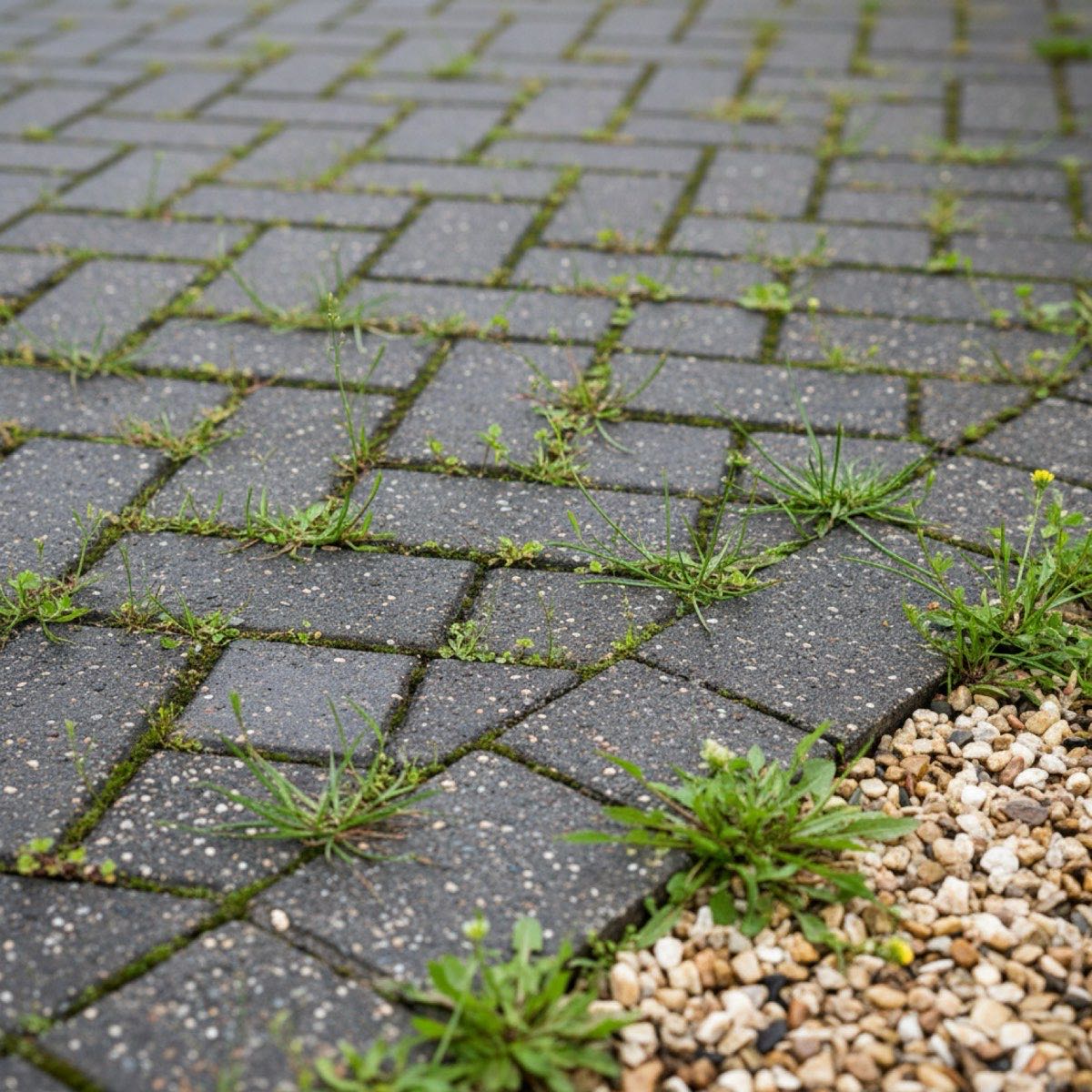
A block-paved drive is built up in layers: the blocks on top, a bed of laying-course sand, then a sub-base underneath, with fine sand brushed into the joints between the blocks to lock them together. That jointing sand is the bit that matters here. Over a couple of years it washes out in the rain and gets blasted out by cleaning, and grit and windblown soil settle into the gap that’s left. Seed lands in that little pocket of debris, finds some damp, and roots. The weed was never coming up from under the drive. It was growing in the joint, a few millimetres down.
It’s usually the same handful of culprits: annual meadow grass and low self-seeders like chickweed and the odd dandelion that get a foothold in the joint. They look like they’re rooted deep, but they’re living in the sand line, which is exactly why the fix is about the joint, not the slab.
Gravel is the same story played out on top rather than in a joint. A membrane underneath stops most weeds pushing up from the soil, but wind and birds drop seed onto the gravel, dust and leaf litter build up between the stones, and that thin layer of muck is all a weed needs. Which is why gravel that was spotless two summers ago is suddenly green all over.
What to put back in the joints
Once the weeds are gone, what you fill the joints with decides whether they stay gone. The three options, honestly compared.
| Jointing | Stops weeds? | Lasts | The trade-off |
|---|---|---|---|
| Kiln-dried sand | Barely | Top up yearly | Cheap and easy to top up yourself, but washes out and gives weeds nothing to fight. |
| Polymeric (hard-setting) sand | Yes | 5 to 10 years | Sets hard in 3 to 10mm joints, so it resists both weeds and wash-out. Must go down clean and dry. |
| Mortar (repointed) | Yes | Years, until it cracks | Rigid and weed-tight, but it can crack over time and is a job for a professional. |
Getting the weeds out first
Do the killing before the tidying. Spray what’s growing and let it die off at the root first, because if you scrape or pull it out while it’s alive the root snaps off in the joint and comes back. The how and why of killing it properly is in what actually kills weeds for good.
Once it’s dead and brown, then you clear it out. A block-paving weed knife or a stiff wire brush lifts the dead growth and the loose old sand out of the joints, which is exactly what you want before re-sanding. A long-handled version saves your back on a big drive. Pulling live weeds by hand is the one to avoid: it feels productive and it’s the reason they keep coming back.
Re-sanding the joints
With the joints cleared, brush fresh sand back in. Aim to fill them to within about 5 to 10mm of the top of the block, brushing it in dry, in a few passes, until they won’t take any more. A 20 to 25kg bag covers roughly 15 to 30 square metres of joints, so a typical drive isn’t much sand.
Plain kiln-dried sand is the cheap route and fine if you don’t mind topping it up most years. Polymeric (hard-setting) sand is the one that actually earns its keep: brushed in and lightly wetted it sets firm, so it resists both weeds and the wash-out that starts the whole problem again. It wants joints in the 3 to 10mm range and a dry day, and you take the old sand out first rather than layering over it.
Sealing, and getting the order right
A block-paving sealer binds the sand in the joints and puts a film over the surface, so there’s far less for seed to root into. It works, but only if you do it in the right order and on a surface that’s ready: weeds killed and cleared, joints re-sanded, everything clean and properly dry. Give it around a fortnight after any washing so the surface is bone dry, and leave a newly laid drive about three months before you seal it.
So the whole job, in order, is: kill the weeds to the root, clear the dead growth and old sand, re-sand the joints, then seal. Sealing isn’t forever, it wants redoing every year or two, but done in that order it turns a drive that’s green again by August into one that stays clear for years. Sand-jointed paving is the flexible, re-sandable kind; mortar-pointed paving is more weed-tight but cracks over time and is a job for a professional.
Gravel: a membrane helps, but it isn't forever
For gravel, a proper woven weed-control membrane under the stone does most of the work, stopping the great majority of weeds pushing up from the soil, especially in the first few years. Lay it under around 50mm of gravel and put an edge around the area so weeds can’t creep in from the lawn or borders at the sides.
The honest catch, which most gravel advice skips: a membrane can’t stop seed blowing in and settling in the dust and grit that builds up on top of the stone. That’s where gravel weeds actually come from once it’s a couple of years old, and no membrane reaches them. It’s a light job to keep on top of, a spray and a rake rather than a dig-out, but it’s ongoing, not one-and-done.
For the full picture on why every membrane eventually lets weeds through, and how long a decent one actually lasts, the honest breakdown is worth a read before you buy one.
The pressure-washing trap
Worth flagging because it catches everyone: blasting the drive with a pressure washer to freshen it up strips the jointing sand straight back out and can churn up the joint, leaving the perfect open seedbed. If you do jet-wash, treat it as step one of a job that ends in re-sanding, never as the finish. Wash, let it dry, then re-sand and seal.
A simple routine to keep on top of it
Once it’s clear, keeping it clear is a light job a few times a year rather than a yearly battle. Roughly:
- Kill new weeds while they’re small, before they seed.
- Top up the jointing sand once a year.
- Reseal block paving every year or two.
- Rake and spot-treat gravel a couple of times a season.
- Go easy with the pressure washer, and re-sand after.
What to spray into the joints
A weed in a joint is rooted in the sand and grit underneath it, not sitting on the surface. That makes it a root-kill job, and concentrate is what lets you mix enough for a whole drive.
What I’d use
Glyphosate concentrate, 360 g/L
Gallup Home & Garden Glyphosate Weedkiller (1 litre)
The one Gallup a homeowner can legally buy and use: a 1 litre glyphosate concentrate at 360 g/L, approved for home and garden use under MAPP 17672.
It is the same active, the same 360 g/L loading and the same isopropylamine salt as the professional Gallup XL, and its single label rate of 24 ml per litre of water is exactly the rate the professional labels reserve for perennial broad-leaved weeds. What the two labels set apart is the authorisation printed on them rather than the strength, and this is the side of that line you are allowed to stand on.
- Active ingredient
- Glyphosate, 360 g/L, as the isopropylamine salt
- Formulation
- Soluble concentrate you dilute yourself
- Approval
- MAPP 17672, labelled for use only as a home and garden weedkiller
- Mixing rate
- 24 ml per 1 litre of water, per the label
- Coverage
- 40 sq m per litre of made-up spray, so roughly 1,667 sq m per bottle
- Rainfast
- Rain within 6 hours may reduce effectiveness, per the label
- Size
- 1 litre of concentrate
Watch out for
- No measuring cap in the bottle. Check a cup arrives, or the dose is guesswork.
- One re-treatment a season, and it takes four weeks. Do not go again early.
- Not for lawns. It is non-selective and takes the grass too.
- Resellers dominate the listing, so check the label that arrives is Barclay.
- "Super strength" is keyword stacking. It is 360 g/L, same as professional Gallup XL.
That’s an affiliate link: buy through it and I earn a small commission at no extra cost to you. It doesn’t change what I recommend or what I say is wrong with it. More on how that works in the affiliate disclosure.
No brand pays for a mention here, and nothing on this page is a paid-for opinion. The card above is an affiliate link, so I earn a commission if you buy through it, at no extra cost to you. It buys no product a kinder write-up, which is why the watch-outs sit on the same card as the reasons to buy.
About this resource
I’m The Weed Guy, one bloke who’s qualified to spray professional weedkiller. This resource is how I’d talk you through keeping a block-paved or gravelled drive clear, over the fence rather than over a counter.
The honest disclosure: nothing here is a paid-for opinion, no brand sponsors this site, and the product card above carries an affiliate link, so I earn a commission if you buy through it, at no extra cost to you. Re-sanding and sealing is a genuine homeowner job if you fancy it. The one thing that has to happen first is killing the weeds properly, so whatever you do next is going onto a clean drive rather than over live roots.
Common questions
Does vinegar kill weeds in block paving?
It browns the tops off, which is why so much advice online swears by it, but household or even strong vinegar only burns what it touches. The acetic acid never travels down to the root, so the weed regrows from the joint in a week or two and you’re back to spraying it every fortnight. It can also etch or dull some stone. It’s a top-up at best, not a fix.
What do councils use to kill weeds?
Councils spray a professional glyphosate-based weedkiller, applied by qualified operators, because it’s systemic: it goes in through the leaf and kills the plant down to the root rather than just scorching the top. It’s the same class of product I use, and it’s stronger than anything on the shop shelf, which is why it actually keeps a surface clear instead of browning it for a fortnight.
Does Roundup kill weeds in gravel?
Glyphosate-based weedkillers do kill what’s already growing in gravel, right down to the root, so they beat pulling or hoeing. The catch is they can’t stop new seed blowing in and germinating in the dust that settles on top of the stone, so gravel still needs an occasional spot-spray. Shop concentrations are also weaker than the professional stuff, so they can be slow on established weeds.
Does salt kill weeds in block paving?
It knocks the top back, but it’s a bad idea on a drive. Salt sterilises the ground so nothing grows there for ages, washes into your borders, and can leave white efflorescence staining on the blocks. It also doesn’t kill the root, so they return anyway.
What tool is best for removing weeds from block paving?
A block-paving weed knife or a stiff wire brush to lift dead growth and old sand out of the joints, or a long-handled weeder for a big drive. But clear them after they’re dead, not while alive, or the root stays in the joint.
How fast does bleach kill weeds in block paving?
It browns the top in a day or two, but it never reaches the root, so the weed regrows, and bleach can permanently stain block paving and stone. It’s not worth the risk to your drive.
What is the difference between kiln-dried and polymeric sand?
Kiln-dried sand just fills the joint and washes out over time, so it needs topping up most years and gives weeds an easy home. Polymeric sand has a resin that sets it hard, so it resists weeds and wash-out and lasts around five to ten years, but it needs joints of about 3 to 10mm and a dry day to go down.
Should I seal block paving to stop weeds?
Sealing helps a lot: it binds the jointing sand and leaves less for seed to root into. Do it last though, on a weed-free, clean, dry, freshly re-sanded surface, and expect to redo it every year or two.
Does a weed membrane stop weeds in gravel for good?
It stops most weeds coming up from the soil, but it can’t stop seed blowing in and germinating in the dust that collects on top of the gravel. So it’s a big help, not a permanent fix, gravel needs a bit of ongoing topping up.
How deep should gravel be to stop weeds?
Around 50mm over a proper woven membrane is the usual target. Too shallow and the membrane shows through and weeds get a look in. The depth plus the membrane does the work from below, though it still can’t stop seed landing on top.
Should paving joints be sand or mortar?
Both work if they’re sound. Sand joints flex with the paving and you can re-sand them yourself, which is why most block drives use them. Mortar-pointed joints are more weed-tight but rigid, so they crack over time and repointing is a professional job. For a typical block drive, well-kept jointing sand is the simpler answer.