Do weed membranes actually work?
Yes, for a while. No, not forever, and nobody selling you a membrane tends to mention that part. Here is what a weed membrane genuinely stops, why every membrane eventually fails, how long a decent one actually lasts, and what university research says beats it in a planted bed.
By The Weed GuyLast updated
The short version
A weed membrane blocks light and slows weeds well while it is new and clean. It is not a permanent fix: sunlight degrades the fabric over years, and dust and grit that settle on top of it build a thin new layer of soil that weed seed can root into regardless of what is underneath. Under gravel it is still worth laying, mainly to stop the gravel sinking into the soil, with weed control as a genuine but temporary bonus.
Membrane types, and what each is actually for
'Weed membrane' covers several different products with different jobs. Picking the wrong type for the wrong spot is the most common reason people say membranes 'don't work'.
| Type | How it behaves | Best for | Verdict |
|---|---|---|---|
| Woven landscape fabric | Lets water and air through, blocks most light | Under gravel, around shrubs/borders | The standard choice. Slows weeds well while it is intact; degrades under UV over years and eventually lets more light and weeds through. |
| Non-woven (spun-bonded) fabric | Similar permeability, often cheaper | Budget jobs, short-term beds | Usually thinner and less durable than woven, so it tears more easily and needs replacing sooner. |
| Plastic sheeting (impermeable) | Blocks water and air too | Rarely the right choice outdoors | Stops weeds completely while intact, but also stops water reaching the soil and can waterlog or starve anything planted nearby. Not recommended under a permanent bed. |
| No membrane, thick organic mulch instead | Not a barrier at all | Garden beds and borders | University research has found a deep mulch layer alone controls weeds as well as fabric in planted beds, and it improves the soil instead of degrading into it. Not a substitute under gravel or paving, where a membrane earns its place. |
Why every membrane fails eventually
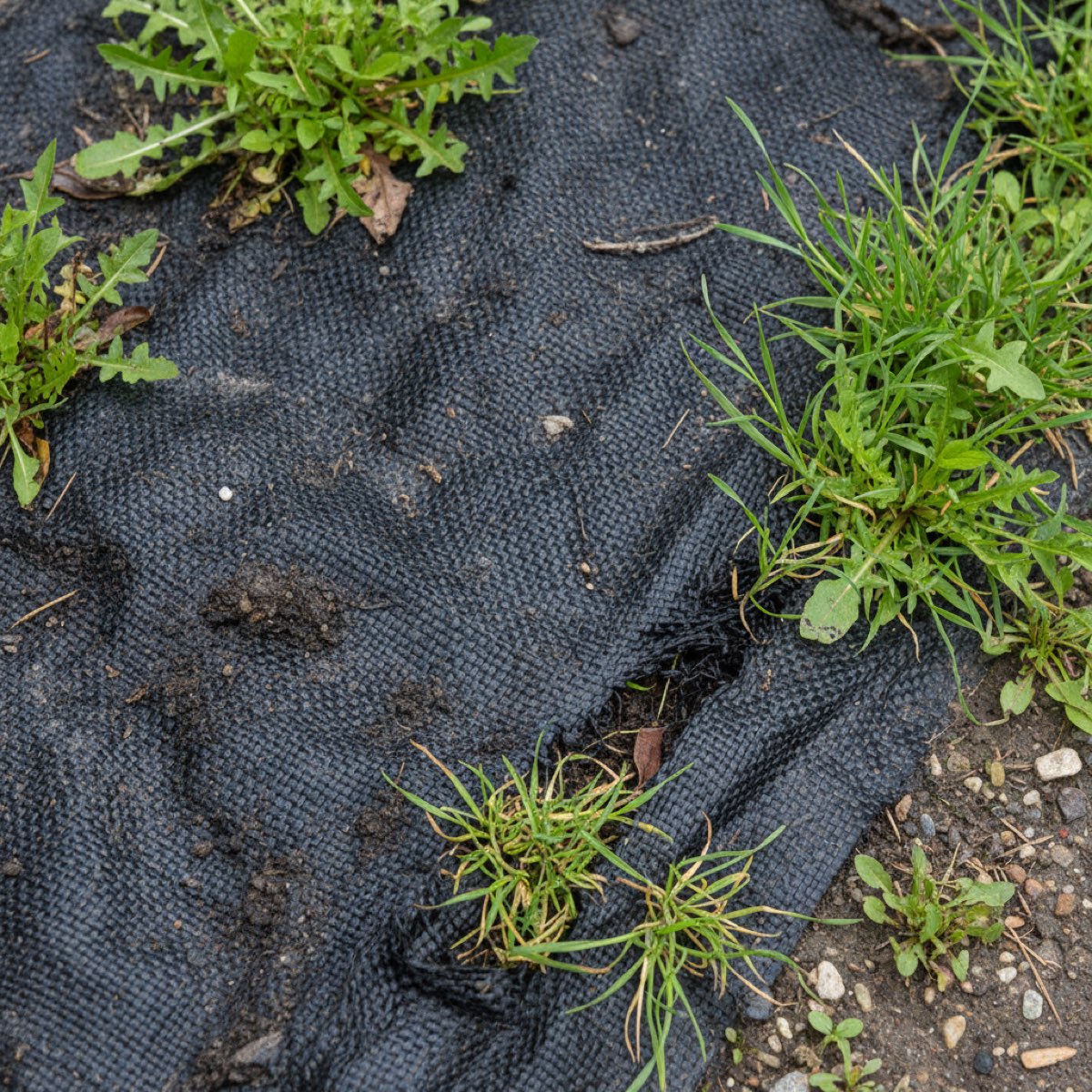
Extension horticulture research out of Washington State University, reviewing landscape fabric performance in permanent plantings, found that fabric can slow weeds but cannot stop them completely, and concluded that the fabrics are not a lasting weed-control solution because the product itself is not permanent. Exposed to sun, temperature swings and moisture over years, synthetic fabric degrades, becoming brittle and prone to tearing.
The part that surprises most people is the second failure mode, which has nothing to do with the fabric wearing out. Wind carries dust, fine grit and organic debris onto any outdoor surface, membrane or not, and over a few years that builds a thin layer of genuine soil sitting on TOP of the membrane. Airborne weed seed roots into that new surface layer exactly as it would root into bare ground, so a membrane that is technically still intact underneath can still be growing weeds on top of it.
That same research points to a practical alternative for planted beds and borders: a deep layer of organic mulch, in the region of 6 to 12 inches of wood chip in the studies cited, suppressing weeds as effectively as fabric while also improving the soil as it breaks down, rather than shedding microplastic into it as ageing fabric eventually does. That is the right comparison for a border or a bed. Under gravel or block paving, you still want the membrane, mainly for what it does to the structure beneath your feet.
Getting the most life out of a membrane you've already laid
Keep sunlight off it. A membrane covered properly with gravel, bark or chippings and kept topped up as the covering settles or gets kicked around will comfortably outlast one left thin or exposed at the edges, because UV is the main thing ageing the fabric, not simple time.
Sweep or blow off the surface debris occasionally rather than letting it accumulate for years. It sounds like a small thing, but it is the one maintenance step that directly targets the actual failure mode (new soil forming on top) rather than the fabric itself, and it is far less work than digging weeds out of an established root system later.
Overlap the joins generously when you lay it and peg it down properly at the edges. Gaps at a join or a lifted edge are the fastest route for both light and blown-in debris to reach the soil underneath, and they tend to be where the first weeds through a membrane actually appear.
What to use where the membrane has failed
A membrane loses at its edges, its joins, and anywhere soil builds up on top of it. What comes through those gaps is rooted underneath, so it needs killing at the root rather than covering over again.
What I’d use
Glyphosate concentrate, 360 g/L
Gallup Home & Garden Glyphosate Weedkiller (1 litre)
The one Gallup a homeowner can legally buy and use: a 1 litre glyphosate concentrate at 360 g/L, approved for home and garden use under MAPP 17672.
It is the same active, the same 360 g/L loading and the same isopropylamine salt as the professional Gallup XL, and its single label rate of 24 ml per litre of water is exactly the rate the professional labels reserve for perennial broad-leaved weeds. What the two labels set apart is the authorisation printed on them rather than the strength, and this is the side of that line you are allowed to stand on.
- Active ingredient
- Glyphosate, 360 g/L, as the isopropylamine salt
- Formulation
- Soluble concentrate you dilute yourself
- Approval
- MAPP 17672, labelled for use only as a home and garden weedkiller
- Mixing rate
- 24 ml per 1 litre of water, per the label
- Coverage
- 40 sq m per litre of made-up spray, so roughly 1,667 sq m per bottle
- Rainfast
- Rain within 6 hours may reduce effectiveness, per the label
- Size
- 1 litre of concentrate
Watch out for
- No measuring cap in the bottle. Check a cup arrives, or the dose is guesswork.
- One re-treatment a season, and it takes four weeks. Do not go again early.
- Not for lawns. It is non-selective and takes the grass too.
- Resellers dominate the listing, so check the label that arrives is Barclay.
- "Super strength" is keyword stacking. It is 360 g/L, same as professional Gallup XL.
That’s an affiliate link: buy through it and I earn a small commission at no extra cost to you. It doesn’t change what I recommend or what I say is wrong with it. More on how that works in the affiliate disclosure.
No brand pays for a mention here, and nothing on this page is a paid-for opinion. The card above is an affiliate link, so I earn a commission if you buy through it, at no extra cost to you. It buys no product a kinder write-up, which is why the watch-outs sit on the same card as the reasons to buy.
About this resource
I’m The Weed Guy, one bloke who’s qualified to spray professional weedkiller. This resource leans on published extension horticulture research rather than marketing copy from anyone who sells membranes, because that is the more honest source for a question about whether a product actually works long-term.
The honest disclosure: nothing here is a paid-for opinion, no brand sponsors this site, and the product card above carries an affiliate link, so I earn a commission if you buy through it, at no extra cost to you.
Common questions
Will weeds grow through a weed membrane?
Not through an intact one, but yes eventually, in two ways. First, any planting hole or peg puncture is a gap seed can use straight away. Second, and this is the one most advice skips, wind-blown dust, grit and organic debris settle on TOP of the membrane over time and slowly build a thin layer of soil there, and that new surface layer catches airborne seed just like bare ground would, membrane or no membrane underneath it.
How long does a weed membrane last?
It depends almost entirely on UV exposure. Left uncovered in direct sunlight, ordinary polypropylene fabric can start degrading within about a year. Covered with gravel, mulch or soil so sunlight cannot reach it, a decent heavy-duty membrane can last five to ten years or more before it becomes brittle and starts to tear. So the depth and consistency of whatever you put on top of it matters as much as the fabric quality itself.
Should I put a weed membrane under gravel?
Generally yes, for two reasons that have nothing to do with weeds: it stops the gravel sinking into the soil beneath it over time, and it stops loose soil working its way up between the stones. The weed-suppression it gives you is real but temporary, per the point above, so think of the membrane as protecting the gravel bed structurally, with slowing weeds as a welcome secondary benefit rather than a permanent guarantee.
Do I need to put soil on top of a weed barrier?
No, and doing so usually defeats the point of laying it. The membrane should sit under your gravel, bark or paving, not have topsoil piled straight onto it, because a soil layer on top gives weed seed exactly the growing medium it needs, membrane or not. Keep the covering material inorganic (gravel, chippings) wherever you want the membrane to keep earning its place.
How many layers of weed membrane do I need?
One good layer, properly overlapped at the joins and pegged down, beats two cheap layers. Doubling up thin fabric does not meaningfully extend its life if both layers are exposed to the same UV and the same dust buildup on top, and it makes the job harder to lay flat. Spend the money on a single heavier-duty fabric instead of buying two lightweight ones.
What is better than a weed membrane?
For a permanent garden bed or border, university research has found that a deep organic mulch layer, roughly 6 to 12 inches of wood chip in the studies behind this, suppresses weeds as well as fabric while also feeding the soil as it breaks down, rather than degrading into microplastic as ageing synthetic fabric eventually does. That is a bed-and-border answer, not a driveway one: under gravel or paving, where you need a firm structural base, a membrane is still the right tool, and the maintenance step that actually keeps it working is topping up or sweeping off the surface debris before it turns into a new seed bed.