Glyphosate Concentrate Strengths and Mixing Rates
Every glyphosate bottle on a shelf is the same active ingredient at a different concentration, and that concentration is the whole reason mixing rates vary so much between products. Here is the millilitres-per-litre rate off each named product's own label, what that comes to in a 5, 15 or 16 litre knapsack, and who is legally allowed to spray which.
By The Weed GuyLast updated
The short version
There is no one glyphosate rate, because there is no one glyphosate strength. Off their own labels: Roundup Ultra is 10 ml per litre of water for annual weeds and 15 ml for perennials, Roundup Optima+ is 20 ml and 30 ml, Gallup Home & Garden is a flat 24 ml, Rosate 360 TF is 16 ml and 24 ml, and Gallup Hi-Aktiv 490 is 12 ml and 18 ml. Multiply by your tank. A 16 litre knapsack takes 160 ml of Roundup Ultra at the annual rate, 384 ml of Gallup Home & Garden, or 192 ml of Hi-Aktiv 490. A 5 litre pressure sprayer takes 50 ml, 120 ml and 60 ml of the same three.
A higher g/L figure doesn't mean a better kill. Mix each bottle to its own label rate and a stronger concentrate mostly changes how much you measure out. The two professional products have to be used by someone holding a Certificate of Competence, or under their direct supervision; the amateur ones need nothing. The strongest amateur concentrate is 360 g/L, level with Rosate 360 TF, while Gallup Hi-Aktiv sits above both at 490 g/L. And mix to your own bottle's label rate: these are worked examples from published labels, not a substitute for the one in your hand.
How many millilitres of glyphosate per litre of water
Between 10 ml and 30 ml per litre for the amateur concentrates, and 12 ml to 24 ml for the professional ones. Which of those it is depends entirely on the bottle in your hand, so here is every named product at its published strength and its own label rate.
| Product | Glyphosate | Mixing rate and coverage | Who can use it |
|---|---|---|---|
| Ready-to-use (RTU) spray | ~7-9 g/L | Pre-diluted, no mixingNothing to work out, it comes pre-mixed | Anyone, no certificate |
| Roundup Optima+ (amateur concentrate)MAPP 18846 | 170 g/L | 20 ml per litre of water for annual weeds; 30 ml per litre for perennialsAt the annual rate, 1 litre makes up to 50 litres of spray treating up to 1,500 sq m. At the perennial rate it makes about 33 litres | Anyone, no certificate |
| Roundup Ultra (amateur concentrate)MAPP 18850 | 360 g/L | 10 ml per litre of water for annual weeds; 15 ml per litre for perennials and for ground you want kept clearAbout 30 sq m per litre of made-up spray | Anyone, no certificate |
| Gallup Home & Garden (amateur concentrate)MAPP 17672 | 360 g/L | 24 ml per litre of water, the only rate on the labelUp to 40 sq m per litre of made-up spray | Anyone, no certificate |
| Rosate 360 TF (professional)MAPP 17682 | 360 g/L | 16 ml per litre of water (general use); 24 ml per litre where perennial broad-leaved weeds are present40 sq m per litre of made-up spray | Operator needs a Certificate of Competence, or supervision by a holder |
| Gallup Hi-Aktiv 490 (professional)MAPP 17681 | 490 g/L | 12 ml per litre of water (general use); 18 ml per litre where perennial broad-leaved weeds are present1 litre of made-up spray treats roughly 40 sq m | Operator needs a Certificate of Competence, or supervision by a holder |
That last column is not my opinion of who ought to use what. Amateur and Professional are a field on the HSE pesticide register, and you can look up any bottle by the MAPP number printed on it. Gallup Home & Garden and Roundup Optima+ are recorded there as Amateur. Rosate 360 TF and Gallup Hi-Aktiv Amenity are recorded as Professional. That is the whole test, and it takes a minute.
Rates are off each product's own approved label. Check your specific pack before mixing, because a label rate can vary by target weed and by surface. Why the millilitres-per-litre figure moves with the water volume is worked through on the Rosate 360 TF resource, and the whole Gallup range, amateur and professional, is decoded on the Gallup weed killer resource. The 7-9 g/L and 360-490 g/L figures match the register work already cited on the best weed killer UK resource.
What that is in a 5, 15 or 16 litre knapsack
Every figure below is the rate in the left-hand column multiplied by the tank, and nothing else. Find your bottle, find your sprayer, measure that out.
| Product and label rate | 5 litre sprayer | 15 litre knapsack | 16 litre knapsack |
|---|---|---|---|
| Roundup Ultra, 360 g/L amateur, at 10 ml per litre for annual weeds | 50 ml | 150 ml | 160 ml |
| Roundup Ultra, 360 g/L amateur, at 15 ml per litre for perennials | 75 ml | 225 ml | 240 ml |
| Roundup Optima+, 170 g/L amateur, at 20 ml per litre for annual weeds | 100 ml | 300 ml | 320 ml |
| Roundup Optima+, 170 g/L amateur, at 30 ml per litre for perennials | 150 ml | 450 ml | 480 ml |
| Gallup Home & Garden, 360 g/L amateur, at its single 24 ml per litre rate | 120 ml | 360 ml | 384 ml |
| Rosate 360 TF, 360 g/L professional, at 16 ml per litre for general use | 80 ml | 240 ml | 256 ml |
| Rosate 360 TF, 360 g/L professional, at 24 ml per litre where perennial broad-leaved weeds are present | 120 ml | 360 ml | 384 ml |
| Gallup Hi-Aktiv 490, 490 g/L professional, at 12 ml per litre for general use | 60 ml | 180 ml | 192 ml |
| Gallup Hi-Aktiv 490, 490 g/L professional, at 18 ml per litre where perennial broad-leaved weeds are present | 90 ml | 270 ml | 288 ml |
For 1 litre, read the rate itself. For 10 litres, double the 5 litre column. For anything else, the calculator below takes the number. Choosing and calibrating the sprayer is a separate job, covered on the knapsack sprayer resource.
Work out your own mix for any tank size
Pick the bottle you have got and the sprayer you are filling, 1, 5, 10, 15 or 16 litres or a volume you type in yourself, and this does the multiplication. Every rate in it comes off the named product's own label, and the last option asks you for the rate on yours.
2. The rate
One rate on this label: 20 ml per litre of water.
Your mix
100 ml
of Roundup Optima+ into 5 litres of water.
- Dilution
- 1 to 50
- Rate used
- 20 ml per litre
- Covers
- around 150 sq m
From Roundup Optima+ own label data: 1 litre makes up to 50 spray litres, treating up to 1,500 sq m.
Half-fill the tank with water first, add the measured concentrate, then top up to the full volume, agitating as you go. Mix only what you will spray that session, and remember the figure above is a worked example from a published label rather than a substitute for reading your own bottle.
Doing the maths for your tank size
The working behind the table and the calculator, if you would rather do it on the back of your hand.
Work out the millilitres per litre first, then multiply by however many litres your tank actually holds. That is the whole method, and it never changes. Gallup Hi-Aktiv 490's own label states 12 ml of product per litre of water for general hard-surface use. Scaled up: a 5 litre pressure sprayer takes 60 ml, a 10 litre knapsack takes 120 ml, a 15 litre knapsack takes 180 ml, a 16 litre knapsack takes 192 ml. Where perennial broad-leaved weeds are present and the label calls for the stronger 18 ml/litre rate, those same tanks take 90 ml, 180 ml, 270 ml and 288 ml.
Roundup Optima+ works out the same way from its own label figures: a 1 litre bottle makes up to 50 litres of made-up spray, which is 20 ml of concentrate per litre of water for annual weeds. So a 5 litre pressure sprayer takes 100 ml, a 15 litre knapsack 300 ml, and a 16 litre knapsack 320 ml. At the 30 ml rate its label gives for perennials, the same three take 150 ml, 450 ml and 480 ml.
The one thing that trips people up is that a millilitres-per-litre figure is not a fixed property of the product. A professional label doses per hectare of ground and converts to millilitres per litre only by assuming a water volume, which is why the same 360 g/L concentrate gets quoted at 15, 20, 25 and 35 ml per litre by different sellers. An amateur label skips all that and prints the per-litre rate directly, which is one real advantage of the consumer bottle nobody mentions.
One caution worth repeating: these are worked examples from published label figures for the named products above, not a substitute for reading your own bottle. Formulations change, and a label rate can vary by target weed or surface, so the number on your actual product always wins over a figure quoted here or anywhere else.
The certificate question, answered straight
A product labelled for professional use needs the operator to hold a Certificate of Competence, or to be supervised by someone who holds one. A consumer or amateur-labelled bottle needs nothing at all.
There’s a real, sourced distinction here worth being straight about. HSE guidance on the Certificate of Competence is clear: anyone using a plant protection product authorised for professional use must hold the relevant NPTC or SSTS certificate, commonly starting with the PA1 theory module plus PA6 for hand-held equipment, or be working under the direct, personal supervision of someone who does. That requirement applies whether the spraying is commercial or on your own land, and since 26 November 2015 it has applied to everyone regardless of age. The birth date people still quote worked the other way round: anyone born on or before 31 December 1964 spraying on their own or their employer's land was exempt under what was known as grandfather rights, and that exemption ceased to have effect on 25 November 2015. Consumer/amateur-labelled products carry no such requirement.
In practice that means a professional-strength concentrate like Rosate 360 TF or Gallup Hi-Aktiv is restricted on both counts, not just at the lance. Regulation 9(5) puts the prohibition on the buyer rather than the shop, and the seller is under no duty to check, so a merchant putting one through the till is not the same thing as you being entitled to buy it. A consumer concentrate is the straightforward route if that is not you, and the strongest of those runs to the same 360 g/L anyway.
Mixing it properly
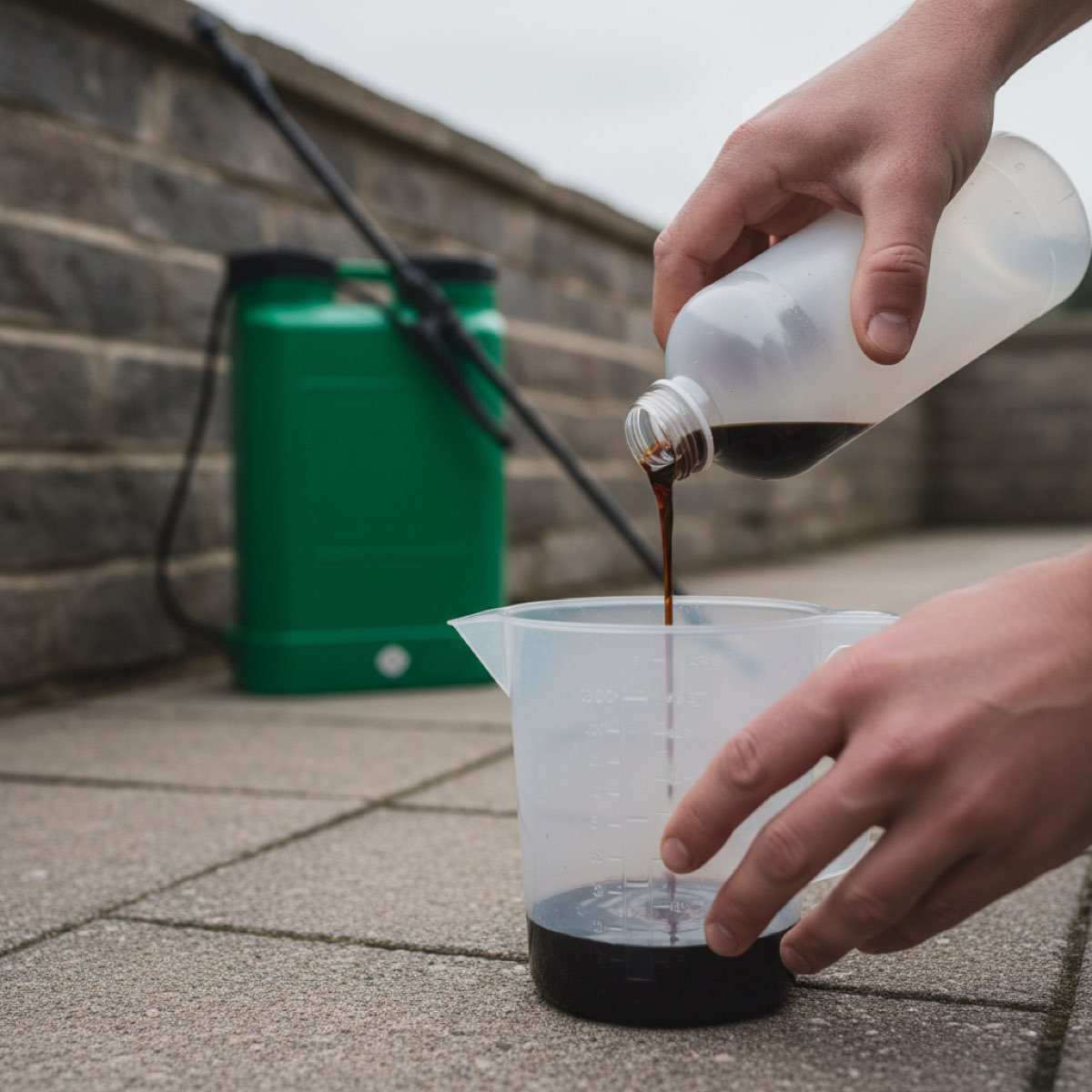
Half-fill the tank with clean water first, add the measured concentrate, then top up to the full volume, agitating throughout rather than dumping the concentrate straight into an empty or full tank. Mix only what you plan to use in that session; both a consumer and a professional label are consistent on spraying out the same day rather than storing a made-up batch for next time.
Rinse the tank, lance and nozzle with clean water straight after spraying, before the mix has a chance to dry anywhere in the mechanism. A dried residue is the most common reason a sprayer stops working cleanly on its next outing.
A bottle whose label prints one rate
Half the confusion this page exists to clear up comes from labels that band their rates or leave the g/L off the front. This one states 360 g/L and a single rate of 24 ml per litre, which is what makes the arithmetic above easy to apply.
What I’d use
Glyphosate concentrate, 360 g/L
Gallup Home & Garden Glyphosate Weedkiller (1 litre)
The one Gallup a homeowner can legally buy and use: a 1 litre glyphosate concentrate at 360 g/L, approved for home and garden use under MAPP 17672.
It is the same active, the same 360 g/L loading and the same isopropylamine salt as the professional Gallup XL, and its single label rate of 24 ml per litre of water is exactly the rate the professional labels reserve for perennial broad-leaved weeds. What the two labels set apart is the authorisation printed on them rather than the strength, and this is the side of that line you are allowed to stand on.
- Active ingredient
- Glyphosate, 360 g/L, as the isopropylamine salt
- Formulation
- Soluble concentrate you dilute yourself
- Approval
- MAPP 17672, labelled for use only as a home and garden weedkiller
- Mixing rate
- 24 ml per 1 litre of water, per the label
- Coverage
- 40 sq m per litre of made-up spray, so roughly 1,667 sq m per bottle
- Rainfast
- Rain within 6 hours may reduce effectiveness, per the label
- Size
- 1 litre of concentrate
Watch out for
- No measuring cap in the bottle. Check a cup arrives, or the dose is guesswork.
- One re-treatment a season, and it takes four weeks. Do not go again early.
- Not for lawns. It is non-selective and takes the grass too.
- Resellers dominate the listing, so check the label that arrives is Barclay.
- "Super strength" is keyword stacking. It is 360 g/L, same as professional Gallup XL.
That’s an affiliate link: buy through it and I earn a small commission at no extra cost to you. It doesn’t change what I recommend or what I say is wrong with it. More on how that works in the affiliate disclosure.
No brand pays for a mention here, and nothing on this page is a paid-for opinion. The card above is an affiliate link, so I earn a commission if you buy through it, at no extra cost to you. It buys no product a kinder write-up, which is why the watch-outs sit on the same card as the reasons to buy.
About this resource
I’m The Weed Guy, one bloke who’s qualified to spray professional weedkiller. The concentrations and rates above come from the named products’ own published label data, not a lab test I’ve run myself.
The honest disclosure: nothing here is a paid-for opinion, no brand sponsors this site, and the product card above carries an affiliate link, so I earn a commission if you buy through it, at no extra cost to you. Where a figure varies by pack or has not been confirmed to a specific product, it is flagged as such above rather than stated as exact.
Common questions
How many ml of glyphosate per litre of water?
Somewhere between 10 ml and 30 ml, and which one depends on the bottle. Off their own labels: Roundup Ultra is 10 ml per litre for annual weeds and 15 ml for perennials, Roundup Optima+ is 20 ml and 30 ml, Gallup Home & Garden is a flat 24 ml, Rosate 360 TF is 16 ml and 24 ml, and Gallup Hi-Aktiv 490 is 12 ml and 18 ml. The spread is concentration: those products run from 170 g/L to 490 g/L of the same active ingredient, so a stronger bottle needs less of itself per litre to land the same dose on the ground. Read the rate off the product in your hand rather than one you have seen quoted for a different one.
How much glyphosate per 5 litres of water?
Five times the per-litre rate, so at the rates above: 50 ml of Roundup Ultra for annual weeds or 75 ml for perennials, 100 ml of Roundup Optima+ or 150 ml at its perennial rate, 120 ml of Gallup Home & Garden, 80 ml of Rosate 360 TF at general use or 120 ml where perennial broad-leaved weeds are present, and 60 ml of Gallup Hi-Aktiv 490 or 90 ml at its stronger rate. Five litres is a hand-pumped pressure sprayer, which is the right tool for a path or a small patio rather than a whole drive.
How much Roundup do you put in 16 litres of water?
It depends which Roundup, because the name covers several different strengths. Roundup Ultra is 360 g/L glyphosate and its label gives 10 ml per litre for annual weeds, so a 16 litre knapsack takes 160 ml, or 240 ml at the 15 ml rate for perennials. Roundup Optima+ is 170 g/L and mixes at 20 ml per litre, so the same tank takes 320 ml, or 480 ml at its 30 ml perennial rate. The ready-to-use trigger bottles are already diluted at about 7.2 g/L and go nowhere near a knapsack. Check the strength on the back before you pour, because those two concentrates differ by a factor of two in what you measure out.
What's the actual difference between 360 and 490 glyphosate?
Concentration, and nothing else, both are glyphosate at professional strength and both need the operator to hold the relevant certificate. Because Gallup Hi-Aktiv 490 is packed at a higher concentration than a 360 g/L product like Rosate 360 TF, you use less of it per litre of water to hit the same on-the-ground dose, its own label rate is 12 ml per litre for general use, where Rosate 360 TF at 360 g/L gives 16 ml for the same job. Neither number tells you anything about which kills weeds more effectively when both are mixed and applied correctly.
Can I buy Gallup Hi-Aktiv or Rosate 360 TF as a homeowner?
No, and both halves of that are restricted, not just the spraying. The Plant Protection Products (Sustainable Use) Regulations 2012 restrict the sale of a professional-use product as well as its use, and contravening them is a criminal offence, so a merchant putting one through the till is not the same thing as you being entitled to buy it. On the using side, the operator must hold a recognised Certificate of Competence (commonly the PA1 and PA6 modules for hand-held equipment), or be working under the direct, personal supervision of someone who does, and that applies whether you are spraying commercially or your own driveway. The pre-1965 exemption people still mention ended in November 2015. Consumer-labelled concentrates carry none of this, and the strongest of them runs to 360 g/L, so for most jobs the amateur route is not the compromise it sounds like.
How long does mixed glyphosate spray solution last once diluted?
Not long, and it isn’t designed to be stored. Manufacturer mixing guidance for both a professional concentrate and a consumer one is consistent on this: mix only as much as you’ll use that session and spray it out the same day, rather than making up a batch to use across several visits.
Do I need to add anything to glyphosate to make it work better?
For a straightforward driveway, path or patio job, no. Some professional labels do permit an authorised adjuvant for specific harder situations (dense woody weeds, for instance), but that’s a label-specific allowance, not a general upgrade, and adding an unauthorised surfactant or "booster" to any product is using it in a way its approval doesn’t cover. Getting the label’s own rate right and spraying on a dry day does more for results than anything added to the mix.
Why does my sprayed weed look fine a week later?
Most likely the dose was too weak for the amount of product you actually applied, not that glyphosate "doesn’t work" on it. Working from a rate meant for a different, weaker product, under-filling the water first so the concentrate is over-diluted, or rain within a few hours of spraying are the three most common causes, and all three come back to matching the mixing rate to the exact product you bought.