How to Choose, Calibrate and Use a Knapsack Sprayer
A knapsack sprayer is the tool a pump sprayer can't keep up with once you're doing a whole drive, not a whole path. Here's how to pick the right tank size and type, how to calibrate it so you're actually applying the rate the label expects, the common faults and their real fixes, and the licence question answered straight.
By The Weed GuyLast updated
The short version
A hand-pumped 1-5 litre pressure sprayer suits a few stray weeds; anything the size of a driveway wants a 15-16 litre knapsack worn on the back, manual lever or battery-powered. There’s no licence to own or use the sprayer itself, calibration is just matching how much you spray to a measured area, and most “it won’t spray” problems are a blocked filter or nozzle from residue left to dry in it. Ignore the headline pressure figure on a battery model: weedkiller labels want a low nozzle pressure, so what matters is that you can turn it down and hold it there.
Sprayer types, and what each is actually for
Match the tank size to the job before you match the brand. A 5 litre pressure sprayer on a full drive means refilling and re-pumping a dozen times over.
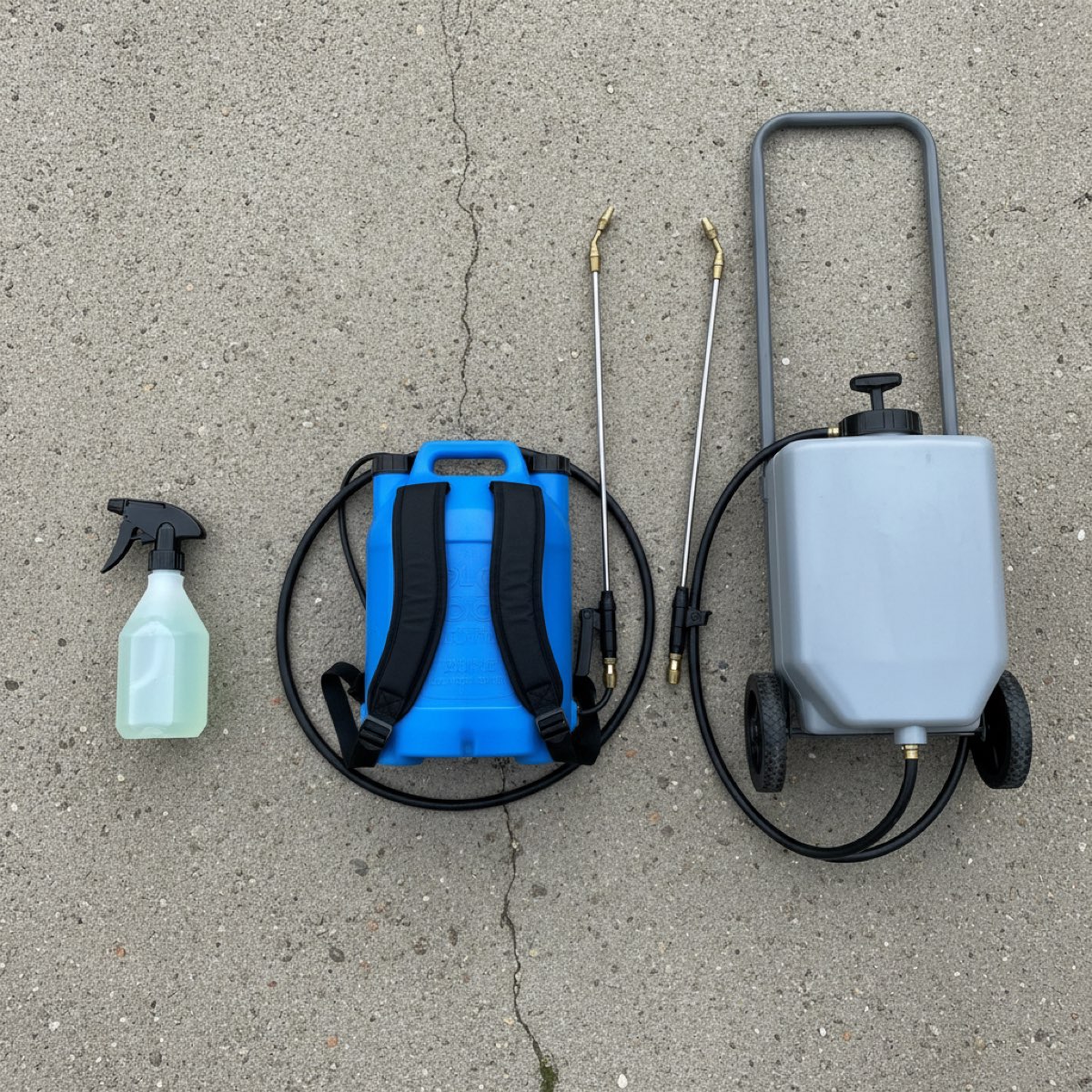
| Type | Best for | How it works | Verdict |
|---|---|---|---|
| 1-5 litre pressure/pump sprayer | A few weeds, cracks, a small patio | Pump up by hand, spray until pressure drops, pump again | Cheap and light, but you’ll be re-pumping constantly on anything bigger than a path. |
| 15-16 litre manual knapsack (lever-operated) | A whole drive, a long run of block paving | Worn on the back, lever pumped with one hand while you spray with the other | No batteries to charge, cheap to maintain, and you can feel when pressure is dropping. 15, 16 and 20 litres are all sold here: Cooper Pegler goes 15 then 20 with nothing between, and 16 is a Matabi and Berthoud size. |
| 15-20 litre battery-powered knapsack | The same jobs, less arm work | Electric pump holds a constant pressure, you just squeeze the trigger | Even output all the way down the tank, which makes a consistent mix easier to apply evenly. Battery life and a motor that can fail are the trade-off. |
The nozzle matters as much as the tank
Most knapsacks ship with an adjustable cone nozzle that twists from a fine mist to a solid jet. For weedkiller, you want the coarser end of that range, not the finest mist it can produce. Professional glyphosate labels specify application as a "medium or coarse spray" at nozzle pressures not exceeding 2.5 bar, and that’s not a technicality: a fine mist drifts further in any breeze, meaning more of what you paid for ends up on the plants either side of the weed you’re aiming at, not the weed itself.
A flat-fan nozzle tip, sold separately for most knapsack models, gives a more even band of coverage along a straight run, a path edge or a fence line, than the cone nozzle’s circular pattern does. It’s a small upgrade that’s worth it if most of your spraying is long straight lines rather than odd patches.
Which is why the pressure figure on the box is the most misleading number in the category. Battery knapsacks are sold on it. The one named further down this page lists a maximum of 100 PSI, adjustable down, and that's about 6.9 bar, close to three times the 2.5 bar ceiling those same professional labels specify. Nobody spraying weedkiller should be anywhere near the top of that range. It’s useful headroom for washing something down or reaching up a fence line, not a setting to treat a driveway at, because the harder you push a nozzle the finer the droplet gets and the further it drifts off target.
So read the spec sheet backwards. A high maximum pressure is worth nothing on its own. What you want is a sprayer you can turn down low and hold there, evenly, from the first litre of the tank to the last. Being able to do that does more for how well a treatment works than any other choice you make about the equipment.
Calibrating it: how to know you're applying the right rate
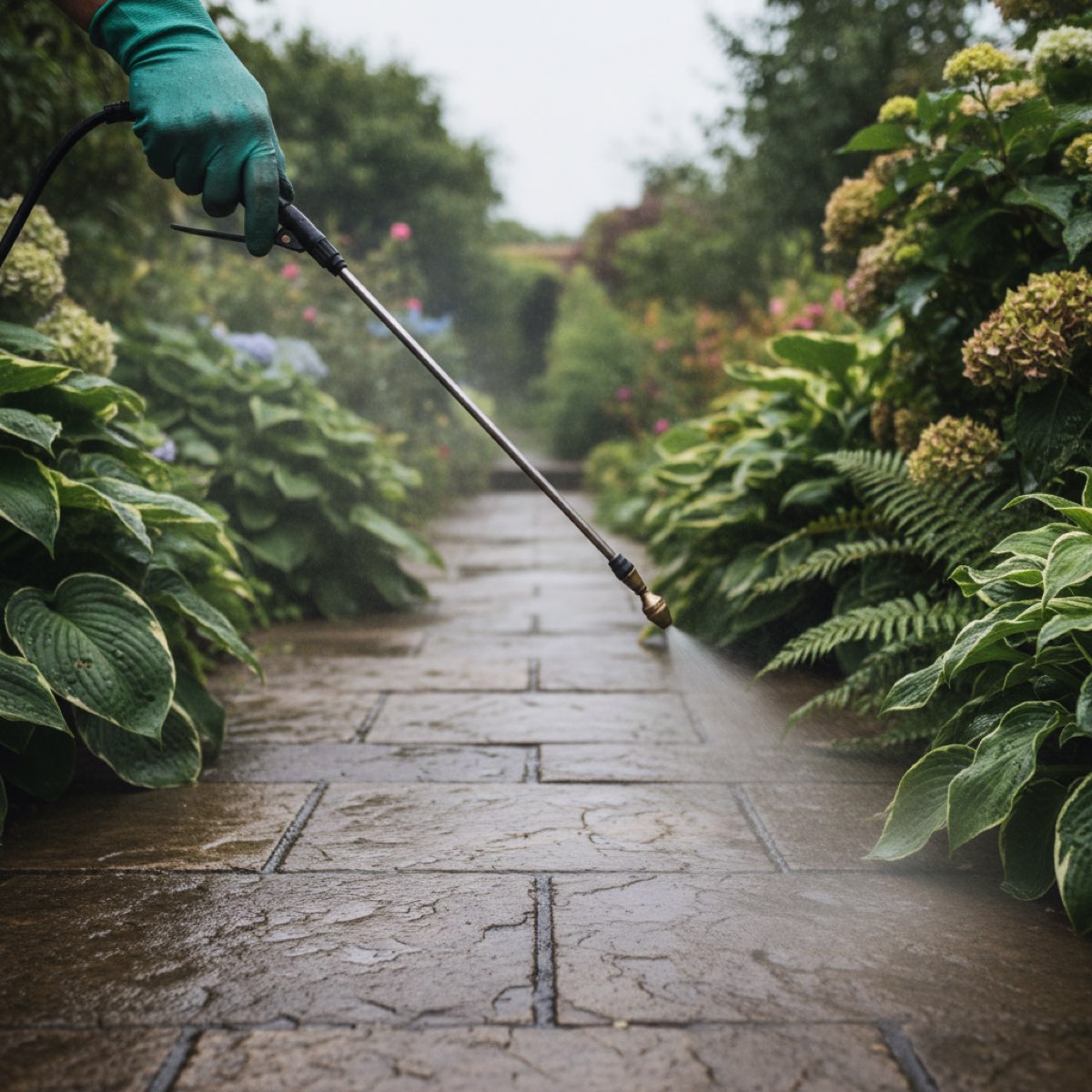
Every weedkiller label states its dose as a rate per hectare in a stated volume of water, for example one widely-used professional glyphosate label gives its hard-surface rate as 2.9 litres of product in 250 litres of water per hectare, which works out to one litre of made-up spray solution treating roughly 40 square metres. That figure is the whole point of calibrating: it tells you how far your tank should actually go, so you can check your sprayer is putting down that much, not more and not less.
To check it yourself: fill the tank with plain water, mark out a measured area (a driveway is easy, most are 30-50 square metres), and spray it at your normal walking pace and nozzle setting exactly as you would with the real mix. Measure how much water you used to cover that area, then work out the equivalent per-hectare rate and compare it to the label’s. Walking faster or opening the nozzle wider both mean less product lands per square metre than you think; walking slower or a finer mist means more. Get that dialled in with water before you ever mix the real thing, and the same setting is reusable every time you refill.
What goes in the tank
A knapsack is the applicator, not the treatment. For most of the jobs on this site what goes in it is a glyphosate concentrate mixed to the label rate, which is exactly what the calibration above is for.
What I’d use
Glyphosate concentrate, 360 g/L
Gallup Home & Garden Glyphosate Weedkiller (1 litre)
The one Gallup a homeowner can legally buy and use: a 1 litre glyphosate concentrate at 360 g/L, approved for home and garden use under MAPP 17672.
It is the same active, the same 360 g/L loading and the same isopropylamine salt as the professional Gallup XL, and its single label rate of 24 ml per litre of water is exactly the rate the professional labels reserve for perennial broad-leaved weeds. What the two labels set apart is the authorisation printed on them rather than the strength, and this is the side of that line you are allowed to stand on.
- Active ingredient
- Glyphosate, 360 g/L, as the isopropylamine salt
- Formulation
- Soluble concentrate you dilute yourself
- Approval
- MAPP 17672, labelled for use only as a home and garden weedkiller
- Mixing rate
- 24 ml per 1 litre of water, per the label
- Coverage
- 40 sq m per litre of made-up spray, so roughly 1,667 sq m per bottle
- Rainfast
- Rain within 6 hours may reduce effectiveness, per the label
- Size
- 1 litre of concentrate
Watch out for
- No measuring cap in the bottle. Check a cup arrives, or the dose is guesswork.
- One re-treatment a season, and it takes four weeks. Do not go again early.
- Not for lawns. It is non-selective and takes the grass too.
- Resellers dominate the listing, so check the label that arrives is Barclay.
- "Super strength" is keyword stacking. It is 360 g/L, same as professional Gallup XL.
That’s an affiliate link: buy through it and I earn a small commission at no extra cost to you. It doesn’t change what I recommend or what I say is wrong with it. More on how that works in the affiliate disclosure.
No brand pays for a mention here, and nothing on this page is a paid-for opinion. The card above is an affiliate link, so I earn a commission if you buy through it, at no extra cost to you. It buys no product a kinder write-up, which is why the watch-outs sit on the same card as the reasons to buy.
What owners work out the hard way
Five things buyers of battery knapsacks keep repeating, none of which appear on a box. They apply to just about any electric model, not one brand.
Run a tank of plain water through it first. This is the one that costs people money. An electric pump shifts liquid a lot faster than a hand-pumped sprayer, and owners are consistently caught out by how quickly a tank goes down at a high setting. Spraying too fast over too small an area means over-applying, which on a lawn feed or an iron treatment does visible damage to the grass. It’s the same calibration run described above, and doing it once with water tells you what your walking pace and pressure setting are actually delivering before there’s anything harmful in the tank.
Set the pressure before you put it on. The controls sit on the unit, which is on your back once you’re working, so dialling it in mid-job means taking the whole thing off again. Owners treat this as normal for electric knapsacks rather than a design fault, but it does mean deciding your setting first rather than adjusting on the fly the way you might with a lever.
Check the hose and lance connectors before you switch on. A powered pump doesn’t wait for you to notice a loose fitting the way a manual one does. It just pushes the mix straight out of it, over you. Two seconds of checking saves getting soaked in something you specifically don’t want on your skin.
Load a full tank off a waist-height surface. Sixteen litres is sixteen kilos before you count the sprayer, and swinging that off the ground onto one shoulder is how people hurt their backs. The trick owners land on is to stand it on something roughly back height first, a wheelie bin or a wall, then step in front and put the straps on without twisting or lifting the weight at all.
Sort the straps before the first job. Loose strap ends can pull back through the buckle at the worst moment, when you’re shrugging a full tank onto your back. A knot tied in each end stops it for good. Worth doing on day one rather than discovering it with a full tank of weedkiller on your shoulders.
Common faults, and the actual fix
Won’t spray at all or loses pressure fast: check the inline filter and the nozzle tip first, dried weedkiller residue left in a sprayer between jobs is the single most common cause of a blockage. On a manual lever model, pressure dropping as you go and needing a few more pumps mid-job is completely normal, not a fault. If a manual model won’t build any pressure at all even when pumped, the pump seal or diaphragm has likely worn out and needs replacing.
Uneven spray pattern or dribbling from the nozzle: usually a partially blocked nozzle or a worn nozzle washer letting the pattern collapse. A cheap spares kit (washers, filters, a spare nozzle tip) fixes most of these faults for a few pounds rather than a whole new sprayer.
The mechanism seizes up between seasons: almost always down to storing it with old mix or rinse water still inside. Empty and rinse it fully at the end of every single session, before it goes back in the shed.
Cleaning, care and what to wear
Rinse the sprayer straight after every use: half-fill the tank with clean water, agitate it, then pump the rinse water through the lance and nozzle to flush the whole system, and do it twice. Manufacturer guidance on professional glyphosate products is explicit that traces of herbicide left in a sprayer can seriously damage or destroy whatever is sprayed with the same equipment later, so if you ever use the sprayer for anything else, a plant feed, a fungicide, treat that rinse as non-negotiable rather than optional.
In practice a couple of litres of clean water covers it: run half of it out through the lance so the pump, hose and nozzle all get flushed, then swill the rest round the tank and tip it away. Pull the filter out and rinse that separately, because it’s the part that catches the residue you’re trying to get rid of, and it’s the part people forget. Then leave the tank open somewhere warm to dry rather than sealing it damp.
For PPE, professional label guidance for hand-held sprayer use calls for suitable protective gloves, protective clothing (coveralls) and rubber boots when handling concentrate and spraying, plus washing hands and any exposed skin before eating and after finishing. That’s written for the concentrated professional product, but it’s sound practice with any glyphosate concentrate, gloves on for mixing at minimum.
About this resource
I’m The Weed Guy, one bloke who’s qualified to spray professional weedkiller. This resource reflects the equipment knowledge and label-reading that comes with that.
Where I name a sprayer, here is exactly what that is and isn’t based on. It isn’t a comparison test: I haven’t bought a shelf of these and run them against each other, and I’m not going to imply I have. It’s the published specification, read against what the weedkiller labels actually require, plus the themes that come up again and again in what buyers report about living with the thing. That last part is genuinely useful and it’s also secondhand, so I’ve labelled it as what owners report rather than dressing it up as my own findings.
The rest of the advice stays deliberately by sprayer TYPE and tank size, because that, not the badge on the front, is what determines whether it’s the right tool for your job. And the commercial disclosure: nothing here is a paid-for opinion and no brand sponsors this site, but the product link above is an affiliate link, so I earn a commission if you buy through it at no extra cost to you. It changes nothing about what I recommend, which is why the watch-outs sit on the same card as the reasons to buy. The full explanation is on the affiliate disclosure page.
Common questions
Do you need a licence to use a knapsack sprayer?
There’s no general licence for owning or using a knapsack sprayer itself; it’s just a tool. What can require certification is the weedkiller you put in it. HSE guidance is clear that anyone using a plant protection product authorised for professional use must hold the relevant certificate (or be working under the direct, personal supervision of someone who does), and this applies whether you’re spraying commercially or on your own land. It also applies to everyone regardless of age: the old exemption for anyone born on or before 31 December 1964 ceased to have effect on 25 November 2015. Amateur/consumer-labelled weedkillers, the kind sold in garden centres and DIY stores, carry no such requirement and can be bought and used by anyone.
What’s the difference between a knapsack sprayer and a backpack sprayer?
Nothing, they’re the same thing. "Knapsack" is the older, more common term in UK gardening and amenity trade circles; "backpack sprayer" is the more literal, more common term in retail listings. Both mean a tank worn on the back with a lance and trigger, as opposed to a smaller pressure sprayer you carry in one hand or set down on the ground.
Why won’t my knapsack sprayer spray, or why has it lost pressure?
Three usual suspects. First, a blocked filter or nozzle, weedkiller residue dries into a paste if left in the mechanism, so check the inline filter and unscrew the nozzle tip to look for a blockage. Second, on a manual lever model, pressure genuinely does fall as you spray and needs topping up with a few more pumps, that’s normal, not a fault. Third, a worn pump seal or diaphragm on an older sprayer will stop it building pressure at all, and that’s a parts-replacement job, not a clean.
How do I clean a knapsack sprayer after using weedkiller?
Rinse it straight after use, not the next time you reach for it. Half-fill the tank with clean water, agitate it, then pump it through the lance and nozzle to flush the whole system, and repeat once more. This matters beyond keeping the sprayer working: if you ever use the same sprayer for anything else, from a plant feed to a fungicide, dried herbicide residue left in the tank or lines can carry over and damage or kill whatever you spray next.
Manual or battery-powered, which is better for weedkiller?
Manual lever knapsacks are the simpler, cheaper, more repairable choice, and they’re what most people spraying a driveway or a path actually need. A battery-powered knapsack holds a constant pressure without you pumping, which gives a more even application rate from the first litre to the last, useful if you’re doing a large area and want a consistent result without the pressure dropping off toward the end of the tank. Neither changes what weedkiller you use or how much of it, that’s a mixing-rate question, not an equipment one.
How many PSI do I need in a knapsack sprayer for weedkiller?
Far less than the sprayers are sold on. A battery knapsack listing maximum pressure of 100 PSI is quoting roughly 6.9 bar, while professional glyphosate labels specify application as a medium or coarse spray at nozzle pressures not exceeding 2.5 bar, about 36 PSI. So the headline number is close to three times what you should actually be spraying weedkiller at. That doesn't make a high-pressure sprayer a bad buy, it just means the number to care about is whether the pressure is adjustable and holds steady when turned down, not how high it goes. Pushing a nozzle harder produces a finer droplet that drifts further off target, which wastes product and puts it on plants you weren't aiming at.
How much weed killer do I actually put in a knapsack sprayer?
That depends entirely on the concentration of the product you’ve bought, not on the sprayer, every label states its own rate and it varies a lot between an amateur concentrate and a professional one. See the full mixing-rate breakdown, with worked examples for common tank sizes, on the glyphosate concentrate and mixing rates page.