How to get rid of bindweed
Bindweed's roots can run nearly as deep as horsetail's, but that's not actually why it beats people. Here's the real reason it keeps coming back, why pulling it sometimes helps and sometimes makes it worse, whether it can get through your fence from next door, and the straight answer on the law and the horse-safety questions that keep coming up.
By The Weed GuyLast updated
The short version
Bindweed doesn’t survive spraying by shrugging it off the way horsetail does. It survives because any snapped-off fragment of root, even a few centimetres, grows into a new plant, and because weedkiller only travels properly into the root while the plant is flowering and pulling its own sugars downwards. Get the timing right and get the whole root crown out where you can, rather than chopping through the root mass, and repeat it across more than one season. That combination is what actually wears it down.
What actually gets rid of bindweed, and what just wastes an afternoon
Same test as every weed on this site: does it reach the root, or does it just deal with the leaf?
| Method | Kills it? | What actually happens |
|---|---|---|
| Hoeing, digging or rotavating carelessly | No, often worse | Chops the root mass into fragments, and a piece as short as 5cm can grow into a whole new plant. |
| Pulling the whole root crown deliberately | Yes, if done right | Gripping and drawing out the point where the root meets the stem removes a growing point intact, instead of snapping it. |
| Cutting off all top growth every 2 to 3 weeks | Yes, over 2+ years | Repeated removal on a strict cycle starves the root of the chance to rebuild its reserves. |
| Vinegar or boiling water | No | Scorches the leaf on contact. The root, which is the entire problem, never feels it. |
| Glyphosate sprayed whenever you get round to it | Rarely | Only translocates well while the plant is pulling sugars down to the root, roughly while it is flowering. Spray outside that window and most of it is wasted. |
| Glyphosate sprayed while flowering, repeated over seasons | Yes, eventually | Timed right, it travels down with the plant’s own sugars into the root, but one dose is never the end of it. |
| Covering with membrane or mulch | Only after years | The rhizomes can push through fabric, and light exclusion alone typically takes three to five years to finish the plant off underneath. |
| A root barrier at the boundary | Stops it spreading, not what’s already there | A solid vertical barrier sunk deep enough blocks new ground being invaded. It does nothing to bindweed already established behind it. |
Bindweed: the plant with the trumpet-shaped flowers strangling everything
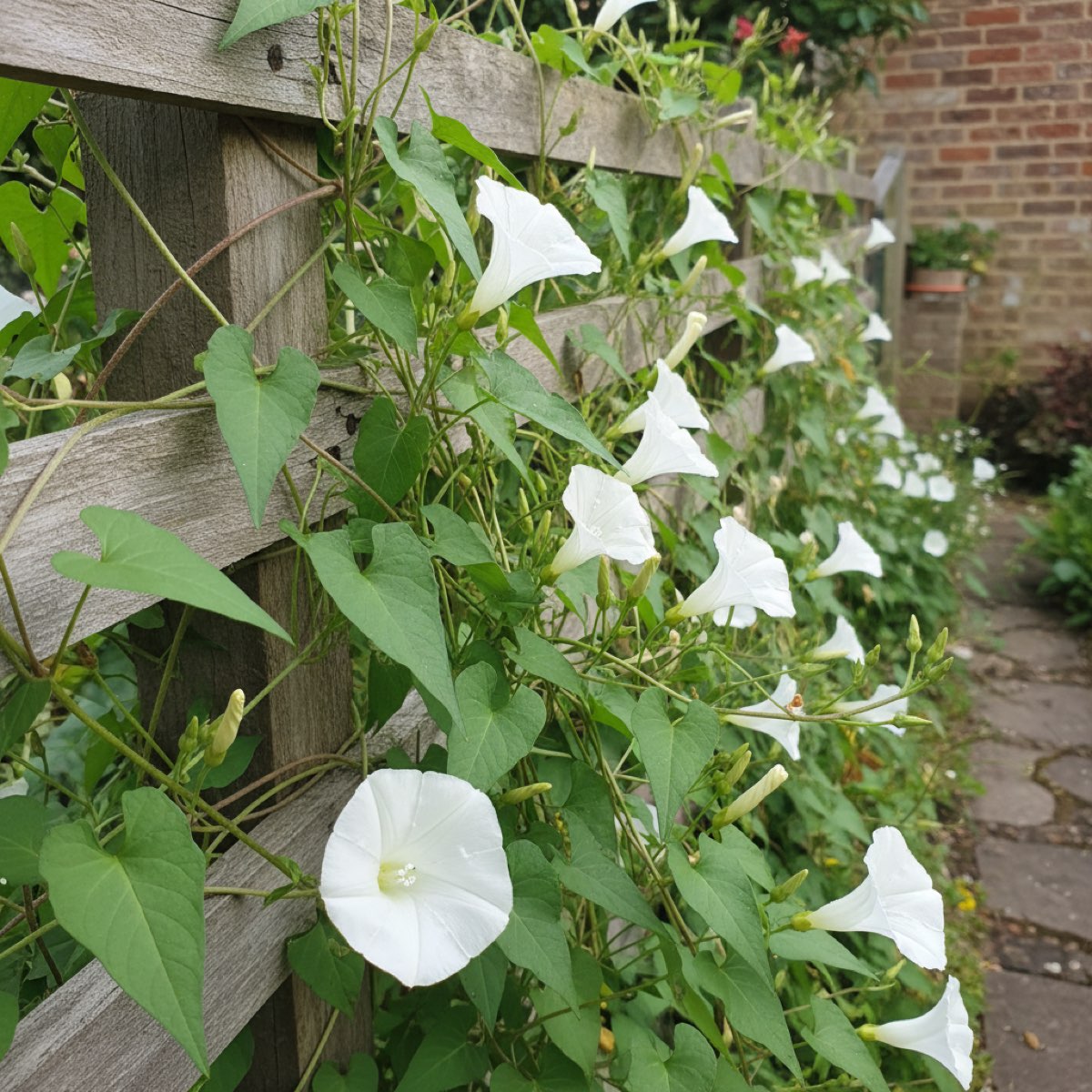
There are two versions in the UK. Hedge bindweed (Calystegia sepium) is the bigger one, climbing stems up to 3m with large white trumpet flowers. Field bindweed (Convolvulus arvensis) is smaller and lower-growing, under a metre, with pink-and-white flowers, and tends to spread further sideways. Both are UK native wildflowers, both twine anticlockwise around anything they touch, fences, shrubs, other plants, and both are a genuine nuisance for the same underlying reason: an extensive, easily fragmented root and rhizome system that a spray or a session with a spade barely dents.
The roots on an established plant can reach as deep as around 4 metres according to the Royal Horticultural Society, with the bulk of the mass usually sitting much shallower, in the top half metre or so of soil. That figure puts it in the same territory as horsetail’s roots, but the reason it’s hard to kill is genuinely different, and worth understanding properly before you spend a weekend on it.
Why bindweed beats people, and it's not the same reason as horsetail
Horsetail defeats a spray mostly at the surface. Its stem is coated in silica and sheds water-based weedkiller before it can be absorbed at all. Bindweed doesn’t have that defence, its leaves take up spray just fine. It survives a different way, through two things happening at once.
- Any fragment regrows. Snap the root at more or less any point and each broken end is capable of throwing up a new plant. A piece as short as around 5cm is enough. That is exactly why careless digging, hoeing or rotavating multiplies an infestation instead of clearing it.
- Timing matters more than coverage. A systemic weedkiller only travels properly down into the root while the plant is itself pulling sugars downward, roughly while it’s flowering through summer. Spray it at the wrong time of year and you’ll brown the leaves and achieve very little else.
Put together, that’s why one good spray or one thorough dig was never going to be the end of it. It is not that bindweed repels treatment, it is that the plant is built to survive being damaged and only vulnerable at certain moments, so beating it takes hitting the right window, more than once, across more than one year.
Does pulling bindweed make it worse, or does it actually help?
Both things you’ve probably read are true, and they’re not actually a contradiction once you separate what’s being described. Hoeing, digging over or rotavating a bed chops indiscriminately through the root mass, creating dozens of wound sites and dozens of fragments, each one a fresh plant. That genuinely backfires, and it’s the single most common way people turn a patch of bindweed into a much bigger problem.
Deliberately pulling the whole root crown, the point just below the surface where the stem meets the root, is a different action entirely. Done carefully, gripping low and drawing the root out slowly rather than yanking the stem, it removes a growing point intact instead of snapping it into pieces. That works, and repeated often enough it genuinely thins an infestation.
If you can’t get a clean pull, the fallback is cutting all the top growth off on a strict two-to-three-week cycle, kept up for a couple of growing seasons. It doesn’t remove anything, but it starves the root of the chance to rebuild what it just lost, and over enough cycles that reserve runs down.
Which weed killer for bindweed, and when to put it on
A systemic weed killer based on glyphosate, put on while the plant is flowering. That is the whole answer, and the name on the bottle is the least important part of it. Bayer sets the rule out plainly in the approved label for its professional Roundup ProActive: perennial broad-leaved weeds are most susceptible around the flowering stage. Bindweed is a perennial broad-leaved weed, so that line is written about it.
The same label is just as blunt about getting it wrong. It tells the operator that all weeds must be at the correct growth stage when treated, otherwise some re-growth may occur and will need re-treating. On bindweed a mistimed spray is not a weaker kill, it is a wasted one, and it is the commonest reason people decide weed killer does not work on this plant at all.
On the shelf there is less to choose between products than the packaging suggests. HSE's home-garden register lists 133 approved glyphosate products, and they all run on the same active. What genuinely differs is the strength and the format: a ready-to-use bottle you spray straight from, or a concentrate you dilute yourself, and the numbers on that are in what the glyphosate strengths and dilution rates actually work out at. None of them changes the timing rule above, and none of them finishes bindweed in a single pass.
Bindweed on a boundary, fence or driveway edge
Bindweed rarely comes up through a solid surface the way horsetail does. What it does instead is climb. Its twining stems find any gap in a fence panel, trellis or gate and work their way through it, which means a plant rooted entirely on your neighbour’s side can still be growing and setting seed on yours. That’s worth knowing before you spend a season clearing your own side: if the root system is on the other side of the boundary and stays untreated, you’re fighting a plant that has an escape route you can’t reach.
Around a driveway or patio, it’s more likely to be found spreading through a border or gravel bed alongside the hard surface than actually growing up through the paving itself. Where it does exploit a gap, a crack, a gap at the edge of a slab, it’s using an opening that’s already there rather than creating one.
If it’s a genuine boundary problem, a solid vertical root barrier sunk deep, a reasonable spec is 45cm or more, stops new ground being invaded from next door. It does nothing for bindweed already established on your side, but it stops the fight starting over every time you clear it.
Can bindweed actually damage a fence, wall or paving?
Not structurally, no. Nothing in the research backs up bindweed cracking sound masonry or lifting paving the way a tree root or Japanese knotweed’s shoots can. What it genuinely does is climb over and through whatever it can reach, and as its twining stems thicken over a season they can tighten around a young shrub or sapling stem enough to restrict it, a real strangling effect rather than a structural one. On a fence, expect it woven through the boards and trapping a bit of moisture against the timber, not the panel itself failing because of it.
Is bindweed illegal to have in the UK?
No, and it’s worth clearing this up directly because the question comes up a lot. Schedule 9 of the Wildlife and Countryside Act 1981, the list that gives Japanese knotweed its legal weight (giant hogweed is on there too), is a long list of non-native invasive species, over fifty of them. Bindweed isn’t one of them, and given both hedge and field bindweed are UK native wildflowers, it was never a candidate for a list that governs non-native species in the first place.
There’s no notifiable status and no mortgage-form question attached to bindweed. If something you’ve read about "dangerous invasive weeds" has you worried, there’s a decent chance you’re actually thinking of knotweed, and here’s how to tell the two apart if you’re not certain which one is actually growing.
Is bindweed dangerous to pets, horses or livestock?
For horses specifically, there’s a real but fairly modest risk. HorseDVM rates it a middling 4 out of 10 on the toxicity scale, linked to colic and weight loss rather than anything more severe, and it tends to become an actual problem only when a pasture is grazed down until bindweed is most of what’s left, or it’s ended up baled into hay. Most horses leave it alone given other forage. Sheep, cattle, goats and pigs generally tolerate it without issue.
On a genuine biological "natural enemy": in the US, a specific gall mite (Aceria malherbae) and a moth (Tyta luctuosa) have been deployed since the 1970s specifically against field bindweed, and the mite’s leaf galls can stop an infested plant flowering or seeding at all. Neither is approved or available for use in a UK garden, so the honest answer here is that there isn’t a real shortcut, birds and insects nibble it, but nothing that meaningfully controls it the way those agents do in the US.
What to put on bindweed
Bindweed regrows from root fragments, so the only thing that helps is a weedkiller carried down into them. That means a systemic glyphosate concentrate, put on living leaf and left alone.
What I’d use
Glyphosate concentrate, 360 g/L
Gallup Home & Garden Glyphosate Weedkiller (1 litre)
The one Gallup a homeowner can legally buy and use: a 1 litre glyphosate concentrate at 360 g/L, approved for home and garden use under MAPP 17672.
It is the same active, the same 360 g/L loading and the same isopropylamine salt as the professional Gallup XL, and its single label rate of 24 ml per litre of water is exactly the rate the professional labels reserve for perennial broad-leaved weeds. What the two labels set apart is the authorisation printed on them rather than the strength, and this is the side of that line you are allowed to stand on.
- Active ingredient
- Glyphosate, 360 g/L, as the isopropylamine salt
- Formulation
- Soluble concentrate you dilute yourself
- Approval
- MAPP 17672, labelled for use only as a home and garden weedkiller
- Mixing rate
- 24 ml per 1 litre of water, per the label
- Coverage
- 40 sq m per litre of made-up spray, so roughly 1,667 sq m per bottle
- Rainfast
- Rain within 6 hours may reduce effectiveness, per the label
- Size
- 1 litre of concentrate
Watch out for
- No measuring cap in the bottle. Check a cup arrives, or the dose is guesswork.
- One re-treatment a season, and it takes four weeks. Do not go again early.
- Not for lawns. It is non-selective and takes the grass too.
- Resellers dominate the listing, so check the label that arrives is Barclay.
- "Super strength" is keyword stacking. It is 360 g/L, same as professional Gallup XL.
That’s an affiliate link: buy through it and I earn a small commission at no extra cost to you. It doesn’t change what I recommend or what I say is wrong with it. More on how that works in the affiliate disclosure.
No brand pays for a mention here, and nothing on this page is a paid-for opinion. The card above is an affiliate link, so I earn a commission if you buy through it, at no extra cost to you. It buys no product a kinder write-up, which is why the watch-outs sit on the same card as the reasons to buy.
About this resource
I’m The Weed Guy, one bloke who’s qualified to use professional weedkiller. This resource is built to explain why bindweed is genuinely its own fight, not a rerun of horsetail, and to answer the boundary, legal and safety questions that most gardening advice skips entirely.
Straight disclosure: nothing here is a paid-for opinion, no brand sponsors this site, and the product card above carries an affiliate link, so I earn a commission if you buy through it, at no extra cost to you. For the mixing-rate side of using glyphosate on bindweed, see glyphosate concentrate strengths and mixing rates.
Common questions
What kills bindweed permanently?
Nothing in one go. The combination that actually works is glyphosate sprayed while the plant is flowering, so it travels down with the plant’s own sugars into the root, repeated across more than one growing season, alongside pulling out any root crown you can get intact rather than chopping through the root mass. Given how far bindweed spreads and how easily a fragment regrows, "permanently" is really "kept on top of for a couple of years until it stops coming back".
Is it better to pull or cut bindweed?
Both, depending how you do it. Careless digging, hoeing or rotavating chops the root into pieces, and pieces as short as 5cm each grow into a new plant, so that genuinely makes an infestation worse. Deliberately pulling the whole root crown out, where the root meets the stem, removes a growing point intact rather than snapping it, and that works. If you can’t get the crown out cleanly, cutting the top growth off on a strict two-to-three-week cycle for a couple of seasons starves the root instead.
Can vinegar kill bindweed?
No. It scorches whatever leaf it touches and stops there. Bindweed’s entire survival strategy is underground, so a treatment that never reaches the root was never going to finish it, however dead the top looks for a week or two.
Does boiling water kill bindweed roots?
No, for the same reason as vinegar. It kills what it touches on contact and doesn’t travel down into the root system, so the plant regrows from underneath.
How deep do bindweed roots go?
Deep, and further than most people expect. The RHS puts established hedge bindweed’s longer roots at up to around 4 metres, and some field-bindweed research from the US goes further still, though the bulk of the root mass usually sits in the top 60cm or so. Depth isn’t really the reason it’s hard to kill, though. The real problem is that any fragment of that root, however small, can grow into a whole new plant.
Is bindweed illegal in the UK?
No, and this is worth saying plainly. Bindweed does not appear anywhere on Schedule 9 of the Wildlife and Countryside Act 1981, the list that gives Japanese knotweed its legal weight, and it’s a UK native plant, so it was never a candidate for that list in the first place. There’s no notifiable status and no mortgage-form question attached to it. If you’re worried because of something you’ve read about "dangerous" invasive weeds, you may actually be thinking of knotweed, and here’s how to tell the two apart.
Is bindweed poisonous to horses?
There’s a real but fairly low risk. It rates a modest 4 out of 10 on the equine toxicity scales that cover it, linked mainly to colic and weight loss, and it tends to become a genuine problem only when a pasture is overgrazed down to it or it ends up baled into hay, rather than from a horse grazing normally alongside plenty of other forage. Most horses avoid it given the choice.
What is bindweed’s natural enemy?
In the US, a specific gall mite (Aceria malherbae) and a moth (Tyta luctuosa) have been used as biological controls since the 1970s, with the mite causing leaf galls that stop the plant flowering or seeding properly. Neither is an approved or available option for a UK garden, so the honest UK answer is that there isn’t a real natural-enemy shortcut here. Birds and insects nibble it, but nothing that actually controls it.
What is the best weed killer for bindweed?
A systemic one based on glyphosate, and the timing matters far more than the name on the bottle. HSE's home-garden register lists 133 approved glyphosate products and they all share the same active, so the real choice is between a ready-to-use spray and a concentrate you dilute yourself. Put it on while the plant is flowering: Bayer's approved label for its professional Roundup ProActive states that perennial broad-leaved weeds are most susceptible around the flowering stage, and bindweed is one. Whichever you buy, expect to repeat it across more than one season.
Does Roundup kill bindweed?
Yes if you spray it at the right point in the plant's year, and barely at all if you do not. Glyphosate is systemic, so it travels down into the root with the plant's own sugars, but only while the plant is sending sugars down, roughly through flowering. The approved label for the professional version warns that a weed treated at the wrong growth stage may regrow and need re-treating. Even one well-timed pass will not be the end of it.
Can bindweed damage a fence or wall?
Not in the way a tree root or knotweed shoot can. Nothing in the research backs up bindweed cracking sound masonry or paving. What it genuinely does is climb over and through anything it can reach, fence panels, trellis, shrubs, and its twining stems can tighten around a young plant or sapling’s stem as they thicken, restricting it, which is a real strangling problem even though it isn’t a structural one.