How to get rid of horsetail and mare's tail
Horsetail, or mare's tail, is the toughest weed there is. Its roots run as deep as two metres, so boiling water, bleach, pulling it and shop-bought weedkiller all just take the top off and it is back within weeks. Here is what each one really does, why it forces up through drives and patios, and what it actually takes to get on top of it.
By The Weed GuyLast updated
The short version
Horsetail is a prehistoric plant with roots reaching around two metres down, holding enough stored energy to keep sending up fresh shoots for years. Boiling water and bleach both act only on the tissue they physically touch, so neither one gets anywhere near that, and nothing else you pour on will either. Its stems have a waxy, silica-stiffened coat that sheds water-based weedkiller before it can get in, so a single spray only browns the top. Getting on top of horsetail takes the right professional weedkiller, put on the right way at the right stage, and repeated over several seasons. It is the one weed where "do it once yourself" almost never works.
What actually works on horsetail, and what just wastes your time
The honest test for any method is the same: does it reach a root that is a metre or two underground, or does it just deal with the green on top?
| Method | Kills it? | What actually happens |
|---|---|---|
| Pulling or digging it up | No, worse | Every bit of root left behind reshoots, and digging chops the rhizome into pieces and grows you more of it. |
| Hoeing or strimming | No | Takes the top off. The roots and their food stores are a metre or two down, untouched. |
| Jet-washing it off | No | Clears the green and strips the joints, but the root sits deep in the sub-base and comes straight back. |
| Boiling water | No | A kettle only kills the tissue it physically touches and nothing in the soil, so the shoot scalds and the rhizome sends up another. |
| Bleach | No | Acts on contact like the kettle, so it travels nowhere. It also bleaches the colour out of pigmented paving and the run-off leaves your drive down a gully. |
| Salt or vinegar | No | Burn the top and stop there. Salt then washes into the sub-base and the soil around it and sterilises the ground for years. |
| WD-40 | No | An internet myth. It is oil, it contaminates the soil, and it does nothing to the roots. |
| Covering it over | Only over years | A membrane on a drive does nothing, because the rhizomes are already underneath it. On open ground, cardboard under a deep mulch kept up for several years will starve the roots out. |
| Shop-bought weedkiller | Rarely | The waxy, silica-stiffened coat sheds most of it, so it browns the top and the plant lives on underneath. |
| Proper repeated treatment | Yes, over time | The right professional weedkiller, put on the right way and repeated over several seasons, is the only thing that wears it down. |
Horsetail, mare's tail: it is the same plant
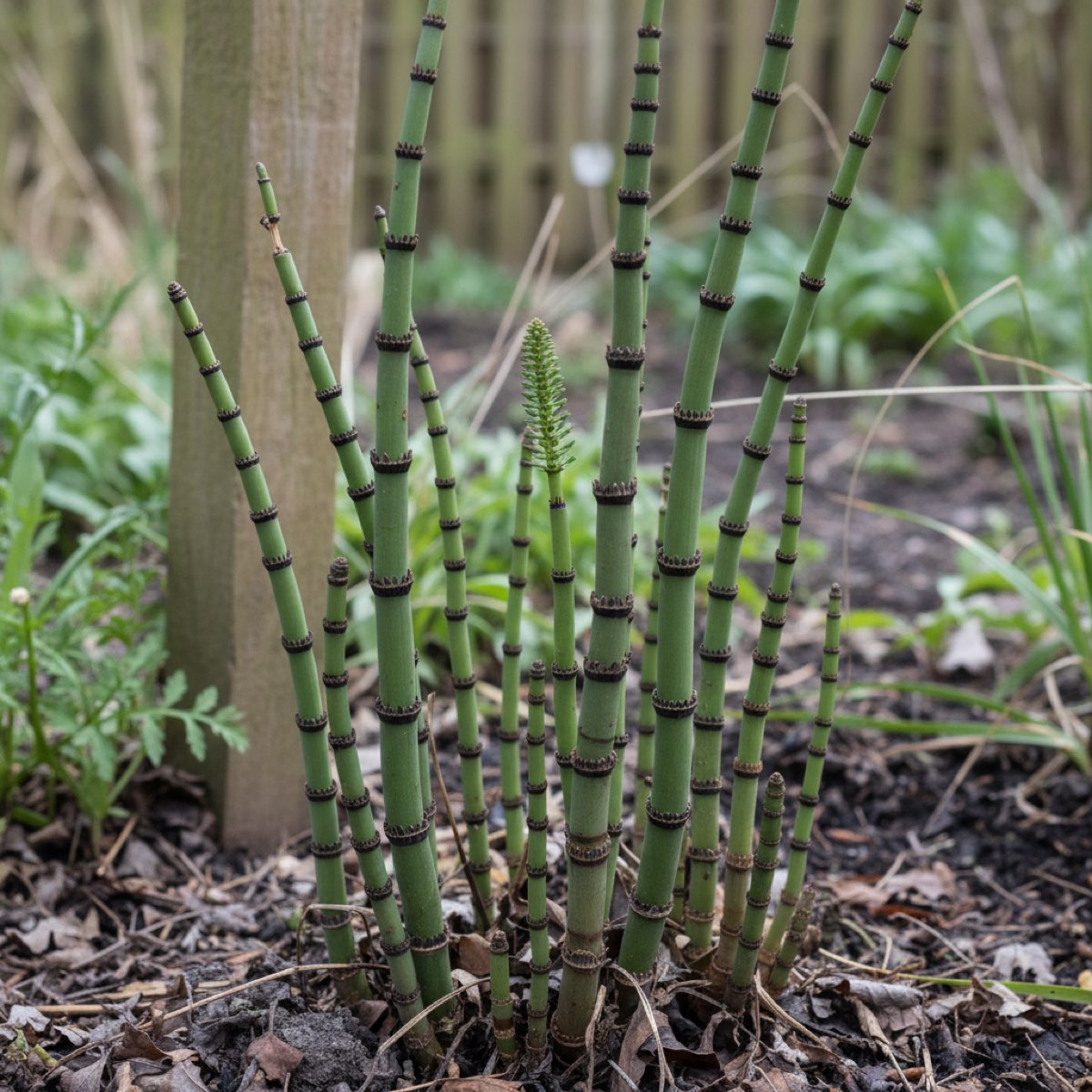
People call it both, and it is one weed: field horsetail. In spring it sends up odd, pale, leafless stalks with a little cone on top, then through summer it turns into the thing everyone recognises, a stiff green stem ringed with fine needles like a bottle brush or a tiny fir tree. It spreads two ways at once, by spores off those early stalks and, mainly, by a creeping root system underground.
If you have searched marestail vs horsetail and come away none the wiser, here is the plain answer. Botanically, true mare’s tail is a different plant altogether: Hippuris, an aquatic weed that grows in ponds and ditches. But almost nobody means that. When someone says “mare’s tail” about the stuff forcing up through the drive, they mean field horsetail, and that is what this resource is about. Same weed, two names.
On a drive or patio you will usually see it coming up through a joint between blocks, along the edge of a slab, or straight out of a crack in tarmac. That is the tell that you are dealing with horsetail and not something softer: it comes up in the same spots, year after year, no matter what you do to the top.
Why it is the hardest weed in the country to kill
Three defences, all working at once: rhizomes about two metres down with the plant's fuel stored in them, stems hardened with silica that shed a water-based spray, and regrowth from the smallest fragment left behind.
Horsetail is a living fossil. It was growing before the dinosaurs, and it has had a very long time to get good at surviving. Three things make it the nightmare it is.
- The roots go down as deep as two metres, some sources say further, and the deepest ones act as food stores. So even when you keep knocking the top off, the plant has a fuel tank buried well out of reach, ready to send up more. A lot of that root sits packed into the top foot or two of ground, which is exactly the layer under your paving.
- The stems are coated in silica, the same stuff as glass. That is why the old country name for it is scouring rush, people used it to scrub pots. That hard, waxy surface sheds water-based weedkiller straight off before it can be taken in, which is the whole reason ordinary spray bounces off it.
- It regrows from the tiniest scrap of root, and the tubers strung along those rhizomes stay viable in the soil for long periods rather than dying back with the stems each autumn. So a piece left behind when you dig is enough to start the whole thing off again, and it does not have to be a big one. The US Forest Service puts the figure at 3cm: a broken segment of rhizome that short will sprout.
What home remedies actually do to horsetail
All of them work on contact. They kill the tissue they physically touch and nothing else, and horsetail keeps its fuel well below anything you can touch. That is the same answer five times over, so here it is one remedy at a time.
Put those three things together and you can see why the usual fixes fail in the same way every time. Whatever you use hits the green on top, the waxy coat sheds most of it, the bit that gets in kills the visible stem, and the deep root shrugs and pushes up a fresh one a few weeks later. You have not killed it. You have pruned it.
Two numbers make the rest of this obvious. Over half the rhizome mass sits in the top 25cm of soil, which already puts it out of reach of anything you pour on. And the tubers, the little food stores strung along those rhizomes that the plant reshoots from, mostly sit below 50cm. That is the depth a treatment has to get to. Hold that in your head and every answer below writes itself.
Does boiling water kill horsetail?
No. A kettle is a contact treatment and nothing more. The extension service at Iowa State puts it as plainly as anyone: boiling water kills only the portion of the plant it comes into contact with, it will not kill roots or other plant parts in the soil, and a plant with an established root system resprouts within days.
What surprises people is how short the reach is. When researchers measured the soil under a hot-water weed treatment, they sank their probes at the surface, at 5mm and at 10mm. Watering the ground at 7.2 litres a square metre, with the water arriving at around 80 degrees, the temperature at 10mm never got above 50 degrees. One centimetre down and the heat had already run out, at a dose far heavier than anything you can tip out of a kettle. The tubers are half a metre further down again.
So it is not that boiling water is a bad idea on horsetail. It is that you are treating the first centimetre of a problem that starts fifty centimetres down. On a young seedling in a joint it genuinely works, and I have said as much in what home remedies do and do not kill. Horsetail is never a young seedling. By the time you can see it, the rhizome under it is years old.
Will bleach kill horsetail?
No, and of everything on this page it is the one I would least like you to try. Bleach is an oxidiser. It wrecks whatever plant tissue it lands on within a day, which is exactly why people believe it is working, and it has no way into the plant and nothing to carry it anywhere once it is there.
One comparison settles it. Roundup ProActive is a professional glyphosate whose own approved label describes it as taken up by foliage and translocated to underground roots, rhizomes and stolons. That is a product engineered to make the journey. The same label then says it will not give an acceptable level of control of horsetail. If the thing built to travel down to the rhizome admits in writing that it cannot finish this plant, a liquid that never leaves the outside of the stem was never in the running.
The Royal Horticultural Society says the same about the whole category: it is not advisable to use household products such as bleach, vinegar or washing-up liquid as pesticides. There is a legal edge to it too. HSE's position is that a product used to control weeds must be authorised or permitted before it can be marketed or used in the UK, and no bleach carries that authorisation. That bites hardest on anyone selling the idea, not on you and your drive, but it tells you what standing the advice has.
Then there is what it does to the drive itself. Taking colour out is the job bleach is designed for, so pigmented blocks and dyed concrete are the surfaces to keep it away from, and it carries a labelled aquatic hazard, which matters on a drive that empties into a gully rather than into soil. All of that, plus the chlorine gas you get from mixing it with anything acidic, is set out properly in my answer on whether bleach kills weeds.
Does salt or vinegar kill horsetail?
No. Both scorch the top and neither moves down inside the plant, so you get the same fortnight of clear-looking paving and the same shoots back through the same joint. Salt then leaves you worse off than you started. It leaches sideways into the sub-base and any soil nearby and sterilises it, and that lasts years, long after the horsetail has grown back through. It reaches your borders. The horsetail does not notice.
Does WD-40 kill horsetail?
No, and this is the one I get asked about most. It is oil. It will not touch the root, and you have poured a petroleum product onto the ground next to your house for nothing. It does the rounds online every summer and it has never worked.
Does covering it over kill horsetail?
Two different answers, and which one you get depends on what you are covering. On a drive or a patio, no. The rhizomes are already underneath the surface you would be covering, so a membrane or a sheet changes nothing for them and the shoots come up through the joints and the edges as before.
On open ground it is a different story, and I would not tell you otherwise just because I sell nothing that does it. The RHS route is cardboard under a layer of organic matter about 20cm thick, or a heavy biodegradable mulch matting, kept covered and topped up for several years. That blocks the light for long enough that the root system eventually dies. It is slow and it takes your border out of use while it happens, but it works, and it is the only thing on this page that does the job without spraying anything.
Whatever you do, don't pull it or dig it up
This is the mistake that turns a patch into an infestation. Pulling snaps the stem and leaves the root, and the root is the plant. Digging it over is worse: you chop that creeping root into dozens of pieces, and every piece is a new plant. People rotavate a bed to get rid of horsetail and end up with ten times as much.
Jet-washing a drive does a smaller version of the same thing. It clears the top and washes the sand out of the joints, opening up the exact gaps the shoots come through, while the root underneath is completely untouched. On paving, scraping and blasting move you backwards.
Horsetail on a driveway, path or patio
The rhizomes live in the sub-base under your blocks or tarmac, well below anything you can get at. That is why re-sanding, sealing and even relaying the surface never finishes it.
Most advice you will find online is about horsetail in a lawn or a border. A drive or patio is a different problem, and in some ways a harder one. The root system sits in the sub-base, the bed of hardcore and sand under your blocks or tarmac, which is a cool, undisturbed reservoir the plant is happy to live in for years. The shoots just find the weak points: a joint, a crack, the gap at the edge of a slab.
That is why the surface fixes people reach for do not hold. Re-sanding the joints, sealing the paving or even relaying it only deals with the top. The root is below all of that, so it comes back up through the new sand, through a membrane, or through the fresh surface. Horsetail will happily exploit and widen a crack that is already there and get into drainage runs, so it is worth sorting rather than living with. The fix has to reach the root, though. Tidying the surface on its own never does it.
It is the same fight on a block-paved driveway as it is breaking through the joints of a patio or path. Of all the hard-surface weeds, this is the one I would never leave to get a hold.
Which weed killer for horsetail? What the labels admit
The honest answer is that no weed killer you can buy finishes horsetail on its own, and two manufacturers say so in their own label text. Roundup ProActive is the professional amenity Roundup, 360 g/L glyphosate, approved for Great Britain under MAPP 21225 on the HSE pesticides register. Its approved label reads: "This product will not give an acceptable level of control of Horsetails (Equisetum arvense) - repeat treatment will be necessary." Barclay's Gallup XL, a different manufacturer's 360 g/L professional glyphosate, carries the same admission about Equisetum arvense.
Read that twice, because it is the most useful sentence on this page. Neither of those is a shop bottle. They are professional concentrates you need a spraying certificate to use, from two of the biggest names in glyphosate, and both tell the operator in writing that the product will not give acceptable control of this one weed. So when a supermarket spray browns your horsetail and it is back a month later, nothing has gone wrong with the product. It did what its professional big brother warns it will do.
Which is why hunting for a stronger bottle is the wrong move on this weed, and why you will not find a shopping list here. The product is not the variable. What changes the result is getting the spray past a stem that is built to shed it, then going back again and again until the deep root runs out of stored energy. If you want the full picture on what a professional glyphosate concentrate does and does not kill, I have been through the labels in my write-up of Gallup weed killer. For horsetail, treat any glyphosate as one pass in a programme rather than a cure. The next section is the method.
What it actually takes to get on top of it
Horsetail is beatable, but not with one hit and not in one go. The professional way round its defences is a systemic weedkiller strong enough to be carried down into the roots, put on with a sticker so it clings to that waxy stem instead of running off, and often the stems knocked or bruised first so the spray has a way in. It goes on when the plant is in full growth and drawing everything downwards, from spring through to late summer, at the stage when the stems are up but still young.
Then you wait. You will see it start to yellow within a week or two, but it takes a month or more for the plant to carry it all the way down, and one treatment is never the end of it. Realistically it is several treatments across two or three seasons, sometimes longer, each one draining a bit more out of those deep food stores until there is nothing left to reshoot. Anyone who tells you a single spray will clear horsetail for good has not dealt with much of it. The mechanism behind why a proper systemic spray works when contact killers don’t is the same for any deep-rooted weed, and I go into it in what actually kills weeds for good.
That long game is exactly why horsetail catches people out. It is not a weekend job you finish, it is a job you keep on top of. Treat it on a rhythm, three passes a year from spring through to late summer, so the plant never gets the run of uninterrupted growth it needs to bounce back.
Do you have to declare horsetail when you sell?
Nothing in law obliges you to volunteer it. If a buyer or their solicitor asks you outright, answer straight, and sort the weed if you want it off the table entirely.
People worry it is like Japanese knotweed. It is not. Knotweed is the one with real legal weight, the one you have to declare on the property information form and can be sued for hiding (here is how to tell the two apart if you are not sure which one you have). There is no specific law that forces you to declare horsetail, and it is nowhere near as destructive.
That said, if a buyer’s solicitor asks the standard questions and you know horsetail is there, the honest answer is to say so. A surveyor who spots it may flag it, and it can make a lender or buyer a little wary because it is a pain to get rid of. Sorting it, or having a treatment plan in place, takes that off the table. That is not legal advice, just how these things tend to go.
What to use on horsetail, and what to expect of it
Horsetail roots run down metres, so nothing finishes it in one season. What beats it is the right product put on properly and kept up over years, and that argues for concentrate on cost alone.
What I’d use
Glyphosate concentrate, 360 g/L
Gallup Home & Garden Glyphosate Weedkiller (1 litre)
The one Gallup a homeowner can legally buy and use: a 1 litre glyphosate concentrate at 360 g/L, approved for home and garden use under MAPP 17672.
It is the same active, the same 360 g/L loading and the same isopropylamine salt as the professional Gallup XL, and its single label rate of 24 ml per litre of water is exactly the rate the professional labels reserve for perennial broad-leaved weeds. What the two labels set apart is the authorisation printed on them rather than the strength, and this is the side of that line you are allowed to stand on.
- Active ingredient
- Glyphosate, 360 g/L, as the isopropylamine salt
- Formulation
- Soluble concentrate you dilute yourself
- Approval
- MAPP 17672, labelled for use only as a home and garden weedkiller
- Mixing rate
- 24 ml per 1 litre of water, per the label
- Coverage
- 40 sq m per litre of made-up spray, so roughly 1,667 sq m per bottle
- Rainfast
- Rain within 6 hours may reduce effectiveness, per the label
- Size
- 1 litre of concentrate
Watch out for
- No measuring cap in the bottle. Check a cup arrives, or the dose is guesswork.
- One re-treatment a season, and it takes four weeks. Do not go again early.
- Not for lawns. It is non-selective and takes the grass too.
- Resellers dominate the listing, so check the label that arrives is Barclay.
- "Super strength" is keyword stacking. It is 360 g/L, same as professional Gallup XL.
That’s an affiliate link: buy through it and I earn a small commission at no extra cost to you. It doesn’t change what I recommend or what I say is wrong with it. More on how that works in the affiliate disclosure.
No brand pays for a mention here, and nothing on this page is a paid-for opinion. The card above is an affiliate link, so I earn a commission if you buy through it, at no extra cost to you. It buys no product a kinder write-up, which is why the watch-outs sit on the same card as the reasons to buy.
About this resource
I’m The Weed Guy, one bloke who’s qualified to use professional weedkiller. This resource reflects how horsetail actually behaves on hard surfaces, not how the product adverts say it behaves.
Straight disclosure: nothing here is a paid-for opinion, no brand sponsors this site, and the product card above carries an affiliate link, so I earn a commission if you buy through it, at no extra cost to you. Horsetail is genuinely the one weed I would steer you away from tackling with a shop bottle, because what beats it is not a stronger product, it is the right product put on properly and kept up over seasons. If you take one thing from this page, take that.
Common questions
Are mare's tail and horsetail the same plant?
For a driveway or garden, yes, treat them as one and the same. The weed people call mare's tail on a drive or in a border is field horsetail (Equisetum arvense). Strictly, true mare's tail is a different, aquatic plant (Hippuris) that grows in water, but almost nobody means that one. Two names, same tough weed.
How deep do horsetail roots go?
The root system, properly called the rhizomes, can run as deep as two metres, and some sources say further. The deepest parts act as food stores, which is why knocking the top off never finishes it: the plant just draws on that buried reserve and sends up more. A lot of the root also sits in the top foot or two of ground, the same layer as the sub-base under your paving.
Does boiling water kill horsetail?
No. Boiling water acts on contact: it kills the bit of plant it physically lands on and nothing in the soil, and anything with an established root system puts up new shoots within days. Horsetail keeps its rhizomes as deep as two metres, so the kettle never gets near the part that matters. It is free and it is harmless to your paving, which is why people keep at it. On this weed it is pruning.
Will bleach kill horsetail?
No. Bleach works on contact and travels nowhere inside the plant, so the rhizome never sees it. Set that against what it is up against: a professional glyphosate that IS carried down into roots and rhizomes still states on its own approved label that it will not give acceptable control of horsetail. Bleach also takes the colour out of pigmented block paving, and it carries a labelled aquatic hazard, which matters on a drive that drains to a gully.
Does salt or vinegar kill horsetail?
No, and salt leaves you with a second problem. Both scorch whatever they touch and neither moves down inside the plant, so the shoot dies and the rhizome does not. Salt then leaches sideways into the sub-base and the soil around it and sterilises the ground for years, which reaches your borders long after the horsetail has grown back through the joint.
Does WD-40 kill horsetail weed?
No. It is an oil, it does not reach the root, and it just leaves a petroleum product in the ground by your house. This one does the rounds online and it does not work.
How do you get rid of horsetail naturally?
Slowly, and it is a real option if you have the patience for it. The RHS route is cultural: pull or cut every green stem as it appears, fork the rhizomes out regularly, shade it out with dense shrub planting because it wants an open sunny spot, and mow it where it has come up in a lawn. On open ground, cardboard under about 20cm of organic matter, kept covered and topped up for several years, blocks the light until the root system dies. None of that is available on a driveway, where the rhizomes sit under the paving and you cannot get at them.
Why does it keep coming back after I spray it?
Because the spray only killed the top. The root goes down as far as two metres and stores enough energy to send up fresh shoots again and again. Until enough of that deep root is worn down over repeated treatments, it will keep returning.
Is there anything that actually kills horsetail?
Yes, but not in one go. A professional systemic weedkiller, applied so it gets through the waxy coat and repeated over several seasons, wears the root system down until it stops reshooting. Nothing off a shop shelf, and nothing you pour on once, will do it.
What is the best weed killer for horsetail?
The ones that work are professional-grade systemic products designed to be carried down into the roots, usually put on with a sticker so they cling to the stem. Home-garden bottles are generally too weak and get shed by the waxy coat. It is as much about how and when it goes on as which one it is.
Does Roundup kill horsetail?
Not on its own, and the label says so. Roundup ProActive, the professional amenity version at 360 g/L glyphosate under MAPP 21225, states in its approved label text that it will not give an acceptable level of control of horsetails (Equisetum arvense) and that repeat treatment will be necessary. Home-garden Roundup is weaker again. Glyphosate is still the active worth using on horsetail, but treat any spray as one pass in a long programme rather than the answer.
Can horsetail damage my driveway or patio?
It will not split sound concrete, but it will push up through a joint, a crack or the edge of a slab, widen gaps that are already there, and get into drainage. It is worth dealing with rather than leaving to spread.
Do you have to declare horsetail when selling a house?
It is not Japanese knotweed, so there is no specific law forcing you to declare it. But if you are asked on the property information form and you know it is there, you should answer honestly. A surveyor may flag it. Having it treated, or a plan in place, settles the question. Not legal advice.