How to get rid of ivy
Ivy on a wall, fence or driveway boundary is a different fight to ivy in a border. Here's why home remedies barely touch it, whether it's actually damaging the brick or the timber underneath, what really works, and the straight answer on the neighbour's-ivy and does-it-devalue-a-house questions that come up every time.
By The Weed GuyLast updated
The short version
Mature ivy has a waxy leaf coating that sheds most weedkiller sprays before they can be absorbed, which is why the shop-bottle approach usually just browns a few leaves and leaves the plant alive. The method that actually finishes it: cut the stem near the base, then either paint concentrated glyphosate straight onto the fresh cut or simply let the growth above die back and strip away, before digging out the stump so it can’t regrow. Vinegar and other home remedies scorch what they touch and nothing more.
What actually gets rid of ivy, and what just wastes an afternoon
The honest test for any method is the same one that applies to every weed on this site: does it reach the root, or does it just deal with the leaf?
| Method | Kills it? | What actually happens |
|---|---|---|
| Pulling or tearing it off while it’s alive | No, and it wrecks what’s underneath | Living ivy grips hard with its aerial roots. Force it off and you tear paint, render or loose mortar away with it. |
| Vinegar spray | No, not on ivy this size | Vinegar burns the leaf on contact and does nothing to the roots, so mature ivy regrows within weeks. |
| Weedkiller sprayed on the leaves | Rarely | Mature ivy leaves are coated in a waxy layer that sheds most water-based spray before it can be taken in. |
| Glyphosate painted onto a freshly cut stem | Yes | Cutting the stem and applying it straight to the cut bypasses the waxy leaf altogether and gets it into the plant. |
| Cutting the stem low and leaving it to die back | Yes, then it strips off easily | Starves the aerial-root grip. Wait for it to dry out and it comes away with a fraction of the force. |
| Digging out the stump | Yes, for that plant | Cutting alone leaves a living stump that regrows. Only removing the stump finishes it. |
| Covering it with a membrane | No, not on a climber | Works on some ground weeds. Does nothing to ivy that’s already gripping a wall or fence. |
Does ivy actually damage a wall, fence or driveway?
This is the question worth answering properly, because the honest answer is more nuanced than either "it's fine" or "get it off now". The Royal Horticultural Society is direct about it: ivy’s aerial roots are “unable to bore into sound masonry”, so on brick or render that’s in decent condition, a covering of ivy is largely cosmetic, and can even help keep a wall dry. What it will do is find and exploit cracks and gaps that already exist, widening them as it grows, and mature, branching growth adds real weight, which becomes a genuine risk on an older house with shallow foundations in exposed, windy conditions.
Fences get less attention from the official advice, but the same logic applies: a timber fence in good condition is at far less risk than one that’s already damp or rotting at a joint, and the RHS’s own guidance is to work carefully rather than assume damage is inevitable. The bit almost nobody says out loud: the RHS is explicit that most real damage happens during removal, not from the ivy growing there. “The process of removing ivy can itself cause damage, pulling away paint and loose mortar” when it’s ripped off with force while still alive and gripping.
There’s one more thing worth knowing before you decide it’s harmless: a dense covering can hide damp, cracked pointing or rot underneath that you genuinely can’t assess until it’s cut back. That matters more than the ivy itself, and it’s the real reason a surveyor might flag a heavily ivy-covered wall.
Why weedkiller so often does nothing to ivy
If you’ve sprayed ivy and watched it shrug it off, there’s a real mechanical reason, not bad luck. Mature ivy leaves are glossy and coated in a waxy layer built to shed water, which is exactly what a water-based weedkiller is. Most of what you spray runs straight off before the plant can take any of it in. It’s the same defence mechanism that makes horsetail’s silica-coated stems shed spray, different plant, same problem.
There is a real fix, and it isn’t “spray it again, stronger”. Cut each stem near ground level, then paint concentrated glyphosate directly onto the freshly cut surface, ideally within a few minutes of cutting, while the cut is still fresh and open. That delivers the herbicide straight into the plant’s system through the cut, bypassing the waxy leaf entirely. It is the same cut-stem principle used on stubborn woody growth generally, and it is dramatically more reliable on ivy than any amount of leaf spraying.
If you are spraying the leaves regardless, new spring growth is your best shot: young spring leaves haven’t built up the full waxy coating yet, so they take up spray far more readily than the mature, leathery leaves you’ll find by summer.
Does glyphosate kill ivy, and which weedkiller should you actually buy?
Glyphosate does kill ivy. Hardly anybody applies it in a way that gets it into the plant, which is why so many people end up deciding it does not work.
The chemical isn’t the problem here, the delivery is. Glyphosate is systemic: it has to be taken in through green tissue and carried down to the root before it does anything at all, and a mature ivy leaf is built to shed water. Sprayed at an established wall of it, most of what you put on runs off. The same bottle, the same active, painted onto a stem you have just cut, goes straight past the leaf and into the plant. So “will glyphosate kill ivy” has two honest answers depending on how you use it: sprayed over mature leaf, usually not; delivered through a fresh cut, yes.
That changes what is worth buying, and the numbers on the pack make the point better than I can. A ready-to-use trigger bottle is made for wetting soft growth, and it is dilute by design: Roundup Fast Action ready to use carries 7.2 grams of glyphosate per litre (MAPP 18679) and Resolva Weedkiller 24H 8.39 grams (MAPP 18921). An amateur concentrate you dilute yourself is a different animal, and Roundup Ultra is 360 grams of glyphosate acid per litre (MAPP 18850), fifty times the strength in the trigger bottle before a drop of water goes near it. If ivy is the job, the concentrate is the buy, and the mixing arithmetic is worked through separately because getting the dilution wrong is the most common way people waste a bottle.
One thing I would rather flag than gloss over: the amateur glyphosate labels I have read give rates for spraying an area, not an instruction for painting a cut surface, so read what the bottle in your hand actually authorises before you use it that way. What the forestry guidance is clear about, and it holds whatever you paint on, is speed and placement. Many woody plants seal off their vascular tissue soon after they are cut, so a water-based treatment wants to be on within about five minutes, and the part that matters is the outer ring of the cut just inside the bark. That is the tissue carrying anything down to the roots. The middle of the stump is dead wood and does nothing with it.
The other half of the answer is triclopyr, and it is worth knowing which job it is for. SBK Brushwood Killer is a home-garden approved concentrate carrying 48 grams of triclopyr per litre (MAPP 12711), and unlike glyphosate it takes broadleaved and woody growth out while leaving grass standing. Its label also carries an explicit cut-surface instruction, equal volumes of product and water painted over all surfaces of a cut stump down to soil level, and the HSE approval lists stumps among its authorised areas. Be straight about the limit though: the pack names brambles, nettles, dock, tough weeds, woody weeds and hardwood saplings, and ivy is not on that list. Where it earns its place is ivy running through rough grass, a hedge bottom or a bank you want to keep green. On a wall or a fence panel there is nothing green to spare, so the selectivity buys you nothing and glyphosate costs less. How a synthetic auxin actually works, and what that label does and doesn’t authorise, is set out on its own page.
The right way to take it off a wall or fence
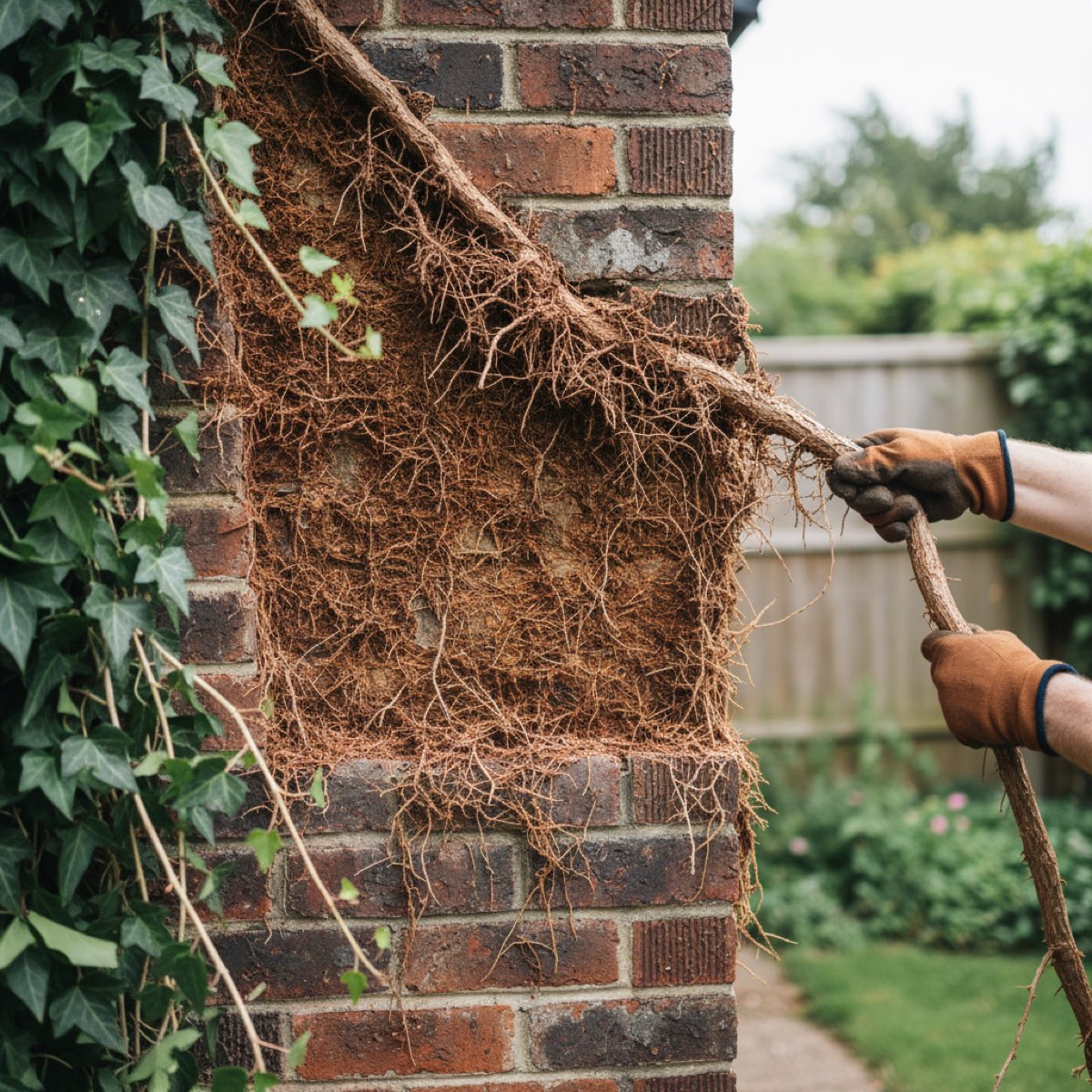
Don’t rip a wall of living ivy off in one go. Start with the outermost stems, which are the most strongly attached, and cut and peel them away with secateurs or loppers, working slowly rather than pulling large sections off by force. Living ivy is under tension and actively gripping; tear it off while it’s alive and you take paint, render or loose mortar with it.
The better sequence, especially on anything you care about behind it: cut the stems near the base first and leave the top growth to die where it is. As it dries out over the following weeks, the aerial-root grip weakens along with it, and what was once gripping hard enough to lift masonry will strip away with a fraction of the force. Once the stem’s dealt with, dig out the stump. Cutting alone leaves a living root system that will simply throw up new growth.
Worth knowing before you start: ivy sap contains a compound called falcarinol that can cause a skin reaction similar to a mild poison-ivy rash in some people, particularly after extended contact cutting stems or handling roots. Gloves are a sensible precaution.
Does vinegar actually kill ivy?
No, not in any way that finishes the job. Household vinegar is an acetic-acid contact treatment: it burns and desiccates the leaf tissue it directly touches, but it doesn’t move down into the root system the way a systemic weedkiller does. University extension research on vinegar as a weedkiller is consistent that it can work on very young seedling growth at high concentrations, but a mature, established perennial climber with an extensive root network is exactly the profile it fails against: the top might wilt and discolour, then regrow within a week or two because the roots were never touched.
It also won’t save you the actual work. Even a successful vinegar scorch still leaves dead-looking leaf on the wall or fence, which you then have to strip off by hand anyway, so at best it’s a cosmetic head start on a job you were always going to do yourself.
Ivy on a driveway, path or patio boundary
Most advice you’ll find on ivy is written for trees, hedges or general garden groundcover. Around a driveway, path or patio it behaves a little differently. It rarely comes up through a hard surface the way horsetail or bindweed do, but it climbs the boundary the surface sits against: a garden wall, a fence panel, a gatepost, and creeps along the ground at the edge of the paving into gravel and planted borders alongside it.
The practical problem on a hard surface is less about the paving itself and more about what the ivy is holding onto. A fence panel with ivy woven through the boards traps moisture against the timber and is genuinely harder to inspect and treat for rot until the growth comes off. A retaining wall or boundary wall with mature ivy needs the same masonry check as any other wall: sound pointing, no real risk; loose or cracked pointing, worth clearing the ivy back before it gets worse.
If it’s spreading along the ground at the edge of your paving rather than climbing, treat that section like any other ground weed: cut it back hard, then spray or dig the regrowth, rather than trying to pull an established mat of it up in one go.
The neighbour's ivy coming through your fence
This one has a real legal answer behind it. English law has long recognised that a landowner can cut back branches and roots that encroach from a neighbour’s property, back to the boundary line, without asking permission first and without giving notice. The principle goes back to a House of Lords case, Lemmon v Webb, and it treats an encroaching plant as a nuisance you’re entitled to abate yourself, covering roots as well as growth above ground.
The limit matters just as much as the right: you can only cut back to your side of the boundary. Reaching over the line, or going onto their property to do the work, is trespass, however annoying their ivy is. Strictly, the cuttings remain your neighbour’s property, so the tidy approach is to offer them back rather than just bin them. None of this is legal advice, only the general shape of a long-established legal principle.
Does ivy devalue a house?
Worth being straight about this one: there’s no RICS guidance or lender valuation criteria that names ivy itself as a factor that reduces a property’s value. It doesn’t appear to be a real, sourced rule, more a thing people repeat.
What’s real, and almost certainly where the idea comes from, is the masking problem covered above: a dense covering can hide damp, cracked pointing or timber rot that a surveyor needs to see to do their job properly. If a surveyor flags a heavily ivy-covered wall, it’s not the ivy itself knocking money off, it’s that they can’t rule out what might be underneath it until it’s cut back. Clear it before a sale, or before a survey, and that particular question goes away.
Ivy is not Japanese knotweed
If any of the "dangers" framing around ivy has you worried it’s something more serious, it isn’t. Japanese knotweed sits on Schedule 9 of the Wildlife and Countryside Act 1981 as a non-native invasive species, with real legal weight attached: mortgage-form questions, disposal rules, the lot. Ivy (Hedera helix) is a UK native plant and carries none of that. If you’re not sure which one is actually on your wall, here’s how to tell Japanese knotweed apart from its lookalikes.
What to spray ivy with
The waxy leaf on established ivy is the reason a weak mix runs straight off it. Buying concentrate lets you mix at the label's own full rate rather than whatever a ready-to-use bottle decided for you.
What I’d use
Glyphosate concentrate, 360 g/L
Gallup Home & Garden Glyphosate Weedkiller (1 litre)
The one Gallup a homeowner can legally buy and use: a 1 litre glyphosate concentrate at 360 g/L, approved for home and garden use under MAPP 17672.
It is the same active, the same 360 g/L loading and the same isopropylamine salt as the professional Gallup XL, and its single label rate of 24 ml per litre of water is exactly the rate the professional labels reserve for perennial broad-leaved weeds. What the two labels set apart is the authorisation printed on them rather than the strength, and this is the side of that line you are allowed to stand on.
- Active ingredient
- Glyphosate, 360 g/L, as the isopropylamine salt
- Formulation
- Soluble concentrate you dilute yourself
- Approval
- MAPP 17672, labelled for use only as a home and garden weedkiller
- Mixing rate
- 24 ml per 1 litre of water, per the label
- Coverage
- 40 sq m per litre of made-up spray, so roughly 1,667 sq m per bottle
- Rainfast
- Rain within 6 hours may reduce effectiveness, per the label
- Size
- 1 litre of concentrate
Watch out for
- No measuring cap in the bottle. Check a cup arrives, or the dose is guesswork.
- One re-treatment a season, and it takes four weeks. Do not go again early.
- Not for lawns. It is non-selective and takes the grass too.
- Resellers dominate the listing, so check the label that arrives is Barclay.
- "Super strength" is keyword stacking. It is 360 g/L, same as professional Gallup XL.
That’s an affiliate link: buy through it and I earn a small commission at no extra cost to you. It doesn’t change what I recommend or what I say is wrong with it. More on how that works in the affiliate disclosure.
No brand pays for a mention here, and nothing on this page is a paid-for opinion. The card above is an affiliate link, so I earn a commission if you buy through it, at no extra cost to you. It buys no product a kinder write-up, which is why the watch-outs sit on the same card as the reasons to buy.
About this resource
I’m The Weed Guy, one bloke who’s qualified to use professional weedkiller. This resource is built around what actually works on ivy attached to a wall, fence or boundary, cross-checked against the RHS’s own published guidance and real UK case law on the neighbour question, not the vague "dig it out" advice most sites stop at.
Straight disclosure: nothing here is a paid-for opinion, no brand sponsors this site, and the product card above carries an affiliate link, so I earn a commission if you buy through it, at no extra cost to you.
Common questions
Does vinegar kill ivy?
Not established ivy, no. Vinegar is a contact treatment: it burns whatever leaf it touches and desiccates it, but it doesn’t move down into the roots. University extension research on acetic-acid weedkillers is consistent on this, and mature ivy has an extensive root and stem network that simply regrows after the leaves it touched scorch. It might cosmetically brown a few leaves. It won’t finish the plant.
Does ivy actually damage my wall or fence?
It depends on the state of what it’s growing on. The RHS is clear that ivy’s aerial roots "are unable to bore into sound masonry", so on a wall with good pointing it’s largely cosmetic, and can even help keep a wall dry. The real damage happens two ways: the roots exploit cracks and gaps that already exist and widen them, and mature growth adds real weight that can be a problem on old, shallow-founded walls in high wind. Most actual damage, per the RHS, happens when someone rips it off by force, not from it growing there.
What kills ivy permanently?
Removing the roots, one way or another. Either dig out the stump once you’ve cut the stems back, or cut the stem low and paint concentrated glyphosate directly onto the fresh cut, which gets it into the plant’s system without relying on the leaf absorbing anything. Spraying the leaves alone is the method most likely to disappoint you, because the waxy coat sheds most of what lands on it.
What is the best time of year to remove ivy?
For cutting it back, check for nesting birds first: UK nesting season generally runs March to August, so late autumn through winter is the safer window to cut. If you’re going the chemical route on the leaves rather than the cut stem, spring is your best shot, because new spring growth hasn’t built up the full waxy coating that mature leaves have and takes up spray more readily.
How do I stop my neighbour’s ivy coming through my fence?
You’re entitled to cut it back yourself to your side of the boundary, without asking permission first. That right comes from a long-standing legal principle (Lemmon v Webb) that lets a landowner cut back encroaching branches and roots to the boundary line from their own land. The limit is real, though: you can’t go onto their property or reach over the line to do it, and the cuttings are technically still theirs to offer back rather than just bin. This isn’t legal advice, just the general shape of the law.
Does ivy devalue a house?
No source actually backs that up directly, and it’s worth being straight about that. There’s no RICS or lender guidance that names ivy itself as a devaluing factor. What’s real, and probably where the idea comes from, is that a thick covering can hide damp, cracked pointing or rot that a survey needs to see, so a surveyor may flag the property until it’s cut back and the wall underneath can be properly checked. It’s not the ivy costing you money. It’s what might be hiding behind it.
Is ivy treated like Japanese knotweed legally?
No, and it’s worth not conflating the two. Japanese knotweed sits on Schedule 9 of the Wildlife and Countryside Act 1981 as a non-native invasive, with real disposal rules and mortgage-form questions attached. Ivy is a UK native and carries none of that legal weight. If you’re not sure which one you’re actually looking at, here’s how to tell Japanese knotweed apart from the plants people confuse it with.
Will glyphosate kill ivy?
Yes, if you can get it into the plant, and that is the whole difficulty. Glyphosate is systemic, so it has to be absorbed through green tissue and carried down to the root before it does anything, and a mature ivy leaf is built to shed water. Sprayed at established growth it largely runs off, which is why so many people conclude the stuff is useless on ivy. Painted onto a stem you have just cut, it bypasses the leaf entirely and goes in. Don't expect anything quick either: an amateur glyphosate label puts effects at one to four weeks, so a bit of browning on day two means something scorched the surface, not that the root is dead.
What is the best weedkiller for ivy?
It depends on what is growing round it, and there are really only two answers. On a wall, a fence panel or a gatepost, where nothing green needs sparing, a plain glyphosate concentrate is the pick: an amateur concentrate like Roundup Ultra carries 360 g/l glyphosate acid (MAPP 18850) against roughly 7 to 8 g/l in a ready-to-use trigger bottle, and the cut-stem method wants the strong stuff rather than a dilute spray. Where ivy is running through rough grass, a hedge bottom or a bank you want to keep, triclopyr is the selective option: SBK Brushwood Killer is 48 g/l triclopyr approved for home garden use (MAPP 12711) and leaves grass standing. Its label names woody weeds and hardwood saplings rather than ivy specifically, which is worth knowing before you buy it for this job. here is how triclopyr works and what its label actually authorises.
Can removing ivy hurt my skin?
It can, and it’s not commonly mentioned. Ivy sap contains a compound called falcarinol, which can cause a rash on some people similar to a mild poison-ivy reaction, particularly if you’re cutting stems or handling roots for a while. Gloves are a sensible precaution for anything more than pulling off a few strands.