The Best Tool for Weeding Block Paving and Patios
A weeding knife, a long-handled weeder and a powered rotary brush all work the same joints at very different speeds, and the joint is narrower than most of these tools are. Here's what actually gets down inside a block paving joint, what only clears the top of it, and the honest trade-off a wire brush makes with your jointing sand.
By The Weed GuyLast updated
The short version
A block paving joint is 2 to 5mm wide. A weeding knife blade goes down into that and cuts the root out. A powered weeder brush is 8 to 15mm thick, so it works across the mouth of the joint, clearing seedlings, moss and debris fast over a whole drive while leaving anything properly rooted. Use the brush for speed and the knife for the joints that matter, then spray, because neither of them finishes the job on their own.
Block paving weeding tools compared
Match the tool to the area and to the joint, not to the price. A weeding knife on a full drive is an afternoon lost; a powered brush on three joints is overkill.
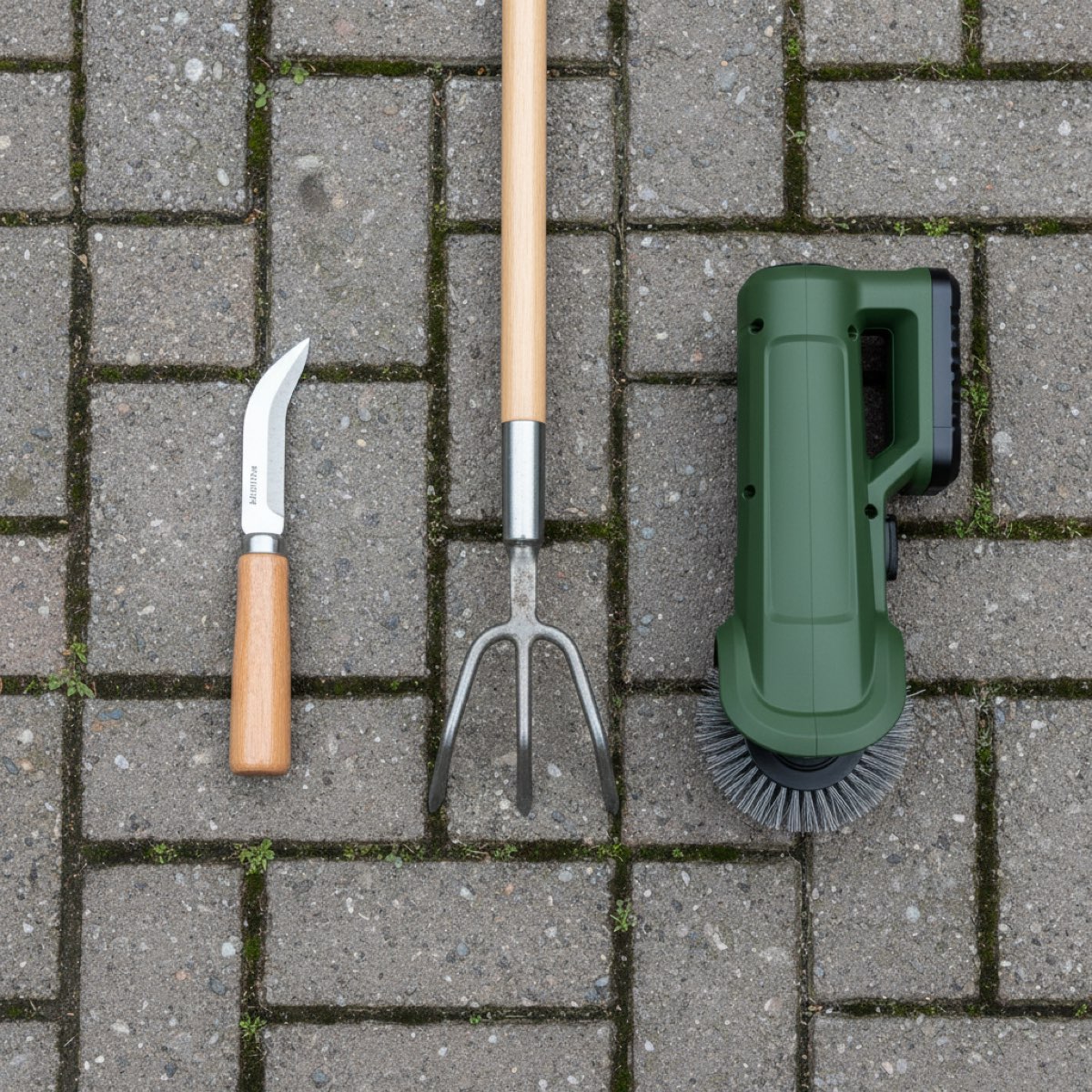
| Tool | Best on | Gets into the joint? | The catch |
|---|---|---|---|
| Weeding knife or crevice tool | A block paving drive, and any joint too narrow for anything else | Yes. The blade goes down the joint and cuts the root out | Slow. Dragging a hand blade down every joint of a full drive is a kneeling afternoon. |
| Long-handled standing weeder | The same joints, done regularly, without kneeling | Yes, one joint at a time | Still hand-powered. It saves your back, not your afternoon. |
| Cordless or corded rotary brush | A whole drive or patio cleared in one session | No. The brush disc is wider than a block paving joint | Clears seedlings, moss and debris off the mouth of the joint, and drags jointing sand out with them. |
| Pressure washer | A patio or drive that needs the whole surface doing anyway | No. It strips the joint instead of the root | Takes the jointing sand out with the weeds, so re-sanding is part of the job, not an optional extra. |
| Long-handled soil weed puller | Rooted weeds in soil, turf and borders. Not paving joints | In open ground, yes. On paving, it never gets hold of anything | The right tool a few feet away and the wrong one here. Its claws need open ground on every side of the stem. |
Why a powered weeder brush rides over a block paving joint
Two numbers decide this job, and only one of them is on the box.
Block paving is laid to a joint you can measure. BS 7533-3, the British Standard for it, allows a maximum joint width of 5mm and reckons on 2 to 5mm; in practice, with blocks that carry spacer nibs, the typical minimum lands nearer 3mm. That is the gap every tool on this page has to work in.
Now put a powered weeder against it. The VonHaus Cordless Weed Remover ships with three brush heads, and the listed thickness of the discs is 8mm steel, 15mm steel and 8mm nylon. The thinnest of those is still wider than the widest joint the standard allows. The brush body cannot go into the joint at all. It runs across the mouth of it, and only the tips of the bristles flex down inside.
That matches what the brush is actually for. The RHS description of a paving brush is a tool with angled wire bristles for scrubbing mosses, weed seedlings and debris out of cracks and joints. Seedlings and debris. Not a rooted weed that has been in the joint since spring. Its own advice on a weeding knife is the opposite: run the blade along the crack to sever the roots and lever the weed out.
So the cheapest tool on this page is the only one that gets into a block paving joint, and the most expensive one is the fastest at clearing what is sitting on top of it. Both of those are true at once, which is why people buy a powered weeder, use it, and find the same joints green again a few weeks later.
| Surface | Typical joint | What gets into it | What that rules out |
|---|---|---|---|
| Concrete block paving | 2-5mm, usually nearer 3mm | A knife blade, and the tips of a wire bristle | No brush disc goes in. It works across the top of the joint. |
| Slabs pointed with mortar | 6mm minimum for a mortar joint | A blade, a narrow chisel, bristle tips | Wider, so a powered brush does more real work here than on a drive. |
| Slabs jointed with resin compound | 3mm minimum wide, 25mm minimum deep | Nothing abrasive. The compound is the joint | A wire brush removes the jointing along with the weed. |
| Gravel | No joint at all | A hoe blade, slid under the surface | A knife and a brush both have nothing to work on. |
Block paving widths from BS 7533-3. Mortar joint minimum as normally specified. Resin compound minimums are the manufacturer's, for EASYJoint. Gravel from the RHS hoeing method.
Hand tools, long-handled weeders, and the weed puller that does not work here
A weeding knife or crevice tool, a narrow blade you drag along the joint, is the cheapest and most precise option, and on block paving it is the one that actually reaches something. It just does not scale: dragging a hand blade down every joint of a full driveway is a slow, kneeling job. Buy one for the joints that keep coming back, not for the whole drive.
A long-handled standing weeder does the same cut from a standing position, usually with a stirrup-shaped or serrated head you push and twist into the joint. It suits someone doing this regularly and wanting to stay off their knees, but it is still one joint at a time, just without the back strain.
One more tool gets recommended in the same breath as those two and does not belong on a drive at all: the long-handled weed puller, the sort with four claws and a foot pedal. It is a soil tool, and the difference is in the mechanics. A weeding knife scrapes. You drag a blade down the joint and lift out the sand, the debris and the shallow rooting sitting in it. A puller grips. You stand the head over the crown, put your foot on the pedal to drive the claws into open ground all round the plant, then lever the handle back so they close on the root and bring it up whole.
That second action needs two things a drive cannot give it: room to go in, and firm ground either side to lever back against. The Fiskars Xact, the model most people mean when they say weed puller, is listed as handling weeds up to about 4cm across, so the claws have to open wider than that and enter the ground on every side of the stem. A block paving joint is a fraction of that, and what sits under the sand is compacted sub-base, not soil. The claws stay on the surface with nothing to close on. That is not a mark against the tool. It is the only one of these that takes the root with it instead of tidying the top, which is the standard everything on this site gets judged by, and it meets that standard when it is lifting a dandelion out of a border or a lawn. It cannot meet it on paving, because there is no plug of ground to lift out.
Electric and cordless patio weeders, and the pressure washer question
A powered rotary brush is the fastest way to clear a whole drive, patio or pavement in one session. A spinning wire or nylon head sweeps growth, moss and loose debris off the joints as you walk it along. Two named products give a sense of what is actually on the market. The VonHaus Cordless Weed Remover spins at a listed 1,200 RPM and ships with three heads, an 8mm steel for tighter joints, a 15mm steel for wider gaps and an 8mm nylon, on a telescopic shaft at 97cm. The Lazy-Weeder Electric Weed Sweeper runs a 400W mains motor turning a 110mm brush, supplied in both wire and nylon, the wire for brick, concrete and paving slabs and the nylon for softer stone like sandstone. It weighs 2kg on an adjustable aluminium shaft from 94cm to 122cm, with a 10 metre lead.
Pick the head for the stone, not for the weed. Steel marks sandstone and other soft paving, which is the whole reason both tools supply a nylon option. Test it on a corner nobody looks at before you run it down the length of a patio.
The honest trade-off: a wire brush clears growth by abrasion, and that same abrasion drags jointing sand out of the joint a little with every pass. Marshalls' own maintenance guidance puts it plainly, that sand removed during weed removal should be replaced as soon as the surface is clean, because partially filled or empty joints are bad for the pavement itself. So a powered brush is not free. It costs you a bag of kiln-dried sand and the time to brush it back in, and it is still quicker than doing a whole drive on your knees.
A pressure washer is the same bargain, worse. It takes weeds, moss and sand out of the joint together. Marshalls advise holding the lance at an oblique angle, at least 200mm off the surface, on medium pressure and sprayed diagonally at 30 degrees, because not doing that can break up the jointing material and leave you needing to re-sand. As a weeding tool it strips the joint rather than the root, so the weed returns to an emptier joint than it started in. What to put back, and whether to go kiln-dried or polymeric, is covered on stopping weeds in block paving and gravel.
What I'd actually buy
Every tool on this page clears the joint. None of them touches what is rooted in it, which is why a brushed drive is green again by August. That half of the job is a root-kill, and it wants a concentrate.
What I’d use
Glyphosate concentrate, 360 g/L
Gallup Home & Garden Glyphosate Weedkiller (1 litre)
The one Gallup a homeowner can legally buy and use: a 1 litre glyphosate concentrate at 360 g/L, approved for home and garden use under MAPP 17672.
It is the same active, the same 360 g/L loading and the same isopropylamine salt as the professional Gallup XL, and its single label rate of 24 ml per litre of water is exactly the rate the professional labels reserve for perennial broad-leaved weeds. What the two labels set apart is the authorisation printed on them rather than the strength, and this is the side of that line you are allowed to stand on.
- Active ingredient
- Glyphosate, 360 g/L, as the isopropylamine salt
- Formulation
- Soluble concentrate you dilute yourself
- Approval
- MAPP 17672, labelled for use only as a home and garden weedkiller
- Mixing rate
- 24 ml per 1 litre of water, per the label
- Coverage
- 40 sq m per litre of made-up spray, so roughly 1,667 sq m per bottle
- Rainfast
- Rain within 6 hours may reduce effectiveness, per the label
- Size
- 1 litre of concentrate
Watch out for
- No measuring cap in the bottle. Check a cup arrives, or the dose is guesswork.
- One re-treatment a season, and it takes four weeks. Do not go again early.
- Not for lawns. It is non-selective and takes the grass too.
- Resellers dominate the listing, so check the label that arrives is Barclay.
- "Super strength" is keyword stacking. It is 360 g/L, same as professional Gallup XL.
That’s an affiliate link: buy through it and I earn a small commission at no extra cost to you. It doesn’t change what I recommend or what I say is wrong with it. More on how that works in the affiliate disclosure.
No brand pays for a mention here, and nothing on this page is a paid-for opinion. The card above is an affiliate link, so I earn a commission if you buy through it, at no extra cost to you. It buys no product a kinder write-up, which is why the watch-outs sit on the same card as the reasons to buy.
Clearing what's there vs stopping it coming back
Every tool on this page does the same fundamental job. It removes what is visible above the joint. None of them reliably reaches a root sitting below the sand line, so a weed cleared by knife, long-handled weeder, brush or jet washer can regrow from the same spot within weeks.
There are two honest ways out of that, and only one of them is quick. The slow one is persistence: the RHS position on a joint too narrow to clear properly is that repeated removal of the top growth will weaken a weed and may eventually kill it. That works, and it means going over the same drive every few weeks all season, every season, because you are starving the root rather than killing it.
The quick one is to clear the joints mechanically first, so the leaf that regrows is fresh and accessible, then spray a systemic weedkiller so it is taken in through the leaf and carried down to the root. Marshalls describe the same split on their own paving: a contact weedkiller kills what it touches, a systemic one is slower but absorbed and taken into the whole plant. Concentrations, rates and worked examples for a knapsack tank are on glyphosate concentrate strengths and mixing rates, and which product suits a hard surface is on weed killer for driveways and patios.
About this resource
I’m The Weed Guy, one bloke who’s qualified to spray professional weedkiller. What I know first hand is what mechanical clearing does and does not achieve on a hard surface, and that is the part of this resource I am writing from experience.
The named tools are a different matter, and it is worth being straight about the basis. This is not a comparison test. Nothing here has been tested against anything else. Every figure on the VonHaus, the Lazy-Weeder and the Fiskars is the published specification for that model, read against what a 2 to 5mm joint actually needs, and where owners are quoted it is what buyers report rather than anything I have measured. The joint widths, the re-sanding guidance and the RHS method are all linked to their sources so you can check them yourself.
Common questions
What is the best tool for removing weeds from block paving?
A weeding knife, and the reason is the size of the gap. A block paving joint is 2 to 5mm wide, usually nearer 3mm, and a knife blade is the only tool here thin enough to run down inside it and cut the root out. A long-handled weeder makes the same cut from standing. A powered rotary brush is far faster over a whole drive, but its brush disc is 8 or 15mm thick, so it works across the mouth of the joint rather than down in it: it takes off seedlings, moss and debris and leaves anything properly rooted. Brush the drive by all means, then spray, or the same joints are green again by August.
What type of brush can I use to remove weeds between pavers?
A paving brush with angled wire bristles is the right shape, on a broom handle or on a motor. Wire suits brick, concrete and standard block paving; a nylon brush is the one for sandstone and softer stone, because steel marks them. What no brush does is get down inside a block paving joint, because the head is wider than the gap. It clears the mouth of the joint, which is worth doing before you spray, and it is not the same thing as removing the weed.
Is a patio weeder the same as a block paving weeder?
Not really, and the joint is why. A block paving joint is 2 to 5mm. A mortar joint between slabs is 6mm at the very least, and a slab patio jointed with a resin compound wants 3mm minimum and 25mm deep. So a powered brush that only skims the surface of a drive genuinely gets into a wide slab joint and does real work there. The same tool, two different results, decided by the gap and not by the tool.
Does an electric weed brush actually work on block paving?
Yes, for what it is designed to do: sweeping loose growth, moss, seedlings and surface debris off the joints quickly across a big area. What it cannot do is reach a root sitting below the sand line, because the brush disc is thicker than the joint and rides over it. So a weed cleared this way regrows from the same spot within weeks unless something addresses the root. On a wide-jointed slab patio it gets further in, and does more.
Will a wire brush damage block paving or jointing sand?
It wears the jointing sand down, yes. The same abrasion that clears growth drags sand out of the joint a little with every pass. Marshalls' own maintenance guidance is that sand removed during weed removal should be replaced as soon as the surface is clean, because partially filled or empty joints are bad for the paving itself. That is not a reason to avoid a brush. It is a reason to keep a bag of kiln-dried sand in the shed and top the joints up, rather than assuming they stay full.
Should you pressure wash block paving to get rid of weeds?
It takes them off, and it takes your jointing sand off with them. Marshalls' guidance is to hold the lance at an oblique angle, at least 200mm off the surface, on medium pressure and sprayed diagonally at 30 degrees, because not doing that can break up the jointing material and leave you needing to re-sand. As a weeding tool it is the bluntest one going: it strips the joint rather than the root, so the weed comes back and the joint is emptier than it was.
Will a weed puller work on block paving?
No, and it is worth knowing why before you spend anything on one. A weed puller is a soil tool. It drives three or four claws into open ground all round the weed, then levers the whole plug up against the ground either side, so it needs width to go into and firm soil to pull back against. A paving joint gives it neither. The gap is a fraction of the width those claws open to, and under the sand is compacted sub-base rather than soil. Keep the puller for rooted weeds in a border or a lawn, which is the one job it does better than anything else here.
Is it better to pull weeds or spray them on a patio?
Pulling gives an instant clean look but rarely takes the whole root, especially once a weed is established, so it is usually back within a few weeks. Spraying a systemic weedkiller takes one to two weeks to show but is far more likely to take the plant down to the root. The two are not alternatives: clear the joints mechanically, then spray so what is left gets treated.