How to get rid of dandelions, root and all
A dandelion is a taproot with leaves on top, and the reason yours is back within a fortnight is that you snapped it off at about 5cm. Here is how deep the root really goes, why the piece you left is the most regenerative part of the plant, the one month of the year that more than triples your odds, and what to do about the one growing in a paving joint where no tool fits.
By The Weed GuyLast updated
The short version
Get the whole taproot out, or use something systemic that travels down it. Nothing else counts. Dig with a fork or a long-handled puller rather than pulling on the leaves, and do it in May while they are flowering, because that is when a fragment left in the ground is least likely to survive. In a block paving joint or a gravel drive, where no tool will reach, glyphosate is the answer instead. Two to four weeks, not two days.
What actually gets rid of a dandelion
One test, and it is the same test as every other weed on this site. Does it reach the taproot, or does it only deal with what you can see?
| Method | Gets the root? | What actually happens |
|---|---|---|
| Pulling it up by the leaves | No | The leaves tear away at the crown and the top of the root stays put. That is the fattest, most regenerative part of the plant, and what grows back is often a cluster of shoots rather than the one plant you started with. |
| Digging it out with a fork | Yes, if you get under it | The method the RHS actually recommends. Go in wide of the rosette and lever the whole root up rather than pulling on the leaves. Easiest on a young plant and in moist soil. |
| A long-handled weed puller | Mostly, in soil and turf | Grips the crown and drags the root up with it instead of snapping it. Listed reach on the popular one is 10cm underground, so on a mature plant you are taking the top of the root, not all of it. |
| A daisy grubber or dandelion weeder | Yes on a young one | A narrow forked blade that goes down beside the taproot and levers. The RHS notes these target the taproot and limit soil disturbance, which matters in a border. |
| Mowing or strimming it off | No | The rosette sits below the blade, so mowing has no effect on control. Worse, taking the leaves off shifts the plant's growth in favour of the root, so you are feeding the thing you are trying to starve. |
| Boiling water | No | It cooks the leaves and the top centimetre or two of soil. A root that may be running well past 30cm is not in the kettle's reach, and the crown reshoots. |
| Salt | No, and it wrecks the ground | It is the one that keeps getting recommended and the one that does lasting damage to soil and to hard surfaces. Same verdict as everywhere else on this site. |
| A flame gun or weed burner | No, and it can backfire | Garden Organic is blunt: flame weeding is not effective and may actually favour dandelion by clearing the competition around it. You have burned the leaves off a plant that responds to defoliation by growing more root. |
| Glyphosate on the leaves | Yes, in two to four weeks | Systemic, so the plant carries it down the taproot rather than it burning what it lands on. Kills every green thing it touches, which is why it suits gravel, paving and open ground. |
| A "path and patio" contact spray | No | Read the manufacturer's own wording on the ones aimed at drives. The word they use for perennial weeds like dandelion is suppress, and they mean the top-growth. |
Why it is back in a fortnight: the bit you left behind
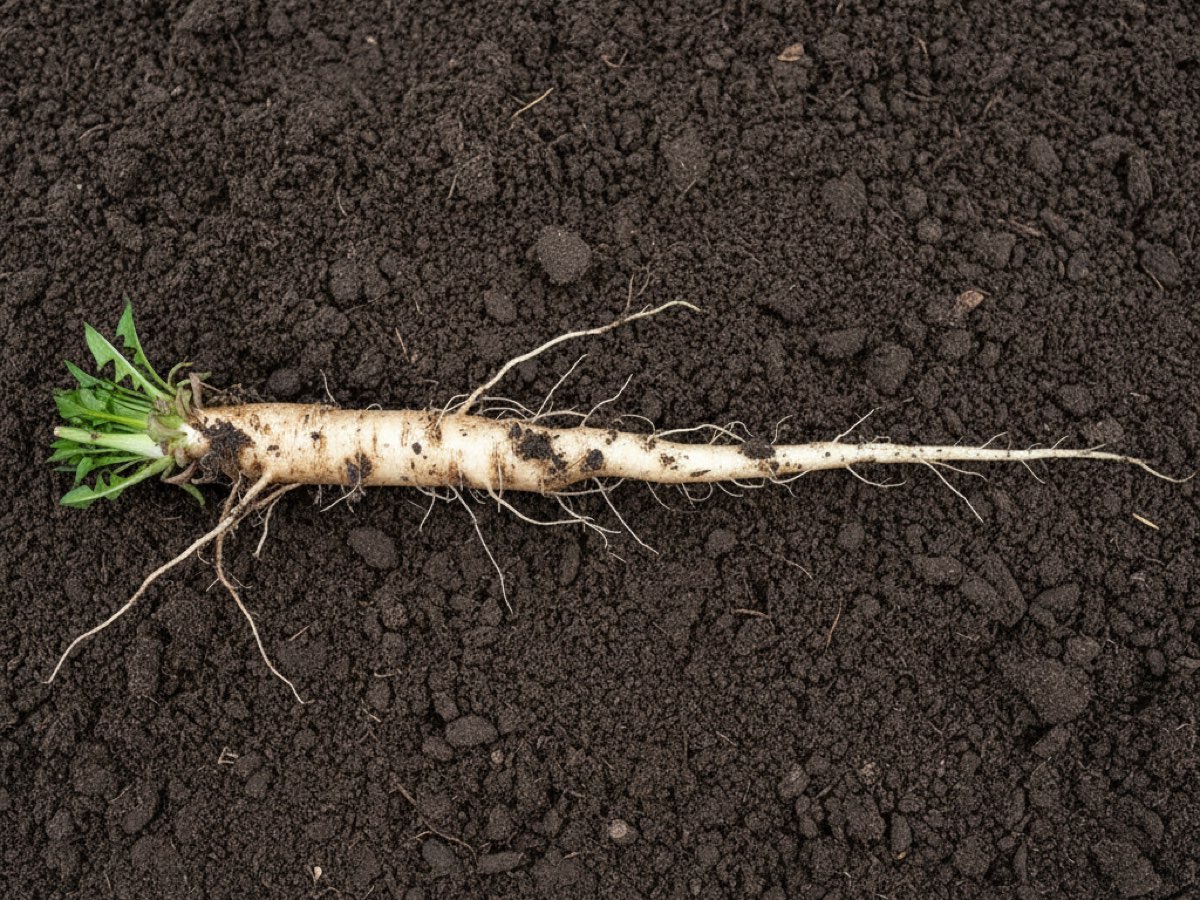
Almost everyone gets rid of a dandelion the same way. You take hold of the leaves, you pull, the leaves come away in your hand with a satisfying little tear, and you move on. What you have actually done is snap the plant off at the crown and leave the top of the taproot sitting in the soil.
Here is the part that is not intuitive. That leftover piece is not a scrap. It is the single most regenerative part of the whole plant. Garden Organic's review of the research explains why: how long a root fragment needs to be in order to regenerate depends on how thick it is, and the wider the diameter, the shorter the piece needs to be. Fragments from the upper parts of the root therefore regenerate better than those from further down. The fat top you just broke off is the ideal cutting.
And it does not give you one dandelion back. Cutting a plant below ground with a blade often fails for exactly this reason, because any portion of root that remains can sprout and a cluster of new shoots develops from it. That is why the patch looks worse in July than it did in April, and why the most reasonable question on this website is why weeds keep coming back after you have dealt with them.
Then there is the bit that genuinely annoys me, because it means the obvious response makes things worse. Defoliating a dandelion, whether by pulling the leaves, mowing it or burning it off, shifts the plant's growth balance in favour of root growth. The plant gets smaller above ground and puts more into what is underneath, and the leaves come back very quickly once you stop. So the person diligently pulling the tops off every fortnight is not slowly winning. They are cultivating a bigger root.
How deep is a dandelion taproot, really
Search this and you will be handed three different numbers with no source behind any of them. One page says most reach four to six inches and calls anything deeper a myth. The next says 15 to 45cm. A third quotes a foot as gospel. They cannot all be right, and the reason they disagree is that the answer depends entirely on the ground.
The RHS gives the practical figure: taproots can extend down a long way but are typically less than 30cm in gardens, and they tend to branch and fork in stony ground. Hold on to that second half, because it is the whole story for anything growing near a drive or a path. Californian extension research puts the strong taproot most commonly in the top 6 to 18 inches of soil, which is roughly 15 to 45cm and sits comfortably around the RHS figure.
The ceiling is a different matter. Garden Organic records that in optimal soil conditions a large taproot may be 3cm in diameter and reach a depth of 2 metres. That is not your lawn and I am not going to pretend it is, but it tells you what the plant manages when nothing stops it, and it explains why a dandelion in a deep, loose, well-worked border is a completely different job from one in a shallow, stony strip.
One last detail, because it explains why the crown always sits deeper than you expect. At the end of the growing season the taproot physically contracts, pulling the growing point at the base of the leaf rosette down below the soil surface. The plant tucks itself in for winter, which is also why a hoe skimming the surface achieves nothing.
Dandelion removal tools: what actually lifts a taproot
The dandelion grubber is not a new idea. Garden Organic notes it as a tool that was used in the past to remove the roots completely, which tells you the problem has always been the same one.
| Tool | What it actually lifts | The honest limit |
|---|---|---|
| Hand fork or trowel | The whole plant on a seedling or a first-year rosette | Fine early, hopeless later. Once the root is thicker than a pencil you will lever the top off and leave the rest. |
| Daisy grubber or dandelion weeder | A young to medium taproot, more or less intact | You have to be on your knees, and it wants moist soil. In dry, baked ground the root snaps instead of sliding out. |
| Long-handled claw puller | The crown and roughly the top 10cm of root, standing up | It leaves a hole that wants backfilling, dry ground makes it much harder, and owners report the plastic pulling arm breaking. Useless in a paving joint. |
| Spade | Everything, plus a lot of soil | Overkill in a border and it chops through the root more often than people admit. Every chopped piece is a potential new plant. |
| Narrow patio knife or joint scraper | The top growth out of a block paving joint, and nothing else | There is no version of this that gets a taproot out of a joint. It is a tidying tool, so treat it as one and deal with the root separately. |
Now do the arithmetic that the tool listings never put next to each other. The popular long-handled puller is listed as gripping roots up to 10cm underground. The RHS puts a typical garden taproot at under 30cm. So on a mature plant in decent soil, the best tool in the category is taking roughly the top third of the root and leaving the rest.
That is still worth doing, and here is why it works better than it sounds. The part it takes is the crown and the thick upper root, which is the section that regenerates most readily. What stays behind is thinner, and a thinner fragment needs to be longer to regenerate at all. You have not removed the plant so much as removed its best chance of coming back. Expect to revisit the spot. And expect a hole: that is by far the most common owner complaint about claw tools, and the fix owners describe is backfilling with compost and a pinch of grass seed as you go, so take a bucket with you. More on how these compare to the hand tools and powered brushes made for hard surfaces, which are a genuinely different category.
The dandelion in a block paving joint, where no tool fits
Dandelion advice is almost always lawn advice. Which is unhelpful, because the dandelion that actually infuriates people is the one rooted in the joint between two blocks on the drive, and none of the lawn advice transfers to it at all.
Start with how it got there, because it explains everything that follows. Dandelion seed is wind-carried up to 500 metres from the parent plant, and it germinates in the top 50mm of soil, with roughly 62 per cent emergence from the top 0 to 2cm and only 7 to 11 per cent from 3cm down. A paving joint packed with sand and years of accumulated grit is exactly that: a thin, shallow, perfectly lit seedbed, re-sown from the air every May. Dandelions in towns also favour shaded spots, which is why the joints along a north-facing path go first.
Then the root does something specific. The RHS notes that taproots branch and fork in stony ground, and a paving sub-base is nothing but stony ground. So instead of one clean carrot you can lever out, you get a forked root wedged down into a slot two centimetres wide. There is no fork you can get in beside it, no claw that can open around it, and no puller that will grip anything but the leaves. Pull it and you do the worst version of the mistake at the top of this page: you take the leaves, leave the thick crown, and it reshoots in the same joint.
So on a hard surface the mechanical route is not the hard option, it is the impossible one, and this is the situation where a systemic weedkiller genuinely earns its place. Glyphosate travels down into that root. That is the entire argument, and it is the same one that applies to everything else colonising the joints in block paving and gravel.
One warning specific to this aisle of the shop, and it is the sharpest thing on this page. There is a well-known path and patio weedkiller sold for permeable paths, patios, driveways and gravel areas that names dandelion, by name, on its own product page. Read the sentence it uses. It says it suppresses the top-growth of perennial weeds such as dandelion. Suppresses. Top-growth. That is the manufacturer telling you, in writing, that it does not go near the root, and the same page allows four applications a year, which is what a suppression cycle looks like when you write it down. On a taproot perennial that is not a treatment, it is a subscription. There is more on what path and drive weedkiller does on block paving if you want the full picture.
The month you dig matters more than the tool you use
If you take one thing from this page, take this.
On anything mature you are going to leave a fragment in the ground. That is a given, so the useful question is how likely that fragment is to survive, and the answer swings hard with the calendar. Work on dandelion root cuttings in natural conditions found that fewer than 20 per cent of fragments regenerated and survived in May, when most plants were in flower. Between June and September, survival was 65 per cent or more.
Read that again, because it is the practical conclusion of the entire page. The same imperfect job, done in June instead of May, is more than three times as likely to hand you a new plant. Digging dandelions is not a summer job you get round to. It is a May job, done while they are flowering and easy to spot in the first place.
The timing stacks up a second way as well. It takes only about 9 to 12 days from flowering to ripe seed, and at least 7 days must pass before that seed is likely to be viable. So the yellow flower you can see today is a clock with roughly a week and a half on it. Deal with the plant while it is yellow and you have caught the root at its weakest moment and stopped a couple of thousand seeds going up in the wind. Leave it until the white clock, and you have missed both.
Two smaller notes on depth and disposal, both from the same research. New plants can emerge from fragments buried 5 to 10cm down, with no consistent difference in survival over that range, though regeneration takes longer the deeper the piece is buried. And do not put dug-out roots on the compost heap. The RHS is explicit that gardeners spread dandelion by composting roots or chopping them up while digging. Bag them.
If you are going to spray one, spray something systemic
The RHS position is that non-chemical control works well enough that there is no need for a weedkiller, and in a border, with a fork, in May, I think that is right. It is a harder line to hold on a hundred square metres of block paving, and that is where this page parts company with the lawn-and-border advice.
The split that matters is systemic against contact, and it is the recurring mechanism behind what actually kills a weed for good. A systemic herbicide is absorbed by the leaves and moved down through the plant into the root. A contact herbicide destroys the tissue it lands on and goes no further. On a plant that is basically a root with a rosette on top, contact chemistry is decorative.
Glyphosate is the systemic option on the amateur shelf, and it takes two to four weeks to fully kill. Nothing happens for the first few days, which is exactly what makes people give up and buy something faster, and the faster thing is almost always a contact herbicide. If you want the full explanation of that lag, it is in how long weed killer takes to work, and the strengths on the shelf are unpicked in glyphosate concentrate strengths and mixing rates.
Two label details worth carrying with you. Concentrates at 360 g/L glyphosate name gravel, paths, drives, patios, tarmac and hard surfaces on the label, which is the direct answer for a paved drive. The residual path products, which pair glyphosate with something that stops the next lot of seed germinating for around three months, are approved for gravel and permeable paths lying on soil and specifically not for impermeable surfaces. Those labels also tell you to spray when the weeds are small and actively growing, between March and September. On a dandelion, small means the rosette before it flowers, not the fully grown thing you finally noticed in July.
Salt, vinegar, boiling water and the flame gun
All four fail on a dandelion for the same reason, and it is not a close call. They are surface treatments applied to a plant whose living, regenerating structure is 30cm underground. The leaves brown off within a day, which reads convincingly as working, and the crown is untouched.
The flame gun deserves a separate mention because it is worse than neutral here. Garden Organic records that flame weeding is not effective on dandelion and may actually favour it, by removing the vegetation competing with it. Combine that with defoliation pushing growth into the root, and you have paid for gas to give a dandelion a clear run.
Salt is the one I get asked about most and the one I would least like you to use. It does not break down, it moves through soil with water, and on paving and concrete it does lasting damage to the surface itself. The full sourced position on salt, vinegar and washing-up liquid is set out in whether organic and homemade weed killers work, and the specific recipe everyone shares is taken apart in the vinegar, salt and dish soap recipe. I am not relitigating it here. I am telling you it does not reach a taproot.
The one non-chemical measure that genuinely works is aimed at the seed rather than the plant: keep light off the ground. Seed germinates in the top 50mm and emergence collapses from around 62 per cent at 0 to 2cm to 7 to 11 per cent by 3cm down, so a decent mulch on a border, or clean, well-filled joints on a drive, stops the next generation before it starts. That is the same reasoning behind whether weed membranes work, and the same reason a dandelion patch is never really finished, only kept.
What to put on a dandelion
A dandelion taproot snaps and regrows from what is left, which is why forking one out so often gives you two. A systemic concentrate is the route that reaches the whole root.
What I’d use
Glyphosate concentrate, 360 g/L
Gallup Home & Garden Glyphosate Weedkiller (1 litre)
The one Gallup a homeowner can legally buy and use: a 1 litre glyphosate concentrate at 360 g/L, approved for home and garden use under MAPP 17672.
It is the same active, the same 360 g/L loading and the same isopropylamine salt as the professional Gallup XL, and its single label rate of 24 ml per litre of water is exactly the rate the professional labels reserve for perennial broad-leaved weeds. What the two labels set apart is the authorisation printed on them rather than the strength, and this is the side of that line you are allowed to stand on.
- Active ingredient
- Glyphosate, 360 g/L, as the isopropylamine salt
- Formulation
- Soluble concentrate you dilute yourself
- Approval
- MAPP 17672, labelled for use only as a home and garden weedkiller
- Mixing rate
- 24 ml per 1 litre of water, per the label
- Coverage
- 40 sq m per litre of made-up spray, so roughly 1,667 sq m per bottle
- Rainfast
- Rain within 6 hours may reduce effectiveness, per the label
- Size
- 1 litre of concentrate
Watch out for
- No measuring cap in the bottle. Check a cup arrives, or the dose is guesswork.
- One re-treatment a season, and it takes four weeks. Do not go again early.
- Not for lawns. It is non-selective and takes the grass too.
- Resellers dominate the listing, so check the label that arrives is Barclay.
- "Super strength" is keyword stacking. It is 360 g/L, same as professional Gallup XL.
That’s an affiliate link: buy through it and I earn a small commission at no extra cost to you. It doesn’t change what I recommend or what I say is wrong with it. More on how that works in the affiliate disclosure.
No brand pays for a mention here, and nothing on this page is a paid-for opinion. The card above is an affiliate link, so I earn a commission if you buy through it, at no extra cost to you. It buys no product a kinder write-up, which is why the watch-outs sit on the same card as the reasons to buy.
About this resource
I'm The Weed Guy, one bloke who is qualified to use professional weedkiller. The biology on this page comes from Garden Organic's dandelion review, written by Bond, Davies and Turner for the Organic Weed Management project and published in 2007, which is where the root-fragment regeneration figures, the seed numbers and the flame-weeding finding come from. The garden-scale root depth and the composting warning are the RHS's. The rosette-below-the-mower-blade point and the top 6 to 18 inches figure come from Californian extension research. Product concentrations, approved surfaces and application windows are off the manufacturers' own labels and product pages.
Where the sources disagreed, I have said so rather than picking the tidiest number. That is why there is no single headline taproot depth on this page, and why the tool section gives a reach figure and then tells you what it does not reach. Where I could not verify something, it is not here. I have not tested any of these tools or products against each other and I am not going to pretend otherwise.
No brand pays for a mention on this page and nobody sponsors this site. Where a product type is named, it is named for what its label or listing actually says, and the site-wide position on how anything here is paid for is set out on the affiliate disclosure page.
Common questions
What kills dandelions permanently?
Only two things: getting the whole taproot out of the ground, or a systemic weedkiller that the plant carries down into that root. Everything else on the list is a haircut. Glyphosate is the systemic option a home gardener can buy, and it takes two to four weeks to fully kill rather than working overnight. Digging works too, and the RHS position is that non-chemical control is effective enough that no weedkiller is needed at all, which is fair in a border and much harder to act on in a block paving joint. Permanent is also doing some work in that question: a dandelion patch is re-seeded from the air every year, so "permanent" means the plant you treated, not the ground it stood in.
Why does my dandelion keep coming back after I pull it?
Because you almost certainly pulled the leaves and left the root. Dandelion leaves tear away at the crown very easily, and what stays behind is the top of the taproot, which is the part most likely to regenerate. Garden Organic puts it plainly: any portion of the root that remains can sprout, and a cluster of new shoots often develops. So one careless pull can turn one dandelion into several. There is a second sting in it as well, because taking the leaves off shifts the plant's growth balance in favour of the root. The plant you keep decapitating is quietly building a bigger root.
How deep do dandelion roots actually go?
The honest answer is that it depends on the ground, and the pages quoting a single number are guessing. The RHS says taproots can extend down a long way but are typically less than 30cm in gardens, and that they tend to branch and fork in stony ground. Californian extension research puts the strong taproot most commonly in the top 6 to 18 inches of soil, so roughly 15 to 45cm. Garden Organic records the ceiling: in optimal soil a large taproot may be 3cm in diameter and reach a depth of 2 metres. Assume 30cm-ish in an ordinary garden bed, deeper in loose soil, and forked and awkward anywhere stony.
What is the best dandelion removal tool?
For a lawn or a border, a long-handled claw puller you drive in with a foot pedal, because it grips the crown and drags the root up rather than snapping the leaves off. Down on your knees in a planted bed, a daisy grubber does a tidier job with less soil disturbance. Both have the same honest limit: the popular long-handled puller is listed as gripping roots to about 10cm underground, which is well short of a mature taproot, so you are removing the top of the root and relying on the rest being less able to regenerate. And in a block paving joint or a gravel drive, no puller works at all. There is nothing for the claws to open into.
When is the best time to dig dandelions out?
May, while they are flowering, and this is the one thing on this page I would change your diary for. Research on root cuttings found that fewer than 20 per cent of fragments regenerated and survived in May when most plants were in flower, against 65 per cent or more when the roots were broken up between June and September. So the same job, done badly, is more than three times as likely to fail if you leave it until midsummer. May is also the last sensible moment before the seed head, because it takes only about 9 to 12 days from flowering to ripe seed.
Does salt kill dandelions?
It kills the top of one and does real damage to everything around it. Salt does not break down, it moves through soil with water, and on paving and concrete it works into the surface. On a taproot perennial you are also asking a surface treatment to reach a root that may be 30cm down, which it will not. The site's full position on salt, vinegar and washing-up liquid is set out separately, along with what those recipes actually do. Short version: it is not a shortcut, it is a different problem.
What kills dandelions naturally?
Digging, and being early. That is not a cop-out, it is what the evidence supports. Boiling water reaches a couple of centimetres. A flame gun is worse than useless here, because Garden Organic records that flame weeding is not effective on dandelion and may favour it by clearing the plants around it. Mulching and smothering work on seedlings by keeping light off them, which is genuinely worth doing, but neither will finish an established taproot. So the natural route is a fork, a grubber and the right month, repeated. It works. It just is not quick.
Does mowing get rid of dandelions?
No, and it selects for them. A dandelion grows from a flat basal rosette that sits lower than a mower blade can reach, so the mower takes the flower stems and leaves the plant intact. In closely mown grass the leaves simply spread flat against the ground instead. Cutting also removes the competition around it, and repeated defoliation pushes the plant's growth into the root. Mowing keeps the flowers down, which does slow the seeding, and that is all it does.
If I pick the flower heads, does that stop it spreading?
It genuinely helps, and there is a caveat worth knowing. Seed ripens about 9 to 12 days after flowering, and at least 7 days must pass before the seed is likely to be viable, so a flower head picked early is not carrying viable seed. Older work found that cut-down flowering stems did not produce viable seed at all. So deadheading before the clock forms is a real intervention, not a token one. What it does not do is touch the root, and a plant can live 10 to 13 years, so you are signing up to do it every year until you deal with what is underneath.
How do I get rid of dandelions in block paving or a gravel drive?
Chemically, because mechanically you cannot. There is no way to get a fork or a puller into a paving joint, and the root is wedged into a slot in the sub-base. A systemic glyphosate is the straightforward answer on solid block paving, concrete or tarmac, and it is one of the few chemistries whose label names those surfaces. On gravel or a permeable path lying on soil, a glyphosate-plus-residual product does the same job and holds new seedlings back for a while afterwards, though check the label, because most residual path products are specifically not approved for impermeable surfaces. What will not do it is a fast-acting contact spray, whatever the front of the bottle says.
How long does it take for a dandelion to die after spraying?
Two to four weeks with glyphosate, and nothing much for the first few days. That lag is the systemic action doing its job: the plant has to move the herbicide from the leaves down into the taproot, and on a plant with that much root to reach, that takes time. If a dandelion goes brown and crispy within hours of being sprayed, you have used a contact herbicide, the crown is alive, and it will be back.