Weed killer for brambles: what actually kills the root
Every bottle that claims to kill brambles is one of three chemistries, and only two of them ever reach a root crown. Here is what glyphosate and triclopyr actually do, why the Roundup on the shelf might contain no glyphosate at all, and the label rate that puts twenty times more herbicide into a cut stem than any spray does.
By The Weed GuyLast updated
The short version
A bramble is a woody perennial with a root crown, so anything that only burns the top growth is wasted money. Two actives reach that crown: glyphosate and triclopyr. Triclopyr, sold to gardeners as SBK Brushwood Killer, is the one that leaves grass alive. And the biggest single lever is not which bottle you buy, it is painting a freshly cut stem instead of spraying leaves, which both manufacturers rate at roughly twenty times the concentration.
Which weedkiller actually kills a bramble
Ignore the brand on the front and read the active ingredient on the back. There are only three chemistries on the shelf, and one of them cannot touch a root crown at any price.
| Active ingredient | What it is sold as | Reaches the crown? | Where it fits on a bramble |
|---|---|---|---|
| Glyphosate, ready mixed at 7.2 g/L | The Roundup Fast Action and Roundup Tough trigger bottles | Yes | Genuinely systemic and fine on soft regrowth. The catch is on the label: a maximum of one treatment per year, which is not a campaign against an established stand. |
| Glyphosate concentrate at 360 g/L | Roundup Ultra, Roundup Stump Killer, own-brand concentrates | Yes | The only route to the cut-stump rate, which is where the dose at the crown goes up twentyfold. Kills grass and every other green thing it lands on. |
| Triclopyr at 48 g/L | Vitax SBK Brushwood Killer | Yes | The pick where the bramble is coming up through grass you want to keep. Labelled for grass and neglected non-crop areas, so not for a paved drive. |
| Pelargonic acid at 43.1 g/L | Roundup Weedkiller Total Optima and the other "glyphosate free" bottles | No | A fatty acid that destroys the tissue it lands on and goes nowhere near a root. Its own label tells you to reapply every 7 to 21 days, which is what that means in practice. |
| Acetic acid | Supermarket and trade "natural" weedkillers | No | Same problem. It browns the leaves within a day, which reads as working, and the crown underneath is untouched. |
| No chemical at all | Loppers, a hedge trimmer, a brush cutter, a spade | Only by digging | Cutting is the necessary first move, never the finish. Digging the crown out works on one plant. Cutting at ground level and walking away makes it worse. |
Concentrations are the manufacturers' own label figures. If a bottle in your hand does not print grams per litre of active ingredient anywhere on it, that is telling you something, and the same rule applies to every glyphosate concentrate strength on the shelf.
Will Roundup kill brambles?
Some Roundup will. One Roundup cannot, and it is on the same shelf. The name is a brand, not a formula, and in a UK garden centre it currently covers at least three different chemistries.
The trigger bottles, Roundup Fast Action and Roundup Tough, are both 7.2 g/L glyphosate, ready mixed. Roundup Ultra is a concentrate at 360 g/L glyphosate acid. And Roundup Weedkiller Total Optima contains no glyphosate at all: it is 43.1 g/L pelargonic acid, a fatty acid that destroys the plant tissue it lands on and is not carried anywhere else. Buy that one for a bramble and you have bought a bottle of leaf burn. Its own label tells you to reapply every 7 to 21 days, up to four times a year, which is exactly what a contact herbicide's life looks like.
Now the part nobody writes down. Roundup Ultra's own label sets the bramble rate at 10ml of concentrate per litre of water. Work that through and the tank comes out at roughly 3.6 grams of glyphosate per litre, which is about half the strength of the ready-to-use bottle everybody tells you is too weak. Concentration is not what is failing you.
Two other things are. First, the ready-to-use labels allow a maximum of one treatment per year, and a bramble stand established enough to need weedkiller has never been a one-pass job. Second, and this is the real one, spraying leaves is the weakest way to get glyphosate into a bramble that exists.
Glyphosate or triclopyr: what the two actually do
"Stronger" is where most bramble advice stops. The two actives are not on the same scale at all. They attack completely different systems, and that difference is the whole reason one of them spares your lawn.
Glyphosate blocks a single enzyme, EPSP synthase. That enzyme runs the shikimate pathway, which is how a plant builds three amino acids it cannot live without: phenylalanine, tyrosine and tryptophan. Every green plant runs that pathway. So glyphosate takes the bramble, the grass around it and anything else it drifts onto, without discriminating between any of them.
Triclopyr does something else entirely. It is a synthetic copy of auxin, the hormone a plant uses to regulate its own growth, and it works by flooding that signalling system until growth runs out of control and the plant wrecks itself. Broadleaved and woody plants cannot cope with that. Grasses tolerate it. That tolerance is the entire selectivity story, and it is about a hormone pathway rather than about strength.
Which is why the question "what is the strongest bramble killer" is the wrong question. The right one is which system you want to attack, and what you are prepared to lose standing next to it.
SBK Brushwood Killer: what the label actually says
SBK is a soluble concentrate containing 48 g/L triclopyr as the triethylammonium salt, approved under MAPP 12711 and held by Vitax. Its own label reads "FOR USE ONLY AS A HOME GARDEN WEEDKILLER", so despite the reputation it carries, it is an amateur product you can buy in a garden centre, not a professional one.
The bramble rate is 30ml in 1.5 litres of water through a sprayer, or 30ml in 6 litres through a watering can with a fine rose, covering 10 square metres either way. That works out at roughly 3ml of product per square metre, which is the number to hold on to, because different pack sizes print slightly different mixing tables and the rate per square metre is the thing that stays constant. Read the pack in your hand.
Here is the line the retail listings do not quote. The same label that says "Kills difficult weeds not grass" on the front also says, a few lines into the instructions, "May cause damage to lawns and other fine turf." Both are true and they are not in conflict. A rough grass verge or a paddock shrugs triclopyr off. A fine lawn is a different sward and it can mark. If the bramble is in the middle of a lawn you care about, that is worth knowing before you mix anything.
The label also tells you to set the sprayer nozzle to a coarse setting, to stop a fine spray drifting onto whatever is growing next to you. That is one of the few label lines that genuinely changes what you do on the day, and it is a setting rather than a technique, so it belongs with everything else about choosing and calibrating a knapsack sprayer.
Spraying leaves or painting the cut: the twentyfold difference
If you take one thing from this website about brambles, take this. The variable that matters most is not the bottle. It is where you put it.
Roundup Ultra's label gives a foliar rate for brambles of 10ml of concentrate per litre of water. For a freshly cut stump the same label gives a 20 per cent solution, its own worked example being 20ml of product to 80ml of water. That is roughly twenty times the concentration, out of the same bottle, for the same money.
SBK does exactly the same thing. Brambles get 30ml in 1.5 litres of water through a sprayer. A cut stump gets equal volumes of product and water, painted onto every cut surface and down the bark to soil level. That is about twenty-five times the concentration.
Two different manufacturers, two different active ingredients, and both labels say the same thing: a cut face is the one place you are allowed to put an order of magnitude more herbicide, because you are putting it straight into living conducting tissue instead of asking a waxy leaf to absorb it.
You will see "within 10 minutes" quoted in one place and "within 30 minutes" in another. Neither figure appears on either label. What Roundup Ultra actually says is to treat the cut surface "as soon as possible after felling", and to make sure the whole cut surface is saturated, particularly around the edges and the bark. The reason the clock runs at all is physical rather than chemical: the cut face dries out and the conducting tissue seals, and once it has sealed you are painting a lid. So cut and treat in one movement, with the brush already loaded, rather than clearing the whole patch first and coming back to it.
When to treat brambles, and why there are two right answers
Search this and you will get five different seasons from five different pages, none of them explaining themselves. The labels give two, and they are two because there are two different jobs.
- Spraying leaves: high summer. Roundup Ultra puts brambles, nettles and scrub at June to September. SBK puts general tough weeds at May to October and woody weeds at June to August. A foliar treatment needs leaves that are actively working, because the leaf is the only way in.
- Painting a cut stump: the cold months. Roundup Ultra says cut the stem close to the ground between November and March. SBK says autumn or winter, and to avoid April, May and June when the sap is rising. Both give the same reason, which is to stay out of the spring and early summer sap flow.
So the sequence that fits both is not complicated. Cut and clear in autumn or winter and treat the cut crowns as you go. Come back in June and treat whatever has regrown while the leaves are working. Then accept that you are doing it again next year, because SBK allows two treatments a season and the ready-to-use glyphosate bottles allow one, and neither of those numbers finishes a bramble stand in a single year.
One more label line worth respecting: rain within six hours of spraying may reduce how well glyphosate works, and SBK says not to spray in drought, in freezing conditions, when rain is imminent, or when the grass is already wet. Brambles are not a job to squeeze into a bad afternoon. More on how long the wait actually is in how long weed killer takes to work.
What I'd actually buy
A bramble stand is a root-kill job and a big one. That makes the bottle that matters a concentrate you can mix by the sprayer-load, not a trigger bottle that runs dry on the first thicket.
What I’d use
Glyphosate concentrate, 360 g/L
Gallup Home & Garden Glyphosate Weedkiller (1 litre)
The one Gallup a homeowner can legally buy and use: a 1 litre glyphosate concentrate at 360 g/L, approved for home and garden use under MAPP 17672.
It is the same active, the same 360 g/L loading and the same isopropylamine salt as the professional Gallup XL, and its single label rate of 24 ml per litre of water is exactly the rate the professional labels reserve for perennial broad-leaved weeds. What the two labels set apart is the authorisation printed on them rather than the strength, and this is the side of that line you are allowed to stand on.
- Active ingredient
- Glyphosate, 360 g/L, as the isopropylamine salt
- Formulation
- Soluble concentrate you dilute yourself
- Approval
- MAPP 17672, labelled for use only as a home and garden weedkiller
- Mixing rate
- 24 ml per 1 litre of water, per the label
- Coverage
- 40 sq m per litre of made-up spray, so roughly 1,667 sq m per bottle
- Rainfast
- Rain within 6 hours may reduce effectiveness, per the label
- Size
- 1 litre of concentrate
Watch out for
- No measuring cap in the bottle. Check a cup arrives, or the dose is guesswork.
- One re-treatment a season, and it takes four weeks. Do not go again early.
- Not for lawns. It is non-selective and takes the grass too.
- Resellers dominate the listing, so check the label that arrives is Barclay.
- "Super strength" is keyword stacking. It is 360 g/L, same as professional Gallup XL.
That’s an affiliate link: buy through it and I earn a small commission at no extra cost to you. It doesn’t change what I recommend or what I say is wrong with it. More on how that works in the affiliate disclosure.
No brand pays for a mention here, and nothing on this page is a paid-for opinion. The card above is an affiliate link, so I earn a commission if you buy through it, at no extra cost to you. It buys no product a kinder write-up, which is why the watch-outs sit on the same card as the reasons to buy.
What actually gets rid of brambles, and what just wastes an afternoon
Same test as every weed on this site: does it reach the crown and the roots, or does it only deal with the canes on top?
| Method | Kills it? | What actually happens |
|---|---|---|
| Spraying a ready-to-use bottle at a mature stand | Not on its own | The chemistry is right and the label cap is the problem: one treatment a year against a plant that regrows from a crown and from roots 45cm down. |
| Cutting to about 30cm and digging out the crown | Yes, for that plant | The RHS method, and the only one that needs no chemical at all. It removes the woody crown the canes grow from, so there is nothing left to resprout. |
| Mowing or cutting hard, repeatedly, right at ground level | Can backfire | Garden Organic is blunt about this: cutting at or near ground level stimulates suckers from the lateral roots. You get more shoots, not fewer. |
| Glyphosate concentrate sprayed on the leaves in high summer | Yes, with repeat treatment | Roundup Ultra puts brambles at 10ml per litre of water, June to September. Rarely a one-spray job on anything established. |
| Glyphosate concentrate painted onto the fresh-cut stem | Yes, and this is the strong move | The same label rates a cut stump at a 20 per cent solution. That is roughly twenty times the spray concentration going straight into a living cut. |
| SBK Brushwood Killer through grass you want to keep | Yes, and the turf survives | Triclopyr works on a hormone pathway that grasses tolerate. It also allows two treatments a season where the ready-to-use glyphosate bottles allow one. |
| Spraying anything in deep winter | Rarely | Foliar treatment needs leaves that are working. Painting a cut stump in the same months is the exception, and that is a different job. |
| Leaving cut canes on a home compost heap | Not a kill method, and a mistake | Brambles regenerate from root and stem fragments. An unshredded cane left near soil can root again and start the problem over. |
Why brambles keep coming back: three ways to spread, not one
Horsetail is really a story about roots going deep. Bindweed is really a story about any fragment regrowing. Brambles do three separate things at once, and that combination is why the weedkiller question matters so much: you are never treating one plant, you are treating a population.
- Tip layering. Garden Organic describes the mechanism precisely: in autumn the stem tips become positively geotropic, which means they actively turn downward, elongate to reach the soil and root into it. A brand new, independently rooted plant appears with no seed and no root spreading involved. This is how one plant becomes a thicket.
- Seed. Around 40,000 seeds per plant, spread by birds, although Garden Organic is honest that much of that seed is non-viable. The part that matters to you is the timing: seed often does not germinate until the second year after it drops, so new plants keep appearing well after you thought a patch was dealt with.
- Root and stem fragments, and suckers. Brambles regenerate from fragments of root and stem, and suckers emerge from roots as deep as 45cm. Chop through roots while digging, or leave stem cuttings lying on soil, and pieces can become new plants on their own.
Does cutting brambles back help, or make it worse?
Both, depending how it is done, and this is more nuanced than most advice admits. Shortening the stems to around 30cm is genuinely the RHS's own recommended first step, using loppers, a hedge trimmer or a brush cutter. It clears growth so you can get at the crown to dig it out, or so fresh regrowth is easier to treat. Cutting is not the trap that digging bindweed is.
The real nuance: Garden Organic states plainly that cutting the stems at or near ground level stimulates the formation of suckers from the lateral roots. Repeated close mowing as a strategy on its own feeds that response rather than starving it. So leave a short stem you can grip and treat, do not scalp it flush with the soil, and follow up by digging out the crown or treating the regrowth rather than assuming cutting alone will finish it.
A brush cutter is the right tool for the clearing half of that and the wrong tool for the killing half. It buys you access to the crown. What you do in the next few minutes, with a brush and a strong mix, is the part that decides whether the plant comes back.
Brambles on a fence line or driveway edge
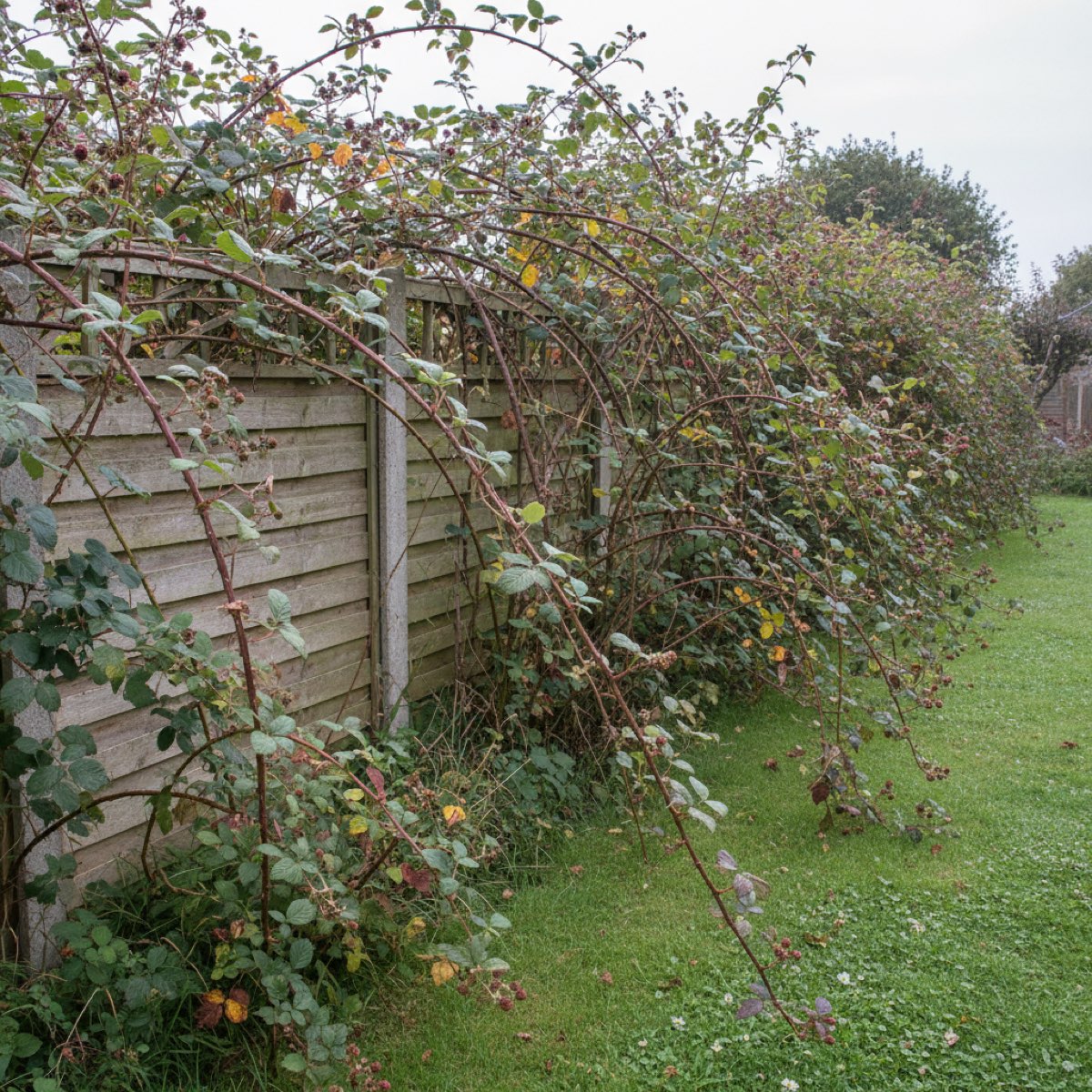
This is where brambles behave differently to a bed weed, and where the product choice flips. An arching cane from a neglected patch next door can root itself over or through a fence and start a brand new plant on your side, entirely independent of whatever is happening to the parent plant, similar in spirit to bindweed climbing through a fence gap, but rooting a whole new plant rather than just growing through.
The bit that catches people out: SBK's labelled area is grass and other neglected non-crop areas. A block-paved driveway is neither. So for a cane rooted in a paving joint or wedged against a kerb edge, the grass safety that makes triclopyr the right call in a lawn buys you nothing at all, and that is not the labelled place for it. Roundup Ultra's label does name hard surfaces explicitly, drives, patios, paths, tarmac, gravel and paving, which makes a glyphosate concentrate the straightforward answer there.
Along a drive or a path edge, a crown wedged against paving is genuinely awkward to dig out without lifting the surface around it. Cut the cane at the joint and paint the cut at the stump rate, then treat the regrowth, rather than trying to excavate. The same logic applies to everything else that colonises the joints in block paving and gravel.
Thorns, tetanus and disposal
A bramble scratch is rarely serious on its own, but the puncture can seal over quickly and trap in soil-borne bacteria, and garden soil is a genuine source of tetanus exposure. If your tetanus vaccination is not current and you have had a dirty puncture wound, it is worth getting checked rather than assuming it is fine. Gauntlet gloves are the simple precaution, because ordinary gardening gloves stop at the wrist and the forearm is exactly what you are reaching through.
Two label lines that matter after you have sprayed. SBK says children and pets can be allowed back on treated areas once the spray has dried, and that grazing animals should be kept off until the foliage of any poisonous weeds like ragwort has died down and become unpalatable. That second one is a paddock and smallholding rule rather than a garden one, but nobody puts it anywhere findable.
On disposal, do not put cuttings or roots on a home compost heap. Because fragments can regenerate, an unshredded cane or root left touching soil can simply start again. Shred or chop canes small before council green waste collection, and handle any dug-out roots separately.
About this resource
I'm The Weed Guy, one bloke who is qualified to use professional weedkiller. Every concentration, dilution rate, application window and restriction on this page comes off the manufacturers' own approved labels: SBK Brushwood Killer under MAPP 12711 and Roundup Ultra under MAPP 18850, both of which anyone can look up on the HSE pesticides register. The biology comes from Garden Organic's bramble datasheet and the RHS.
Where I could not verify something, it is not here. The kill-rate percentages you will see quoted on other bramble pages have no source I could find, and the ten-minute and thirty-minute cut-stump deadlines are on nobody's label, so this page says what the labels say instead. I have not run these products against each other in a test and I am not going to pretend otherwise.
Straight disclosure: nothing here is a paid-for opinion and no brand sponsors this site, but the Gallup card above carries an affiliate link, so I earn a commission if you buy through it, at no extra cost to you. It buys no brand a kinder write-up, which is why the watch-outs sit on the same card as the reasons to buy and why this page still says plainly that a bramble stand is a multi-season job whatever you spray. The full position is on the affiliate disclosure page.
Common questions
Will Roundup kill brambles?
Some Roundup will, and one Roundup cannot. The name covers three different chemistries in UK garden centres: the ready-to-use trigger bottles at 7.2 g/L glyphosate, the Ultra concentrate at 360 g/L glyphosate, and Total Optima, which contains no glyphosate at all and is 43.1 g/L pelargonic acid. Pelargonic acid is a contact herbicide. It destroys the tissue it touches and never reaches the root, so on a bramble it buys you brown leaves and nothing else. Check the back of the bottle for the active ingredient before you check the front for the brand.
What weed killer kills brambles?
Two actives do the job: glyphosate and triclopyr. Both are systemic, meaning the plant carries them down into the root crown rather than the herbicide just burning what it lands on. Glyphosate kills everything green, so it suits open ground, gravel and paving. Triclopyr, sold to gardeners as SBK Brushwood Killer at 48 g/L, leaves grass standing, so it suits a bramble growing through a lawn, verge or paddock. Anything sold as a fast-acting or glyphosate-free alternative is almost always a contact herbicide and will not finish a bramble.
Which Roundup do I need for brambles?
If you only want to spray leaves, the Tough ready-to-use bottle names brambles on the label and gives a June to September window. If you want the treatment that actually works on an established crown, you need a concentrate such as Roundup Ultra, because only a concentrate lets you mix the cut-stump rate. Avoid the glyphosate-free bottles entirely for this job. And read the pack in front of you rather than trusting a range name, because the same brand covers both a 7.2 g/L ready-to-use and a 360 g/L concentrate.
Is a ready-to-use bottle just too weak for brambles?
Not in the way people assume. Roundup Ultra is a 360 g/L concentrate, and its own label puts brambles at 10ml per litre of water, which works out at roughly 3.6 g of glyphosate per litre in the tank. The ready-to-use bottles are 7.2 g/L. The trigger bottle is about twice the spray strength of the concentrate mixed to its own bramble rate. What actually limits it is the label cap of one treatment per year, and the fact that spraying leaves is the weakest way to get herbicide into a bramble.
Is SBK Brushwood Killer better than glyphosate?
Not stronger, genuinely different. Its active, triclopyr, is a synthetic copy of auxin, the hormone a plant uses to regulate growth. It floods that system until growth runs out of control. Broadleaved and woody plants cannot cope with that, grasses can, and that tolerance is the entire reason it is sold as safe on grass. Glyphosate instead blocks an enzyme every green plant needs, which is why it takes the lawn with the bramble. For open ground or a paved drive, glyphosate is the right call and cheaper. For a bramble in turf, SBK is.
How do I kill brambles without killing the grass?
Use a triclopyr product rather than glyphosate. SBK Brushwood Killer is the one sold to gardeners, at 48 g/L, and the label rate for brambles is 30ml in 1.5 litres of water through a sprayer, or 30ml in 6 litres through a watering can with a fine rose, over 10 square metres either way. One honest caveat the retail listings leave out: the same label that says it kills weeds not grass also says it may cause damage to lawns and other fine turf. A rough verge or paddock shrugs it off. A fine lawn can mark.
How long does brushwood killer take to work on brambles?
Longer than you want, and the label tells you roughly how long by what it permits. SBK allows a repeat treatment after six weeks and a maximum of two treatments a season, which is the manufacturer setting expectations rather than me guessing. Glyphosate on this site is always described the same way: two to four weeks to fully kill, and nothing visible for the first few days. If a bramble wilts within hours of being sprayed, you have used a contact herbicide and the crown is still alive.
How many times a year can I treat brambles?
Fewer than the job needs, which is the honest constraint nobody puts in writing. The Roundup ready-to-use bottles state a maximum of one treatment per year. SBK allows two per season, with at least six weeks between them. Neither is enough to end an established stand in a single year, so plan a bramble as a two or three season campaign: cut and clear in year one, treat the regrowth in the right window, then keep treating what comes back. Anyone telling you it is a weekend is selling you something.
What is the best time of year to kill brambles?
There are two answers because there are two jobs. To spray leaves, high summer: Roundup Ultra puts brambles at June to September and SBK puts woody weeds at June to August, because a foliar treatment needs leaves that are actively working. To treat a freshly cut stump, the cold months: Roundup Ultra says cut and treat between November and March, and SBK says autumn or winter while avoiding April, May and June when the sap is rising. Both labels give the same reason, which is to stay out of the spring sap flow.
Will brambles grow back if you cut them?
Usually, yes, unless you also remove the crown or follow up with treatment. Cutting is a legitimate first step, it clears growth so you can get at the crown or treat fresh regrowth. But Garden Organic is specific that cutting the stems at or near ground level stimulates suckers from the lateral roots, so repeated close mowing on its own feeds the response rather than starving it. Leave a short stem to work with, then dig the crown out or treat what regrows.
How deep do bramble roots actually go?
Deep enough that a spade rarely settles it. Garden Organic records suckers emerging from roots 45cm down, and brambles also regenerate from root and stem fragments left behind. That is shallower than horsetail, which runs to around two metres, but brambles make up for it with three separate ways to spread: canes that root where the tip touches soil, seed, and regrowth from fragments. Shallow does not mean easy.
Can I cut back my neighbour's brambles growing over my fence?
Generally yes, to your side of the boundary, without needing to ask first. That comes from a long-standing legal principle that lets a landowner cut back encroaching growth from their own land, the same one that applies to a neighbour's ivy or bindweed. You cannot go onto their land to do it, and the cuttings are technically still theirs to offer back. Spraying is a different matter: drift across a boundary onto someone else's plants is your problem, which is why SBK's own label tells you to set the nozzle coarse. None of this is legal advice.
Can I compost bramble cuttings?
Not on a normal home compost heap, no. Brambles regenerate from fragments of root and stem, so an unshredded cutting left near soil can simply root again. Shred or chop the canes small before putting them in council green waste, and deal with any dug-out roots separately rather than adding them straight to an open heap.
Are bramble thorns dangerous, do I need a tetanus jab?
The scratch itself usually is not serious, but the puncture wound can seal over quickly and trap in soil-borne bacteria, and gardening soil carries a genuine tetanus risk. If you are not sure your tetanus vaccination is up to date and you have had a dirty puncture wound, it is worth getting checked rather than assuming it is fine. Gauntlet gloves that cover the forearm are the simplest precaution, because the forearm is where you actually get hurt.