How to get rid of bamboo: which one you have decides the job
A clumping bamboo is an afternoon with a spade. A running bamboo is a two to three year campaign against an underground stem system that travels over a metre a year and regrows from any piece with a bud on it. Work out which one is in your garden before you buy anything, because every instruction after that depends on the answer.
By The Weed GuyLast updated
The short version
Identify it first. Clumping bamboos (Fargesia, Chusquea) expand slowly from one crown and you can dig them out and be done. Running bamboos (Phyllostachys, Sasa, Pseudosasa) send rhizomes sideways through the top 30cm of soil at over a metre a year, and the RHS is clear that bamboo regrows from any section of rhizome with a node on it. So cutting a running bamboo down is what multiplies it. The two things that finish it are a glyphosate concentrate at a bamboo rate, repeated over two to three years, or cutting it down every time it shoots for the same two to three years. And bamboo is not Japanese knotweed: it is on no statutory list at all.
Running or clumping: the only question that matters first
Bamboo comes in two completely different forms and they need two completely different methods. Answer this before you do anything else, because one of these is a day's work and the other is a project.
| What you are looking at | Running bamboo | Clumping bamboo |
|---|---|---|
| Where new shoots appear | On their own, well away from the parent clump. Through a lawn, up in a border, or on the far side of a fence with nothing joining it to the plant you can see. | Only at the edge of the clump that is already there. The mass gets wider, it does not jump. |
| What a rhizome looks like in your hand | Long, slim and whip-like, running sideways just under the surface, with buds spaced along its length. Any one of those buds can become a cane. | Short, thick and stubby, curving upward almost straight away rather than travelling. |
| The names on the label | Phyllostachys (black and golden bamboo), Sasa, Sasaella, Pseudosasa japonica, Semiarundinaria fastuosa, Bashania fargesii. | Fargesia and Chusquea. These are the two the RHS names as clump-forming. |
| How fast it travels | The RHS puts it at over a metre a year, through the top 30cm of soil. Clemson records rhizomes more than 100 feet from the mother plant. | Slowly, and outward from the crown. There is no runner heading anywhere. |
| What getting rid of it actually means | A two to three year campaign. Every rhizome has to be killed or lifted, because the RHS is clear that bamboo regenerates from any section of rhizome with a node. | An afternoon with a spade and a sharp saw. One crown, one root ball, done when it is out. |
The genera and the spread figures are the RHS's own; the 100 feet is from Clemson's extension factsheet. If you have inherited the garden and cannot find a label, dig one shoot up with a trowel and follow what it is attached to. A rhizome that heads off sideways for a foot and keeps going has answered the question.
Why cutting bamboo down is what multiplies it
The canes are not the plant. They are what the plant puts up. A running bamboo lives in a mat of rhizomes, underground stems that travel horizontally with buds spaced along them, and every one of those buds is a cane that has not happened yet.
So when you cut the canes down, you have removed the visible half of a plant whose entire store of energy is sitting underground, untouched, and whose only response to losing its top growth is to spend that store putting up more. It comes back thicker, and you have made the next spray harder because there is no established foliage left to take a systemic herbicide down.
Digging is worse, if you do it badly. The RHS states plainly that bamboo can regenerate from any section of rhizome with a node on it. A fork or a rotavator through a rhizome mat does not remove a bamboo, it chops one plant into forty cuttings and plants them for you. This is the same mechanism that makes digging ground elder a way of spreading it and it catches people out for exactly the same reason: the tool feels productive.
There is one more piece of the mechanism, and it explains why year two so often looks like failure. ProGreen's guidance notes that in a mature colony some rhizomes sit in a dormant phase and only produce growth once the first flush of shoots has been killed. You do not treat a bamboo once and watch it die. You treat what is there, and then you treat what the plant had in reserve.
How far and how deep bamboo actually goes
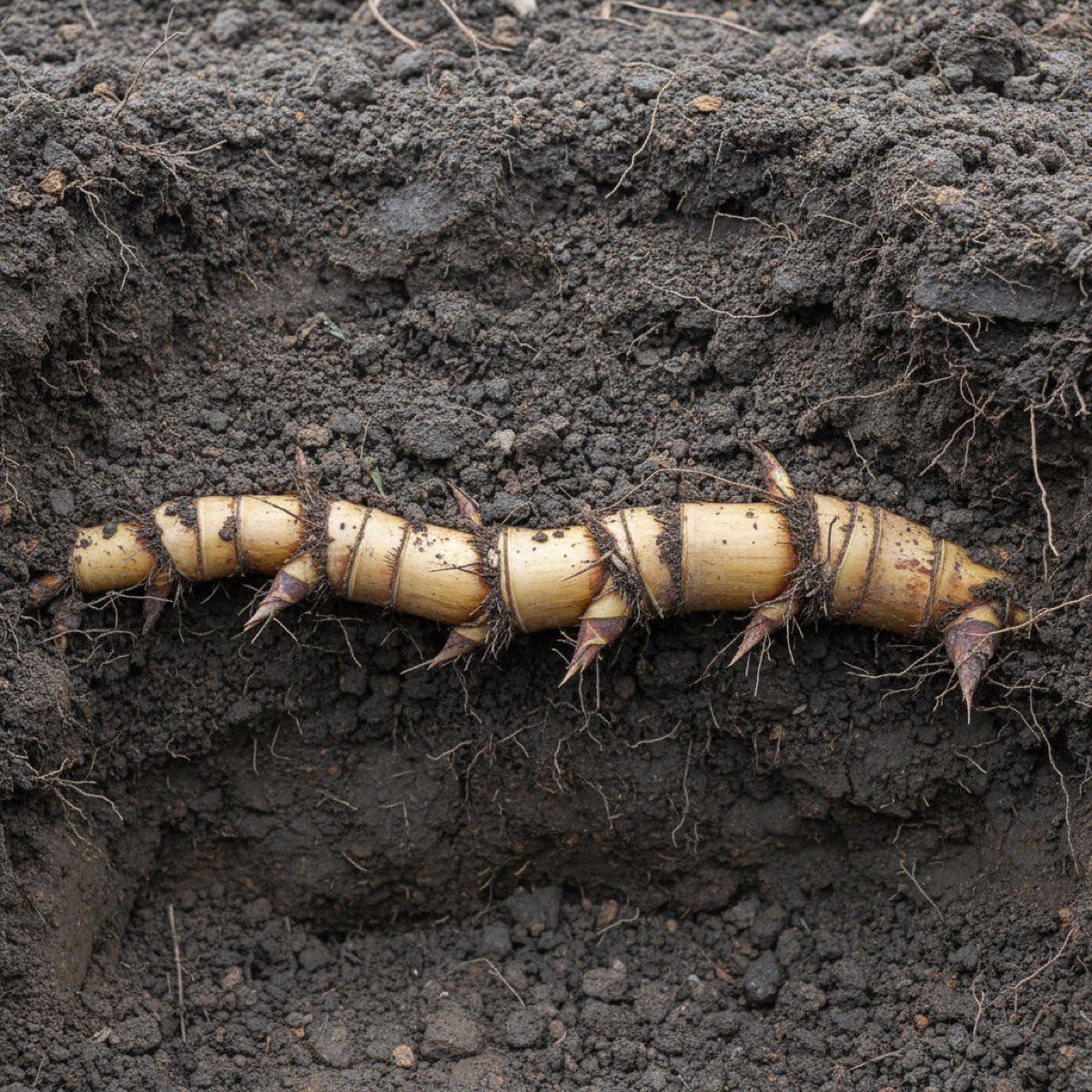
Most of the figures published about bamboo spread are unsourced, and some say outright that their numbers are illustrative rather than predictive. So here are the ones that trace back to somebody who has to stand behind them.
- Rhizomes sit in the top 30cm of soil. That is the RHS figure, and Clemson's extension service says the same thing in imperial: less than a foot deep. Bamboo is a wide problem, not a deep one.
- They spread over a metre a year. Also the RHS. Clemson has recorded rhizomes more than 100 feet from the mother plant, which is the number to hold on to when you are deciding how far out to dig.
- Roots, as opposed to rhizomes, go deeper. The RHS puts a mature plant's roots at as deep as a metre. This distinction matters more than it sounds: roots feed the plant, rhizomes make new canes. Leaving roots behind is untidy. Leaving rhizomes behind is why it came back.
Set against that, the numbers you will see on removal contractors' sites, ten metres of spread, growth into cavity walls, rhizomes through drains, carry no source at all. I am not repeating them. The genuinely documented behaviour is bad enough: a shallow mat travelling a metre a year that will come up through a lawn, a border, a paving joint or the far side of a fence without any warning at all.
What I'd actually buy
Every published bamboo rate is written against a concentrate rather than a ready-to-use trigger bottle, which settles what to buy before anything else does.
What I’d use
Glyphosate concentrate, 360 g/L
Gallup Home & Garden Glyphosate Weedkiller (1 litre)
The one Gallup a homeowner can legally buy and use: a 1 litre glyphosate concentrate at 360 g/L, approved for home and garden use under MAPP 17672.
It is the same active, the same 360 g/L loading and the same isopropylamine salt as the professional Gallup XL, and its single label rate of 24 ml per litre of water is exactly the rate the professional labels reserve for perennial broad-leaved weeds. What the two labels set apart is the authorisation printed on them rather than the strength, and this is the side of that line you are allowed to stand on.
- Active ingredient
- Glyphosate, 360 g/L, as the isopropylamine salt
- Formulation
- Soluble concentrate you dilute yourself
- Approval
- MAPP 17672, labelled for use only as a home and garden weedkiller
- Mixing rate
- 24 ml per 1 litre of water, per the label
- Coverage
- 40 sq m per litre of made-up spray, so roughly 1,667 sq m per bottle
- Rainfast
- Rain within 6 hours may reduce effectiveness, per the label
- Size
- 1 litre of concentrate
Watch out for
- No measuring cap in the bottle. Check a cup arrives, or the dose is guesswork.
- One re-treatment a season, and it takes four weeks. Do not go again early.
- Not for lawns. It is non-selective and takes the grass too.
- Resellers dominate the listing, so check the label that arrives is Barclay.
- "Super strength" is keyword stacking. It is 360 g/L, same as professional Gallup XL.
That’s an affiliate link: buy through it and I earn a small commission at no extra cost to you. It doesn’t change what I recommend or what I say is wrong with it. More on how that works in the affiliate disclosure.
No brand pays for a mention here, and nothing on this page is a paid-for opinion. The card above is an affiliate link, so I earn a commission if you buy through it, at no extra cost to you. It buys no product a kinder write-up, which is why the watch-outs sit on the same card as the reasons to buy.
What actually gets rid of bamboo, and what wastes a season
The same test as every weed on this site: does it reach the underground system, or does it only deal with what you can see?
| Method | Kills it? | What actually happens |
|---|---|---|
| Digging out a clumping bamboo | Yes | This is the honest good news. A Fargesia or Chusquea is one root ball. Cut the canes down, dig round the crown, saw it out and you have finished. No follow-up, no chemical. |
| Digging out an established running stand | Only if you get every node | The RHS says bamboo regenerates from any section of rhizome with a node. Miss a 15cm offcut and you have not removed a bamboo, you have propagated one. On a big stand that means excavating, not forking. |
| Cutting the canes down and walking away | No, and it rewards the plant | Cutting removes the canes and leaves the entire rhizome system intact and full of stored energy. It reshoots, usually thicker, and you have made the stand harder to spray because there is nothing tall left to treat. |
| Cutting it back every single time it shoots, for years | Yes, slowly | This is the genuine no-chemical route and the one nobody says out loud. Clemson puts it at two to three years of regular mowing, because bamboo tolerates the occasional cut and does not tolerate a frequent one. Miss a season and the clock resets. |
| Glyphosate sprayed on the foliage | Yes, over seasons | ProGreen puts bamboo at 25ml of glyphosate per litre of water, sprayed to run-off, July to September. Clemson works the other way round: mow it, let it regrow, then treat the new expanded leaves. |
| Glyphosate into the freshly cut canes | Yes, and this is the strong move | A bamboo cane is a hollow tube straight into the rhizome. ProGreen rates stem filling at 10ml of a 360 g/L glyphosate in 150ml of water per stem, October to March, poured into the cut a few centimetres above ground. |
| SBK or any brushwood killer | No, and the label says so | Vitax sells SBK on the fact that it does not kill grass. Bamboo is a grass. Triclopyr works on a hormone pathway that grasses tolerate, which is the entire reason it is sold as lawn-safe, and it is the reason it is useless here. |
| Salt | No, and it wrecks the ground | It cannot reach a rhizome network running a metre a year through the top 30cm of soil, and what it does do is persist in the soil and attack the mortar and sub-base of anything paved nearby. |
| Vinegar, including the horticultural strength | No | Acetic acid is a contact herbicide. It burns the tissue it lands on and is not carried anywhere. On a bamboo it browns some leaves and the rhizome underneath never notices. |
| Diesel or petrol poured on it | No, and do not | It is not a herbicide, it is a pollutant. Letting fuel oil into soil and groundwater puts you in permitting-offence territory, and gov.uk is blunt about the ceiling: an unlimited fine, up to five years in prison, or both. |
| A rhizome barrier | It contains, it never kills | A barrier is a fence for the future, not a treatment for what is already there. Clemson is precise about what it does: rhizomes are not stopped by a barrier, they are reflected. So they run along it looking for the end. |
Glyphosate on bamboo: the rates, and the two windows
Bamboo is a grass. That single fact settles most of the product question before you reach a shelf, and it settles it in two directions at once.
In glyphosate's favour: it is non-selective and it is systemic, so it goes down into the rhizome rather than burning the leaf it lands on. Against everything else: triclopyr, sold to gardeners as SBK Brushwood Killer at 48 g/L, is marketed on the fact that it does not kill grass, because grasses tolerate the hormone pathway it attacks. Buy brushwood killer for bamboo and you have bought the one chemistry guaranteed to leave it standing. It is the right call for brambles growing through grass and completely the wrong one here.
The rates. ProGreen, who supply the professional weed control trade, put bamboo foliar treatment at 25ml of glyphosate per litre of water, sprayed to the point of run-off, between July and September. For stem filling they give 10ml of a 360 g/L glyphosate in 150ml of water per stem, October to March, introduced into the cut cane a few centimetres above the ground.
Those numbers only mean something once you know how strong your concentrate is, which is exactly why the grams per litre on the back of the bottle is the figure that matters and the brand on the front is not. There is a full breakdown of what real concentrates are and how the mixing maths works if you need to convert a rate to your own tank.
Clemson's extension service comes at the foliar job from a different angle and it is worth knowing about: mow or chop the stand down, let it regrow until the new leaves have expanded, and treat that fresh growth. Young leaves take a systemic herbicide up far better than tough mature foliage, and it also brings a ten foot stand down to something you can actually spray. Same principle as timing any spray to the plant rather than the calendar.
Two honest caveats. Clemson's own figure for complete control by this route is two to three years, not one summer. And glyphosate's GB approval currently runs to 15 December 2026 while the HSE works through the renewal assessment, so if you are planning a multi-year campaign it is worth knowing the regulatory ground is not frozen.
Salt, vinegar and the diesel question
All three of these get searched hard against bamboo specifically, and all three are wrong for the same underlying reason: none of them travels. A bamboo lives in a rhizome mat spreading a metre a year through the top 30cm of soil. Anything that works by touching the plant is fighting the wrong half of it.
Salt has the added problem of what it leaves behind. It stays in the soil, it makes the ground hostile to whatever you plant afterwards, and on anything paved it goes after the mortar and the sub-base. There is a longer, sourced version of that in the piece on whether organic and homemade weed killers actually work, and the same goes for the vinegar, salt and washing-up liquid recipe people keep sharing.
Then there is diesel, which people genuinely search for against bamboo. Do not. It is not a weedkiller, it is a fuel oil, and putting it into the ground is a pollution problem rather than a gardening one. Since 2010 the offence sits in the environmental permitting regime, which makes it unlawful to cause or knowingly permit a groundwater activity without a permit, and gov.uk states the ceiling plainly: an unlimited fine, up to five years in prison, or both. It also would not work. Fuel oil kills the foliage it soaks and leaves the rhizome mat alive under contaminated ground you now have to deal with.
Rhizome barriers: the spec, and the thing nobody tells you
A barrier is for the bamboo you are keeping, or the bamboo next door you cannot do anything about. It contains. It has never killed anything, and installing one round a stand you want gone achieves nothing.
The RHS gives an actual specification, which is more than most sellers of barrier do. At least 60cm deep. At least 7.5cm standing proud of the soil, so a rhizome cannot simply travel over the top of it. And where two lengths meet, an overlap of at least 30cm, bonded rather than butted, because a seam is exactly where a rhizome will find its way through.
Note that Clemson's extension service gives a shallower figure, about 18 inches, for a barrier of concrete, metal, HDPE or pressure-treated wood. Where two sources disagree on a UK garden I would take the RHS number, and I would rather be 20cm too deep than dig the whole thing up again in three years.
Here is the part almost nobody writes down, and it comes from the same Clemson factsheet: bamboo rhizomes are not stopped by a barrier, they are merely reflected. They hit it, turn, and run along it looking for the end or the top. That changes what you do after installation completely. A barrier is not a thing you bury and forget, it is a line you walk once or twice a year, checking along its length and at both ends for a rhizome that has found the edge.
The same logic applies to weed membrane, which people reach for out of habit and which a bamboo shoot goes straight through. A sheet designed to stop seedlings germinating is not designed to stop a sharpened underground stem with a plant's worth of stored energy behind it, and there is more on what a membrane genuinely does and does not stop.
Bamboo and the neighbour: where the law actually sits
Bamboo travels under a fence, so it becomes a neighbour problem more often than any other plant on this site. It is also the subject of more confidently wrong legal writing than any other plant on this site, most of it from firms who remove it.
Start with what bamboo is not. It does not appear anywhere on Schedule 9 of the Wildlife and Countryside Act 1981, which is the list that gives Japanese knotweed its legal weight. The schedule lists no bamboo, and none of Phyllostachys, Fargesia, Sasa or Pseudosasa. So there is no offence of causing bamboo to grow in the wild, cut bamboo is not controlled waste and can go in your green bin, and there is no bamboo question on the TA6 property information form, which asks about Japanese knotweed and nothing else. Anyone marketing bamboo to you as "the new Japanese knotweed" is describing a legal regime that does not exist. Here is what the knotweed regime actually involves, for the comparison.
What does apply is ordinary common law. On growth that has already crossed the line, you are generally entitled to cut it back to the boundary from your own side without asking first, under the long-standing principle in Lemmon v Webb, which covers roots as well as growth above ground. The limits are real: you cannot step onto their land to do it, and the cuttings are technically still theirs to be offered back.
Beyond that, a claim would be in common law private nuisance rather than under any bamboo statute. Solicitors writing on this generally reach for Williams v Network Rail, a 2018 Court of Appeal case about Japanese knotweed which held that encroachment can be an actionable nuisance through its interference with the neighbour's enjoyment of their land, without needing physical damage to a building. That is a knotweed case being reasoned across, not a bamboo one.
Which brings me to the honest bit. One firm publicly describes settling a client's bamboo encroachment claim for just under twenty thousand pounds, but that is a solicitor's own account of a settlement, not a reported judgment, and I could not find a reported UK bamboo judgment at all. On the market side, the HomeOwners Alliance quotes YouGov research putting 38 per cent of homebuyers off a property by bamboo, against 71 per cent for Japanese knotweed. Take the whole picture as background rather than as a position: none of this is legal advice, and a real dispute wants a solicitor who does boundary and nuisance work.
About this resource
I'm The Weed Guy, one bloke who is qualified to use professional weedkiller. The spread, depth, genera and barrier figures on this page are the RHS's own bamboo control advice; the mowing timescale, the 100 foot spread and the barrier-reflection point come from Clemson's extension service factsheet; the glyphosate rates and the two treatment windows come from ProGreen's professional bamboo guidance. The legal position comes from Schedule 9 of the Wildlife and Countryside Act 1981 read directly on legislation.gov.uk, and from published solicitors' briefings, and it is background rather than legal advice.
One thing worth flagging for balance: the RHS states that it does not support the use of weedkillers and recommends non-chemical methods. I've given you their figures and their barrier spec because they are the best-sourced ones available, and I've also given you the herbicide route, because a homeowner with a running bamboo through a fence line deserves to know what the professional trade actually does about it. The non-chemical route is on the page too, and it is two to three years of cutting.
Where I could not verify something it is not here. I found no reported UK court judgment about bamboo, no UK amateur weedkiller label that names bamboo in its weeds-controlled list, and no source at all behind the cavity-wall and drain damage claims that removal contractors repeat, so none of those appear as facts. I have not tested any product on this page against another and I am not going to pretend otherwise. The full position is on the affiliate disclosure page.
Common questions
What kills bamboo permanently?
Only two things: removing every rhizome, or exhausting the rhizome system so completely that it has nothing left to shoot with. There is no bottle that ends an established running bamboo in one pass, and any product sold on that promise is selling you the top growth. For a clumping bamboo, permanent is genuinely a day's digging, because there is one crown and no runners. For a running bamboo, permanent means either an excavation deep and wide enough to catch every rhizome, or two to three years of repeat glyphosate treatment, or two to three years of cutting it down every time it dares to shoot. Clemson puts both of the slow routes at the same two to three years, which is the honest number.
How do I get rid of bamboo roots?
Start by getting the word right, because it changes the job. The thing spreading through your garden is not a root, it is a rhizome, an underground stem with buds along it. Roots come off it and go deeper, and the RHS says a mature plant can root as deep as a metre, but roots do not make new canes. Rhizomes do. The RHS puts the rhizome layer in the top 30cm of soil, which is why a running bamboo is a wide, shallow problem rather than a deep one. That is also why forking it over is such a trap: a rhizome regenerates from any section with a node on it, so chopping the network into pieces multiplies the plant instead of removing it.
Will glyphosate kill bamboo?
Yes, but not on the first go and not at a lawn-weed rate. Bamboo is a grass, so glyphosate is chemically the right choice, and it is systemic, so it moves down into the rhizome instead of burning what it lands on. The catch is the size of the system you are trying to poison. ProGreen, who supply the professional trade, put bamboo at 25ml of glyphosate per litre of water sprayed to run-off between July and September, and they are clear that repeat treatment is normally needed because some rhizomes sit dormant and only shoot once the first flush has been killed. Expect two to three years, and expect the second year to look like a failure until it does not.
What is the best bamboo root killer?
A glyphosate concentrate, used at a bamboo rate rather than a path-and-patio rate, and ideally poured into a cut cane rather than sprayed on leaves. There is no such thing as a dedicated bamboo product on a UK garden centre shelf, and I could not find a single UK amateur weedkiller label that names bamboo in its weeds-controlled list, so anything marketed to you as a "bamboo killer" is a general glyphosate concentrate with a label written for search results. What actually matters is the grams per litre of glyphosate on the back of the bottle, because every published bamboo rate is expressed against a concentrate strength.
Does killing bamboo with salt work?
No, and it leaves you worse off than when you started. Salt has no route into a rhizome network that runs a metre a year through the top 30cm of soil, so at best it scorches whatever foliage it touches. What it does do is stay in the ground, poison it for anything you plant afterwards, and go after the mortar, sub-base and paving of anything hard-surfaced nearby. It is the single worst idea in the whole home-remedy set, which is saying something, and there is a longer sourced version of why on the homemade weed killer resource.
How do you get rid of bamboo with vinegar?
You do not. Vinegar is acetic acid, and acetic acid is a contact herbicide: it destroys the plant cells it physically lands on and is not carried anywhere else in the plant. It is genuinely fast and genuinely convincing to watch, which is exactly the problem. The leaves go brown within a day and the rhizome system, which is where the entire plant actually lives, has not registered anything at all. Against a bamboo it is less useful than doing nothing, because it costs you a growing season you could have spent treating it properly.
Is bamboo illegal in the UK, like Japanese knotweed?
No, and this gets stated wrongly all over the internet. Bamboo does not appear anywhere on Schedule 9 of the Wildlife and Countryside Act 1981, which is the list that gives Japanese knotweed its legal weight. There is no offence of causing bamboo to grow in the wild, cut bamboo is not controlled waste so it can go in your green bin, and there is no bamboo question on the TA6 property information form the way there is a Japanese knotweed one. Sites that call bamboo "the new Japanese knotweed" are describing a legal regime that does not exist. This is not legal advice, only the shape of the law as it stands.
What can I do about my neighbour's bamboo coming under the fence?
Two separate things, and they work at different speeds. First, you are generally entitled to cut back growth that has crossed onto your land, from your own side, without asking permission. That comes from a long-standing principle in Lemmon v Webb which covers roots as well as growth above ground. You cannot go onto their property to do it, and the cuttings are technically still theirs to offer back. Second, where the encroachment is doing real harm, the law that applies is common law private nuisance rather than any bamboo-specific statute. One firm of solicitors describes settling a client's bamboo claim for just under twenty thousand pounds, though that is a firm's own account of a settlement rather than a reported judgment, and I could not find a reported UK bamboo judgment at all. None of this is legal advice.
Does bamboo damage buildings, drains and driveways?
Bamboo rhizomes lift and crack things by growing through gaps, and shoots come up through paving joints, tarmac edges and lawns easily enough. What I am not going to repeat is the stronger version of that claim, that bamboo grows into cavity walls and through drains, because it is published without a source behind it. The realistic damage to plan for is a shallow one: rhizomes exploiting a joint or an edge that was already open, and shoots coming up where you did not want them.
Does bamboo affect a house sale or a mortgage?
Far less than knotweed, and the gap is measurable. The HomeOwners Alliance quotes YouGov research in which 38 per cent of homebuyers said bamboo would put them off a property, against 71 per cent for Japanese knotweed. There is no bamboo question on the TA6 property information form, and no equivalent of the knotweed management-plan machinery that lenders have built up. That said, a surveyor can flag it, and a buyer who spots a running bamboo pushing under a boundary can absolutely make it a negotiating point. Sorting it before you list is the cheaper order of operations.
How deep do I have to dig to get bamboo out?
Deeper than the rhizomes and wider than you think. The RHS puts the rhizome layer in the top 30cm of soil, and Clemson agrees, calling bamboo rhizomes shallow at less than a foot deep. So the depth is not really the challenge. The width is: rhizomes run more than a metre a year, and the shoots you can see mark the middle of the system rather than its edge. Dig out from the last shoot, not from the clump. Roots go further down, a metre on a mature plant according to the RHS, but roots do not produce canes, so leaving those behind is not what brings it back.
What is the best tool for digging up bamboo roots?
A mattock and a pruning saw, in that order, and a spade only for the clearing up. A rhizome mat is dense, woody and full of grit, and a spade blade skids off it or bends. A mattock chops down through it with the weight of the head instead of your back, and a cheap pruning saw cuts the crown out once you have exposed it. On any stand bigger than a few square metres a mini digger is the realistic tool, and this is one of the few weeds where hiring machinery for a day is genuinely proportionate.
Will a rhizome barrier stop bamboo spreading?
It contains it, on a specification, and it never kills anything. The RHS is precise about the spec: at least 60cm deep, at least 7.5cm standing proud of the soil so a rhizome cannot simply run over the top, and edges overlapped by at least 30cm and bonded rather than butted together. The part that gets missed comes from Clemson: rhizomes are not stopped by a barrier, they are merely reflected. So they turn and run along it, looking for the end, which means a barrier needs monitoring along its length rather than installing and forgetting.
When is the best time to treat bamboo?
There are two windows because there are two jobs. Foliar spraying wants July to September, when the leaves are working hardest and the plant is moving sugars down into the rhizome, which is the ride the glyphosate takes. Stem filling wants October to March, when the canes are dormant and you are putting the chemical straight into the plumbing rather than asking a waxy leaf to absorb it. Both figures are ProGreen's. What you should not do is treat in spring when new shoots are coming up, because you are spraying growth that is still being fed by the rhizome rather than feeding it.
Can I burn or compost bamboo cuttings?
Canes are fine, rhizomes are not. Cut canes are just woody stems and they compost or shred without issue. Rhizomes are a different matter, because bamboo regenerates from any section with a node, so a rhizome offcut on a compost heap or dumped in a corner is a bamboo plant waiting to happen. Bag rhizomes separately, let them dry out completely somewhere they cannot touch soil, or send them to the tip. Unlike Japanese knotweed, none of this is a legal requirement, because bamboo is not controlled waste. It is just the difference between finishing the job and starting it again.