How to get rid of couch grass
Couch grass is a grass, which is why nothing you spray on a lawn touches it, and it runs hard white rhizome sideways through the soil, which is why one pass with a rotavator turns one patch into twenty. Here is how to tell it from the grass it is hiding in, what actually reaches the rhizome, and the honest set of choices in a lawn.
By The Weed GuyLast updated
The short version
Confirm it first with a spade, not with your eyes: couch grass runs hard white cords sideways through the top 15cm of soil, with sharp points on the ends. Then pick one route and hold it for two seasons. Systemic glyphosate on actively growing leaf is the only thing on a garden centre shelf that gets into the rhizome, and the Roundup Ultra label names couch at 15ml per litre. If you would rather not spray, dig it out whole and keep going back every two to three weeks, or smother it under cardboard and 20cm of mulch for a few years. What you must not do is chop it up and walk away. Every severed piece is a new plant, and that includes the pieces a rotavator makes.
Is it actually couch grass? A field key that works on a mown lawn
This is the reader's real first problem and almost nothing ranking for it takes the question seriously. You cannot identify a grass by looking at grass, so here is what to look at instead, and what each check rules out.
| What to check | Couch grass | What that rules out |
|---|---|---|
| Under the soil, six inches down | Hard white cords running sideways, with sharp points on the ends and a shoot coming up off them every so often. The RHS calls it a dense network of pale rhizomes with pointed tips. This is the whole diagnosis. | A grass that lifts out as one round clump with a fibrous root ball and nothing running away sideways is a tufted grass. Yorkshire fog and annual meadow grass both do that. |
| What happens when you pull it | The shoot snaps off at the base and the white cord stays in the ground. You are left holding leaves and the plant is still there. | A tufted grass comes up whole, roots and all, and that is the end of that plant. If it pulled out cleanly, you have not got couch. |
| The leaf | Flat, dull green, up to about 40cm long, with sparse long hairs on the upper surface and none underneath. Nothing soft or furry about it. | Yorkshire fog is softly grey-hairy all over and has a pink-striped base to the stems. If it feels like felt, it is not couch. |
| The flower spike, June to August | One upright unbranched spike, smooth to the touch, with flattened spikelets sitting alternately up the stem and each presenting its flat side to the stem. They overlap each other by at least half their length. | Perennial ryegrass makes the same shape of spike but its spikelets sit edge-on, narrow side to the stem. Yorkshire fog makes a branched, pinkish, open head, not a spike at all. |
| How the patch is shaped | It advances. A patch has a front to it, spreading outwards year on year, and it comes up between and through the plants you wanted. | A tufted grass sits where it is and gets fatter. It does not march across a bed or appear a metre away from where you last saw it. |
| Height and habit | Anything from 30cm to about 1.2m if left alone, forming tufts joined up underground by the rhizome network. | Height alone settles nothing, because mown couch is 4cm tall like everything else in a lawn. Which is exactly why the spade test matters more than the leaf. |
The spikelet detail is the one that settles an argument, and it is worth spelling out because it is a genuine botanical character rather than a rule of thumb. Couch and perennial ryegrass both make a single unbranched spike with the little flower packets sitting alternately up it. On couch they lie with their flat face against the stem and overlap each other by at least half their length. On ryegrass they turn ninety degrees and present their narrow edge to the stem instead. Thirty seconds and a flower head tells you which one you are fighting. If you are still unsure, work through the wider UK weed identification key before you spend money on anything.
Why cutting couch grass up makes more of it
Everyone tells you couch grass regrows from fragments. Almost nobody tells you why, and the why is what changes what you do on Saturday morning.
An intact rhizome is not a lump of root. It is a stem, running horizontally underground, with a growing tip at the front and a live bud sitting at every node behind it. In undisturbed soil the great majority of those buds are switched off, and the research names the reason: apical dominance from the actively growing shoots holds them inactive. The tip at the front is chemically telling everything behind it to stay asleep.
Now put a rotavator through it. Every piece you make has lost the tip that was suppressing it, so every piece is released. The finding is stated flatly in the literature: after extensive rhizome fragmentation, at least one bud per fragment develops a new shoot, except in mid-winter when the cold slows it. And the effect scales the wrong way, because repeated fragmentation without deep burial increases the number of aerial shoots rather than the amount of rhizome. Cut the pieces smaller and you get more shoots, weaker ones, but more of them.
One number puts a floor under how seriously to take this. A single-node rhizome fragment has been recorded producing over 80 metres of growth in twelve months. That is one centimetre of white cord, off the end of your fork, left in the soil.
So couch sets exactly the trap bindweed sets with its snapped root fragments, and it explains why the same square metre keeps producing weeds after you were sure you had cleared it. The difference is that people dig bindweed by accident and rotavate couch on purpose, believing they are doing the right thing.
None of which makes cultivation useless. It makes single, one-off cultivation useless. The agricultural method, which is covered further down, works precisely because it fragments the rhizome deliberately and then comes back to kill the regrowth before it has paid the debt off.
How deep couch grass roots go, and why sideways is the real number
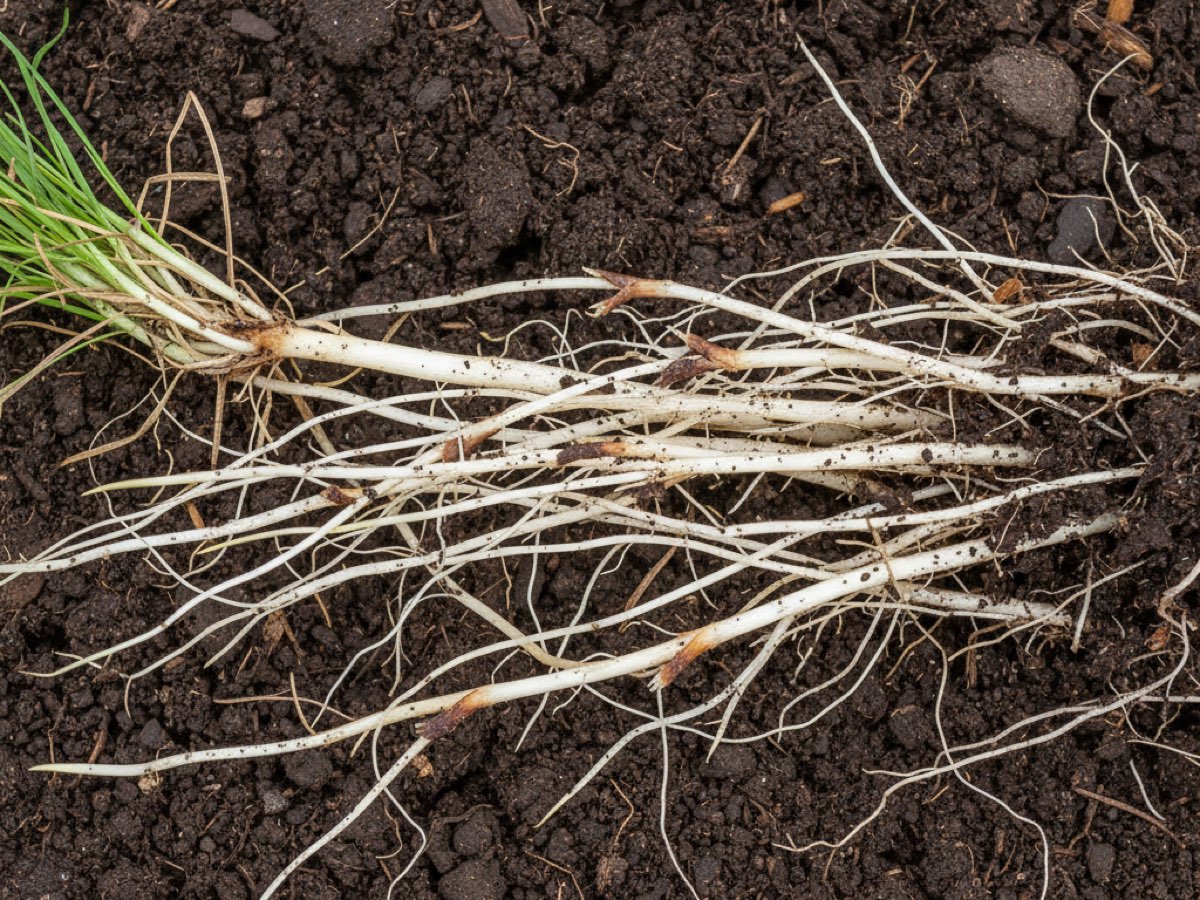
The RHS is direct about this: couch grass is not deep rooting. The measured picture agrees. Depending on the clone, the majority of rhizome buds sit either in the top 10cm of soil or in the 10 to 20cm band, a few are found below 20cm, and essentially none below 40cm. In loose soil the rhizomes travel at about 5 to 10 degrees off the horizontal. They are not going down. They are going out.
Out is the number that hurts. A rhizome commonly reaches 50cm before its tip turns upwards to make a new shoot, a single one can extend 2 metres in a growing season in open ground, and one plant can produce 150 rhizomes in its first year. At the end of an undisturbed season what you have under a patch is a mat of young rhizome sitting in the top 10cm.
Depth actually works in your favour, which is a rare thing to be able to say about a weed. In a burial trial, one- and two-node fragments were put in at 30, 60 and 90cm. Nothing emerged from 60 or 90cm at all. Only the two-node fragments reached the surface and only from 30cm, and the shoots they managed underground topped out at 53cm for a two-node piece and 16cm for a single node. Rhizome ploughed down to 35cm is killed. Separately, planted fragments emerge overwhelmingly from the top 7.5cm of soil with the peak at about 2.5cm, and the optimum depth for a fragment to survive at all is 5 to 10cm.
Read those two facts together and the practical rule falls out. Shallow disturbance without burial is the thing that multiplies couch grass. Deep burial, if you can genuinely achieve it, buries it. In a garden you rarely can, which is why the honest garden routes are systemic weedkiller, patient repeated removal, or light exclusion, and not a machine.
It is a grass, and that is the whole difficulty
This is the awkward answer most content dodges, and it is why so many people are still fighting couch grass after three summers of buying things.
Selective weedkillers work by exploiting a difference between two kinds of plant. The selective products a UK gardener can buy all exploit the same one: they are hormone chemistries that broadleaved plants cannot cope with and grasses shrug off. That is what lets a product kill a dandelion in a lawn and leave the lawn standing.
Couch grass is on the wrong side of that line. It is a grass, so a broadleaf selective walks straight past it. The RHS puts it in one sentence: no selective lawn weedkillers available will kill it without also harming your lawn grass. The Health and Safety Executive's own amateur pesticides register bears that out: it currently lists a few hundred approved home-garden herbicide products. Their active ingredients are glyphosate, pelargonic acid and other fatty acids, acetic acid, iron sulphate, triclopyr and the broadleaved lawn hormones. There is no grass-selective herbicide on it. This is not a gap in what you have found. It is a gap in what exists.
So in a lawn there are three real options, and I would rather set them out than pretend there is a fourth:
- Mow it into submission. Repeated close cutting genuinely suppresses couch, and this is measured rather than hopeful. Cutting the regrowth off completely, repeatedly, stops it forming new rhizome and drains what it has stored. In a ryegrass sward, couch rhizome dry weight went up once the cutting interval stretched past four weeks, and cutting every two to four weeks was what held it back. Weekly, tight, and it stays a green sward you can walk on. It will not disappear, but nobody will know it is there.
- Fork out individual plants. Fine where the infestation is patches rather than the whole lawn. Trace the white cords and lift them, do not chop through them, and take every scrap away with you.
- Kill the area and start it again. Blunt, and it is printed on the pack rather than being my idea. The Roundup Ultra label carries its own lawn destruction rate, 20ml per litre over 30 square metres, with instructions to treat actively growing lawn between May and September, allow 7 to 10 days for it to translocate to the roots, remove the dead lawn, then re-seed or re-turf. That rate is higher than the 15ml the same label asks for couch grass itself, which tells you something quietly useful: killing your lawn takes more chemical than killing the couch in it.
What I am not going to do on this website is send you off to buy a lawn treatment product for this, because there is not one that works and the whole category is a different argument. If a bottle promises to clear grassy weeds from a lawn without harming the lawn, read the active ingredient on the back before you believe the front, the same discipline every weedkiller purchase on this site gets put through.
What the Roundup Ultra label actually says about couch grass
Not brand copy. Lines off the approved amateur label, which is where the useful specifics usually hide, and couch grass gets a row of its own on it.
Roundup Ultra is a soluble concentrate containing 360 g/l glyphosate acid, approved for amateur use under MAPP 18850. I read the label rather than the marketing, and four things on it change how you plan a couch grass job.
- Couch gets named, at 15ml. The weed table has a row reading "Perennial grasses: including Couch", at 15ml of concentrate in a litre of water treating about 30 square metres. Annual weeds, including annual meadow grass, get 10ml for the same area. So the label already grades couch alongside bindweed, docks and thistles rather than with the easy stuff.
- February to November, which is the widest window on the whole label. The tough broadleaved perennials get pinned to flowering time or April to October. Brush weeds get June to September. Couch gets "when actively growing, usually February to November", because it is a cool-season grass that is genuinely working for most of the year. That is a lot more freedom than this weed's reputation suggests.
- No repeat-treatment asterisk. Two weeds on that label carry an asterisk leading to a footnote about needing a repeat treatment if regrowth appears, and they are horsetail and ground elder. Couch is not one of them, which is the manufacturer declining to flag it as a persistent case. Set that against the restrictions box, which reads "Maximum individual dose: 1 per year". One dose a year, on a plant whose buds stay viable for up to 30 months, is why nobody finishes this weed off in one summer with a sprayer.
- Effects within 1 to 4 weeks, and a week before you dig. Rain within 6 hours of spraying may reduce how well it works. And for dense cover including perennial weeds the label wants at least 7 days for the weedkiller to move to underground roots and shoots before you dig or cultivate the soil. On couch that instruction is doing serious work, because digging on day two both cuts the supply line and chops the rhizome into new plants at the same time. Nothing visible after five days is normal, not a failed pass.
One honest caveat, the same one I put on every label section: that is one amateur label and other products word their instructions differently. Read the bottle in your hand, and get the dilution right, because mixing is where most concentrate gets wasted. Timing matters more here than on most weeds too, so it is worth knowing when a spray day is actually a good spray day.
What I would buy for a couch grass programme
One product, not a shopping list, and two things I would tell you not to buy. This is not a comparison test and I will not pretend it is: it is the published specification read against what this particular job needs, plus the themes that come up repeatedly in what buyers report.
What I’d use
Glyphosate concentrate, 360 g/L
Gallup Home & Garden Glyphosate Weedkiller (1 litre)
The one Gallup a homeowner can legally buy and use: a 1 litre glyphosate concentrate at 360 g/L, approved for home and garden use under MAPP 17672.
It is the same active, the same 360 g/L loading and the same isopropylamine salt as the professional Gallup XL, and its single label rate of 24 ml per litre of water is exactly the rate the professional labels reserve for perennial broad-leaved weeds. What the two labels set apart is the authorisation printed on them rather than the strength, and this is the side of that line you are allowed to stand on.
- Active ingredient
- Glyphosate, 360 g/L, as the isopropylamine salt
- Formulation
- Soluble concentrate you dilute yourself
- Approval
- MAPP 17672, labelled for use only as a home and garden weedkiller
- Mixing rate
- 24 ml per 1 litre of water, per the label
- Coverage
- 40 sq m per litre of made-up spray, so roughly 1,667 sq m per bottle
- Rainfast
- Rain within 6 hours may reduce effectiveness, per the label
- Size
- 1 litre of concentrate
Watch out for
- No measuring cap in the bottle. Check a cup arrives, or the dose is guesswork.
- One re-treatment a season, and it takes four weeks. Do not go again early.
- Not for lawns. It is non-selective and takes the grass too.
- Resellers dominate the listing, so check the label that arrives is Barclay.
- "Super strength" is keyword stacking. It is 360 g/L, same as professional Gallup XL.
That’s an affiliate link: buy through it and I earn a small commission at no extra cost to you. It doesn’t change what I recommend or what I say is wrong with it. More on how that works in the affiliate disclosure.
A concentrate rather than a ready-to-use trigger bottle, and the reason is arithmetic rather than snobbery. Couch is a two to three season job over an area, and area is what ready-to-use bottles are worst at. A concentrate you dilute yourself works out at pennies per square metre, and the money you do not waste in season one is the money that keeps you going in season two, which on this weed is the season that decides it.
The first thing I would not buy is a rotavator hire. On most weeds it is a reasonable shortcut; on couch grass it is the single most reliable way to multiply the problem, for the reasons set out above. The second is a path and drive weedkiller with a residual in it, if the couch is in a bed you intend to plant, because a residual is designed to keep ground bare and that is the opposite of what you want there. For a bed, plain glyphosate and patience.
On kit, a 5 litre pressure sprayer covers a border or a lawn patch comfortably. A knapsack only starts earning its money on a driveway or a paddock, and calibrating one to a real target rate is its own small skill.
What actually gets rid of couch grass, and what makes it worse
Same test as every weed on this website: does it reach the rhizome network, or does it only deal with what is above the soil? On this species one row is worse than useless, and it is the one people reach for first.
| Method | Does it work? | What actually happens |
|---|---|---|
| Rotavating the patch, or turning it over once with a fork | Makes it worse | This is the single biggest mistake made on this weed. An intact rhizome keeps most of its buds switched off; chopping it up switches them on. The research is blunt: repeated fragmentation without deep burial increases the number of aerial shoots, not the amount of rhizome. |
| Pulling the tops off, or strimming | No | You have removed leaves from a plant whose body and food store are underground and untouched. It regrows from the same buds within days. |
| Vinegar, boiling water, salt, a flame weeder | No | All four are contact treatments that destroy what they physically touch. Flame weeding has been tested on couch specifically and it regenerated rapidly afterwards. |
| A selective lawn weedkiller | Does not exist | Couch grass is a grass. Every selective product sold to a UK gardener is designed to kill broadleaved plants and leave grasses alone, so it walks straight past this one. The RHS says so outright. |
| Mowing, weekly, tight to the soil | Holds it down | Not a kill, but the one thing that genuinely works in a lawn without starting again. Repeated close defoliation stops it forming new rhizome. Let the interval stretch past four weeks and the rhizome starts putting weight back on. |
| Systemic glyphosate on actively growing leaf | Yes | It is carried down inside the plant into the rhizome network, which is the only thing on this list that reaches the part that matters. The Roundup Ultra label gives couch its own row at 15ml per litre. |
| Digging rhizome out by hand, whole, and going back | Yes, if you are honest about it | Trace and lift the cords rather than chopping through them, take every white scrap out with you, and come back over the same ground repeatedly. One session is not a treatment, it is a propagation event. |
| Repeated shallow cultivation on a three-to-four-leaf cycle | Yes | The agricultural method, and it works because it never lets the regrowth get back to the point where it starts refilling the store. It needs 2 passes on light friable soil and up to 6 on heavy clay. |
| Cardboard, then 20cm of organic matter, left for years | Yes, slowly | The RHS specification. Couch is genuinely sensitive to shade, so light exclusion does work. Plan for a covering that is still a covering in three years, not three months. |
The kitchen-cupboard row is worth a moment because couch grass is a clean example of why contact treatments fail on a rhizomatous perennial rather than a matter of strength. The full sourced verdict on vinegar, salt and the homemade recipes sits on its own page, and the short answer on home remedies is there too.
Digging it out, and the three-to-four-leaf rule that makes cultivation work
There are two completely different ways to get couch grass out with a fork, and they are not variations on a theme. One of them wins and the other one loses badly.
The removal version. You are not digging soil, you are tracing cords. Loosen with a fork well outside the visible growth, then lift and follow each white rhizome by hand, pulling it out along its length rather than snapping it. Every scrap comes out with you and goes in the bin or on the fire. This works best on a young patch in open soil, and it is the only version worth attempting inside a planted border, where the RHS route is to lift the plants you want to keep, clean the couch out of their root balls and replant into cleared ground.
The exhaustion version. This is the agricultural method and it is the opposite instinct: you fragment the rhizome on purpose, then keep coming back. It works because of a timing detail that rarely makes it into gardening advice. When a fragment sprouts it spends its stored reserves on making leaf, and its food store keeps falling until roughly the two-leaf stage. Once the shoot reaches about three to four leaves, or 12 to 15cm tall, the plant flips over into profit and starts putting material back into new rhizome. So the whole programme is: hit the regrowth at the three to four leaf stage, every time, and never let it past that.
The published numbers are consistent about what that costs. The first pass wants the rhizome cut into short lengths, the next follows two to three weeks later, and you are looking at 2 passes on light friable soil and up to 6 on heavy clay. In cereal stubble, one rotary cultivation in late August or September cut the following spring's shoot emergence by 80%, and a second three weeks later took it to 90%. Do half of that and you have done the fragmentation without the follow-up, which is worse than doing nothing.
One bonus if you are working in a dry spell: actively growing rhizome exposed on the surface is readily killed by a few days of dry air. But the bar is higher than it looks. It needs to lose more than 80% of its moisture, and if it gets covered by even a shallow layer of dry soil it survives. Rake it up and take it away rather than trusting the weather.
And whichever route you take, do not compost the rhizome. It goes to the fire, the bin, or council green waste, which is processed at temperatures a garden heap never reaches.
Couch grass on an allotment, in a border, and coming up through paving
On an allotment the exhaustion method genuinely transfers, because you have bare ground, no ornamental planting to protect and a season you can afford to give up. This is the one setting where hiring a machine can be the right call, provided you commit to the whole cycle of repeat passes rather than one afternoon. If your plot is heavy clay and wet in autumn, you will get further with glyphosate and patience, because the cultivation route needs up to six passes on that soil and the weather will not give them to you.
In a planted border you have the hardest version of the job, because there is no selective option at all and the rhizome runs straight through the root balls of the plants you are trying to save. Spraying inside a border means careful spot treatment and accepting collateral damage. The clean reset is the lift-and-clean route: take the perennials out while dormant, wash and pick the rhizome out of their roots, clear the ground properly, then replant.
On a hard surface the job gets easier, and this is worth knowing because couch turns up in path edges, block paving joints and gravel strips far more often than the lawn-and-border advice admits. Nothing green to protect means glyphosate gets a clean run, and glyphosate is deactivated on contact with soil so it leaves nothing behind to worry about in a bed alongside. The catch is the same as with any joint weed: the rhizome you are treating is very often attached to a plant a metre away in soft ground, so you can spray the same joint every year and never touch the parent. Find where it is rooted. And keeping the joints filled is a jointing and gravel maintenance job rather than a weedkiller one.
On a boundary, change the goal from killing to containing. Rhizome advances sideways at a serious rate and if the parent plant is on the other side of the fence you will not win by treating your strip. A physical barrier is what stops new ground being taken, and because couch keeps essentially all its buds in the top 40cm of soil, a barrier does not have to be extravagantly deep to work. Behind it, keep your own side on the programme. You can cut back growth that crosses your boundary provided you do not step onto their land, and you cannot treat their ground. None of that is legal advice.
Seed is the one thing you can mostly stop worrying about. A flower stem carries around 30 seeds of which about half are viable, and buried couch seed has been found to lose viability fast, with only about 7% still alive after a year in soil. Mowing regularly stops it flowering at all. Vegetative spread is the entire story on this weed, which is why the rhizome deserves all of your attention and the seed head deserves almost none.
About this resource
I am The Weed Guy, one bloke who is qualified to spray professional weedkiller. This page is built on published research, an approved product label and horticultural guidance rather than a trial of my own, and it says where each figure came from. The biology, the fragment and burial trials, the cultivation timings and the desiccation and defoliation figures all come from the Garden Organic review of common couch, compiled at HDRA for a DEFRA-funded organic weed management project, which I read as the original document rather than through anybody else's summary of it. The identification characters come from the RHS and from NatureSpot species accounts for couch, perennial ryegrass and Yorkshire fog. The rates, windows, restrictions and the lawn destruction instructions come off the Roundup Ultra amateur label under MAPP 18850. The statement that no grass-selective herbicide is available to a UK gardener is the RHS's, and it holds up against the Health and Safety Executive's own amateur pesticides register.
Where a claim in circulation had nothing behind it, I have left it out rather than repeating it. Couch grass roots do not go deep, whatever you read, and the RHS and the trial data both say so. And I have not run these products against each other in a test, so nothing here is dressed up as one.
The honest disclosure: no brand pays for a mention here, and the product link above is an affiliate link, so I earn a commission if you buy through it at no extra cost to you. It changes nothing about what goes on the card, which is why the drawbacks sit next to the reasons to buy. The full explanation is on the affiliate disclosure page. And read the label on the bottle in your hand before you mix anything: rates and approvals change, and the printed label beats any figure quoted here or anywhere else.
Common questions
What does couch grass look like?
Above ground it looks like grass, which is the entire problem, so do not try to identify it by the leaf. Dig instead. Put a spade in about 15cm down and lift a block of soil out: couch grass runs hard white cords sideways through the soil, with sharp points on the ends and shoots coming up off them. The RHS describes it as a dense network of pale rhizomes with pointed tips. Nothing else you are likely to have in a British garden does that. If you want a leaf-level check as well, couch is flat, dull green, up to about 40cm long with sparse long hairs on the upper surface only, and it grows 30cm to a metre or so if you let it flower. The flower spike is a single upright unbranched spike, and the flattened spikelets sit up it alternately with their flat side against the stem. Perennial ryegrass makes a similar-looking spike but its spikelets are edge-on, narrow side to the stem.
How do I get rid of couch grass in my lawn?
Straight answer: you have three options and none of them is a bottle you spray on the lawn. There is no selective weedkiller that kills couch grass and spares the lawn around it, because couch grass is itself a grass and every selective product on the UK amateur market is built to kill broadleaved weeds. The RHS states it plainly. So your choices are: live with it and mow weekly and tight, which genuinely holds it down and stops it forming new rhizome; fork out individual plants where the infestation is patchy, taking every white cord with you; or kill the affected area off with glyphosate and re-seed or re-turf. That third one is not a workaround, it is printed on the pack. The Roundup Ultra label carries a lawn destruction rate of its own, 20ml per litre, with instructions to treat between May and September, allow 7 to 10 days for it to reach the roots, remove the dead lawn and then re-seed or re-turf.
Does vinegar kill couch grass?
No. It burns off the leaves and the plant regrows from the rhizome, usually within a fortnight. Vinegar is a contact treatment: acetic acid destroys the plant tissue it physically wets and then it is finished, because nothing carries it anywhere. On couch grass, what you can wet is a few leaves. The plant itself is a network of white rhizome running sideways through the soil with a live bud every few centimetres, and not a drop of what you sprayed reaches any of it. Buying stronger vinegar does not change the mechanism, it just browns the leaves faster. Boiling water, salt and a flame weeder all fail for the same reason, and flame weeding has been tested on couch specifically and it regenerated rapidly afterwards.
Will Roundup kill couch grass?
Yes, and unusually the label names it. Roundup Ultra is a 360 g/l glyphosate concentrate approved for amateur use under MAPP 18850, and its weed table has a row reading "Perennial grasses: including Couch" at 15ml per litre of water covering about 30 square metres, to be treated when actively growing, usually February to November. Two things about that row are worth more than the rate itself. First, 15ml is the same as the label asks for bindweed, docks and thistles and half again what it asks for annual weeds, so it grades couch as one of the difficult ones. Second, February to November is the widest treatment window on the whole label, far wider than the flowering-time windows the tough broadleaved weeds get, and couch is not one of the weeds carrying the label's repeat-treatment asterisk. Expect effects within 1 to 4 weeks, and expect nothing at all for the first few days.
How deep do couch grass roots go?
Shallower than you would think, and depth is not the thing beating you. The RHS says outright that couch grass is not deep rooting. The research puts most of the rhizome bud population in the top 10cm of soil, with some clones running theirs in the 10 to 20cm band, a few buds below 20cm and essentially none below 40cm. In loose soil the rhizomes travel at only about 5 to 10 degrees off horizontal, so they are going sideways, not down. Which is the point: sideways is the problem. One rhizome can reach 50cm before its tip turns up to make a new shoot, and up to 2 metres in a single season in open ground. Depth is what saves you, in fact. Fragments buried at 30, 60 and 90cm in a burial trial could not reach the surface from 60 or 90cm at all, and rhizome ploughed down to 35cm is killed.
Will rotavating get rid of couch grass?
One pass will make it considerably worse, and this is the most expensive mistake on this weed. On an undisturbed rhizome, most of the buds are held dormant by the growing tip at the end of it, the same apical dominance that stops the side shoots of a shrub taking over. Chop that rhizome into pieces and you remove the tip from every piece, which releases the buds. The research is explicit that after extensive fragmentation at least one bud per fragment develops a new shoot, except in mid-winter, and that repeated fragmentation without deep burial increases the number of aerial shoots rather than the amount of rhizome. So you go from one patch to a field of them. Rotavating only works as part of a deliberate campaign of repeated passes on a three-to-four-leaf cycle, where each pass hits the regrowth before it has refilled its food store. One pass in April and a summer off is the worst thing you can do to a couch patch.
How do I get rid of couch grass on an allotment?
An allotment is the one place the agricultural method genuinely transfers, because you have bare ground, a season you can write off, and no ornamental planting to protect. Fragment the patch deliberately, then keep going back: the classic programme cuts the rhizome into short lengths on the first pass and repeats every two to three weeks, always hitting the regrowth at the three-to-four-leaf stage, because that is the point where the plant has spent its reserves on new leaf and has not yet started paying them back. A single rotary cultivation in late August or September has been measured cutting the following spring's shoot emergence by 80%, and a second pass three weeks later took it to 90%. Expect 2 passes to clear it on light friable soil and up to 6 on heavy clay. If your soil is heavy and wet you will get more out of glyphosate and patience than out of a machine. Whatever you do, do not barrow the rhizome to the communal heap.
How do I get rid of couch grass naturally, without weedkiller?
Two methods work and both take real commitment. The first is light exclusion: cardboard laid over the patch and then a layer of organic matter about 20cm thick, left in place for at least a few years. Couch is genuinely sensitive to shade, so this is not wishful thinking, but cardboard on its own rots away long before a rhizome network runs out of reserves. The second is repeated defoliation or cultivation on the plant's own timetable, going back over the same ground every two to three weeks so the regrowth is always cut down before it has restocked. In an experiment on regenerating fragments, cutting the shoots off completely exhausted the reserves in a 7.5cm rhizome piece within 35 days, while cutting at 28-day intervals achieved nothing at all. That gap between weekly and monthly is the entire difference between the method working and wasting a season.
Does couch grass have any benefits?
A few real ones, none of which will make you want to keep it in a vegetable bed. The RHS points out that its leaves feed the caterpillars of several moths and butterflies, so a patch at the back of a rough corner is doing a job. Its rhizome has a long medicinal history too, and that is not folklore dressed up: the European Medicines Agency has a finalised herbal monograph on Agropyron repens rhizome, filed under urinary tract and genital disorders. Set against that, couch grass is a carrier of take-all, a serious cereal root disease, and it forms dense stands that shut other plants out. My honest position is that it earns a corner and nothing more.
Can I put couch grass roots in my compost?
No, and this is not a borderline call. A home compost heap does not get hot enough to kill rhizome, so every white cord you add is a live plant sitting in a warm moist medium, which you will then spread round your garden yourself. The scale of the mistake is easier to grasp with a number attached: a single-node fragment has been recorded producing over 80 metres of growth in twelve months. Leaves and mown clippings are fine to compost. Anything white, hard and pointed is not. Burn it, bin it, or send it to council green waste, which is processed at temperatures a garden heap never gets near.
Is couch grass the same as twitch, scutch or quackgrass?
Yes, all the same plant. Its botanical name has been changed more than once, which is why you will see it as Elytrigia repens, Elymus repens, Agropyron repens and Triticum repens, all correct in their day. In English it collects regional names faster than most weeds: couch, couchgrass, twitch, scutch, squitch, quicks, wickens and wicks in Britain, quackgrass in North America. If somebody at the allotment tells you they have got twitch, they have got this.
How long does it take to get rid of couch grass?
Plan on two to three growing seasons and you will be about right. Rhizome buds have been found still viable up to 30 months after they formed, and the working figure in the literature is that two to three years of continuous control is what eradication actually takes. That holds whichever route you pick. Glyphosate reaches the rhizome network but a single pass does not empty it, and the label's own restrictions box reads "Maximum individual dose: 1 per year", so a chemical route is a multi-season plan by definition rather than by choice. Digging works but only as a repeated programme. Smothering works but the RHS timescale is a few years of covered ground. Anyone selling you a weekend is selling you the top growth.